Naphtha is a broad term applied to several distinct mixtures of liquid hydrocarbons characterized by high volatility, low boiling points, and significant flammability. These mixtures are obtained primarily through the distillation of petroleum or coal tar, and occasionally through the distillation of wood, giving rise to the designations petroleum naphtha, coal-tar naphtha, and wood naphtha respectively.
Product Types
Petroleum naphtha — by far the most commercially significant category — is itself subdivided based on boiling range and hydrocarbon composition:
Coal-tar naphtha, a by-product of coal carbonization, is notably richer in aromatic compounds (benzene, toluene, xylene, and naphthalene precursors) and heavier unsaturated species. Wood naphtha, historically produced by the destructive distillation of wood, is primarily methanol-based and has largely been supplanted by synthetic alternatives.
Compositional Data
Table 1 shows the composition of a full range naphtha obtained directly from the Atmospheric Distillation Unit:
Table 1 — Example of a full boiling range naphtha composition
| Common Name |
IUPAC Name |
Formula |
Molar Fraction |
| n-Pentane |
Pentane |
C₅H₁₂ |
0.09827 |
| Isopentane |
2-Methylbutane |
C₅H₁₂ |
0.07968 |
| n-Hexane |
Hexane |
C₆H₁₄ |
0.05832 |
| Isooctane |
2,2,4-Trimethylpentane |
C₈H₁₈ |
0.04428 |
| Propylcyclohexane |
Propylcyclohexane |
C₉H₁₈ |
0.04175 |
| Ethylcyclohexane |
Ethylcyclohexane |
C₈H₁₆ |
0.04170 |
| Isononane |
2,2,5-Trimethylhexane |
C₉H₂₀ |
0.04133 |
| Propylcyclopentane |
Propylcyclopentane |
C₈H₁₆ |
0.04061 |
| Butylcyclopentane |
Butylcyclopentane |
C₉H₁₈ |
0.04029 |
| Methylcyclohexane |
Methylcyclohexane |
C₇H₁₄ |
0.03779 |
| n-Heptane |
Heptane |
C₇H₁₆ |
0.03765 |
| n-Octane |
Octane |
C₈H₁₈ |
0.03605 |
| n-Nonane |
Nonane |
C₉H₂₀ |
0.03561 |
| 2-Methylpentane |
2-Methylpentane |
C₆H₁₄ |
0.03501 |
| Methylcyclopentane |
Methylcyclopentane |
C₆H₁₂ |
0.03149 |
| n-Decane |
Decane |
C₁₀H₂₂ |
0.03102 |
| 3-Methylpentane |
3-Methylpentane |
C₆H₁₄ |
0.02898 |
| Cyclohexane |
Cyclohexane |
C₆H₁₂ |
0.02871 |
| Toluene |
Toluene |
C₇H₈ |
0.01995 |
| Dimethylcyclopentane |
Dimethylcyclopentane |
C₇H₁₄ |
0.01848 |
| Ethylcyclopentane |
Ethylcyclopentane |
C₇H₁₄ |
0.01765 |
| m-Xylene |
1,3-Dimethylbenzene |
C₈H₁₀ |
0.01268 |
| 3-Methylhexane |
3-Methylhexane |
C₇H₁₆ |
0.01232 |
| 1-Methylnaphthalene |
1-Methylnaphthalene |
C₁₁H₁₀ |
0.00916 |
| 2-Methylhexane |
2-Methylhexane |
C₇H₁₆ |
0.00906 |
| 2,4-Dimethylpentane |
2,4-Dimethylpentane |
C₇H₁₆ |
0.00896 |
| Benzene |
Benzene |
C₆H₆ |
0.00800 |
| Cyclopentane |
Cyclopentane |
C₅H₁₀ |
0.00755 |
| o-Xylene |
1,2-Dimethylbenzene |
C₈H₁₀ |
0.00701 |
| 1-Methylindane |
1-Methylindane |
C₁₀H₁₂ |
0.00682 |
| Pentylcyclopentane |
Pentylcyclopentane |
C₁₀H₂₀ |
0.00640 |
| Butylcyclohexane |
Butylcyclohexane |
C₁₀H₂₀ |
0.00640 |
| 1,1-Dimethylindane |
1,1-Dimethylindane |
C₁₁H₁₄ |
0.00628 |
| n-Undecane |
Undecane |
C₁₁H₂₄ |
0.00600 |
| p-Xylene |
1,4-Dimethylbenzene |
C₈H₁₀ |
0.00576 |
| Ethylbenzene |
Ethylbenzene |
C₈H₁₀ |
0.00576 |
| 2,3-Dimethylbutane |
2,3-Dimethylbutane |
C₆H₁₄ |
0.00556 |
| 1,2,3-Trimethylbenzene |
1,2,3-Trimethylbenzene |
C₉H₁₂ |
0.00314 |
| 1,3,5-Trimethylbenzene |
1,3,5-Trimethylbenzene |
C₉H₁₂ |
0.00305 |
| 1,2,4-Trimethylbenzene |
1,2,4-Trimethylbenzene |
C₉H₁₂ |
0.00305 |
| 3,3-Dimethylpentane |
3,3-Dimethylpentane |
C₇H₁₆ |
0.00305 |
| n-Butane |
Butane |
C₄H₁₀ |
0.00279 |
| 2,2-Dimethylbutane |
2,2-Dimethylbutane |
C₆H₁₄ |
0.00214 |
| 1-Methyl-3-ethylbenzene |
1-Methyl-3-ethylbenzene |
C₉H₁₂ |
0.00203 |
| 1-Methyl-4-ethylbenzene |
1-Methyl-4-ethylbenzene |
C₉H₁₂ |
0.00203 |
| 1-Methyl-2-ethylbenzene |
1-Methyl-2-ethylbenzene |
C₉H₁₂ |
0.00203 |
| 2,3-Dimethylpentane |
2,3-Dimethylpentane |
C₇H₁₆ |
0.00203 |
| 2,2-Dimethylpentane |
2,2-Dimethylpentane |
C₇H₁₆ |
0.00203 |
| 2,2,3-Trimethylbutane |
2,2,3-Trimethylbutane |
C₇H₁₆ |
0.00203 |
| 3-Ethylpentane |
3-Ethylpentane |
C₇H₁₆ |
0.00102 |
| n-Propylbenzene |
Propylbenzene |
C₉H₁₂ |
0.00102 |
| Isobutane |
2-Methylpropane |
C₄H₁₀ |
0.00005 |
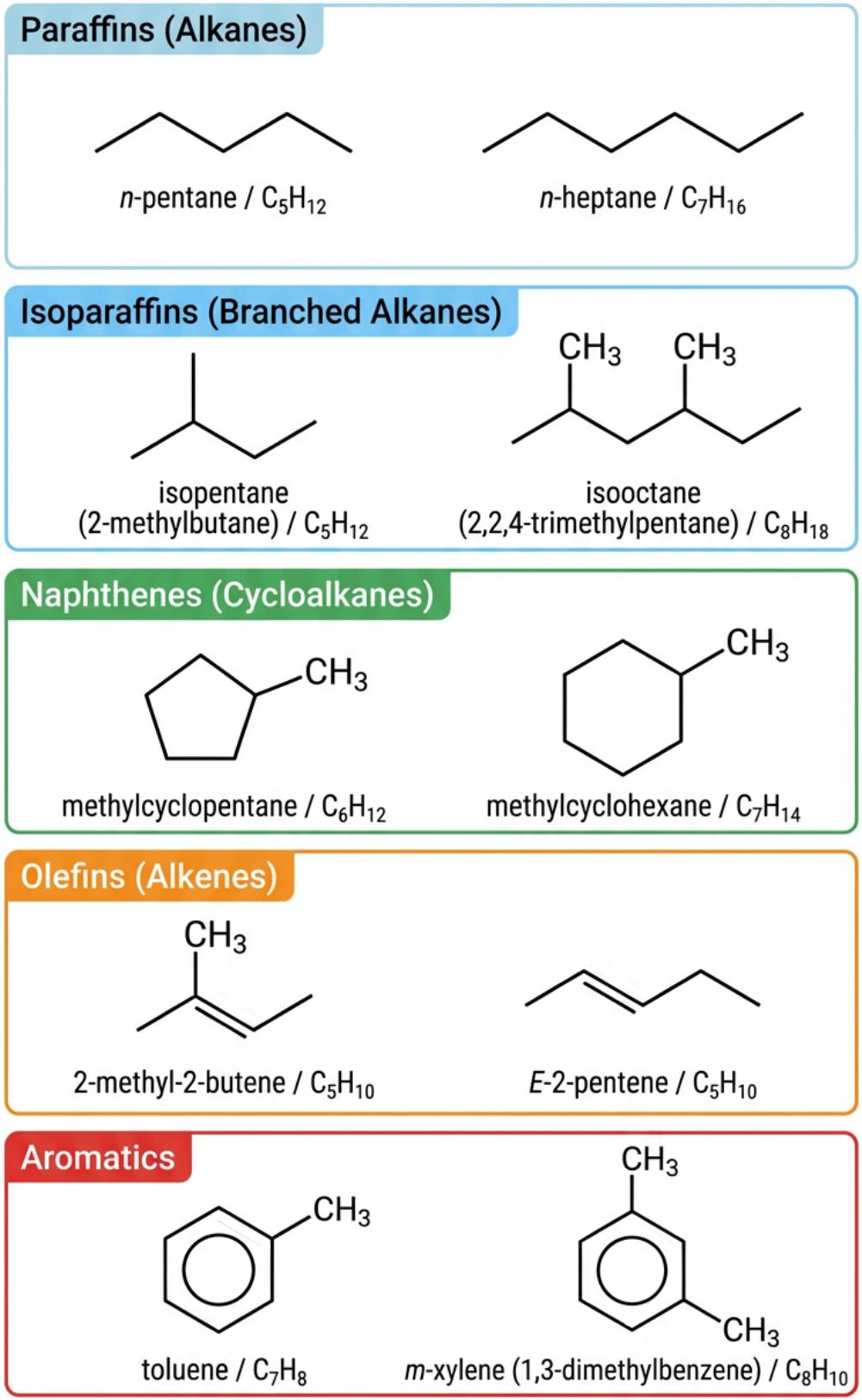
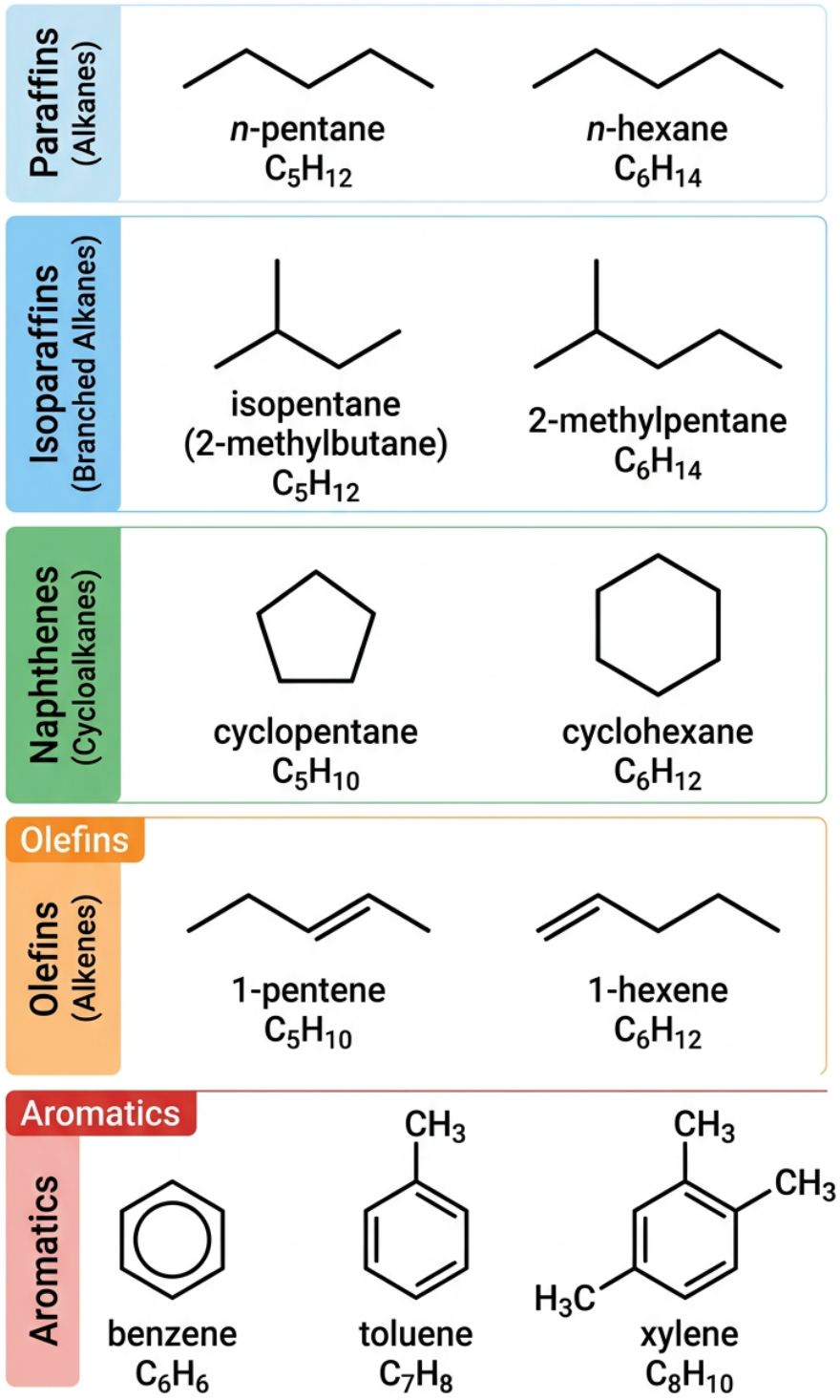
Typical molecular compounds in the five different hydrocarbon classes present in naphtha are shown in Figure 1:
Figure 1 — Key hydrocarbon classes and molecular compounds in petroleum naphtha

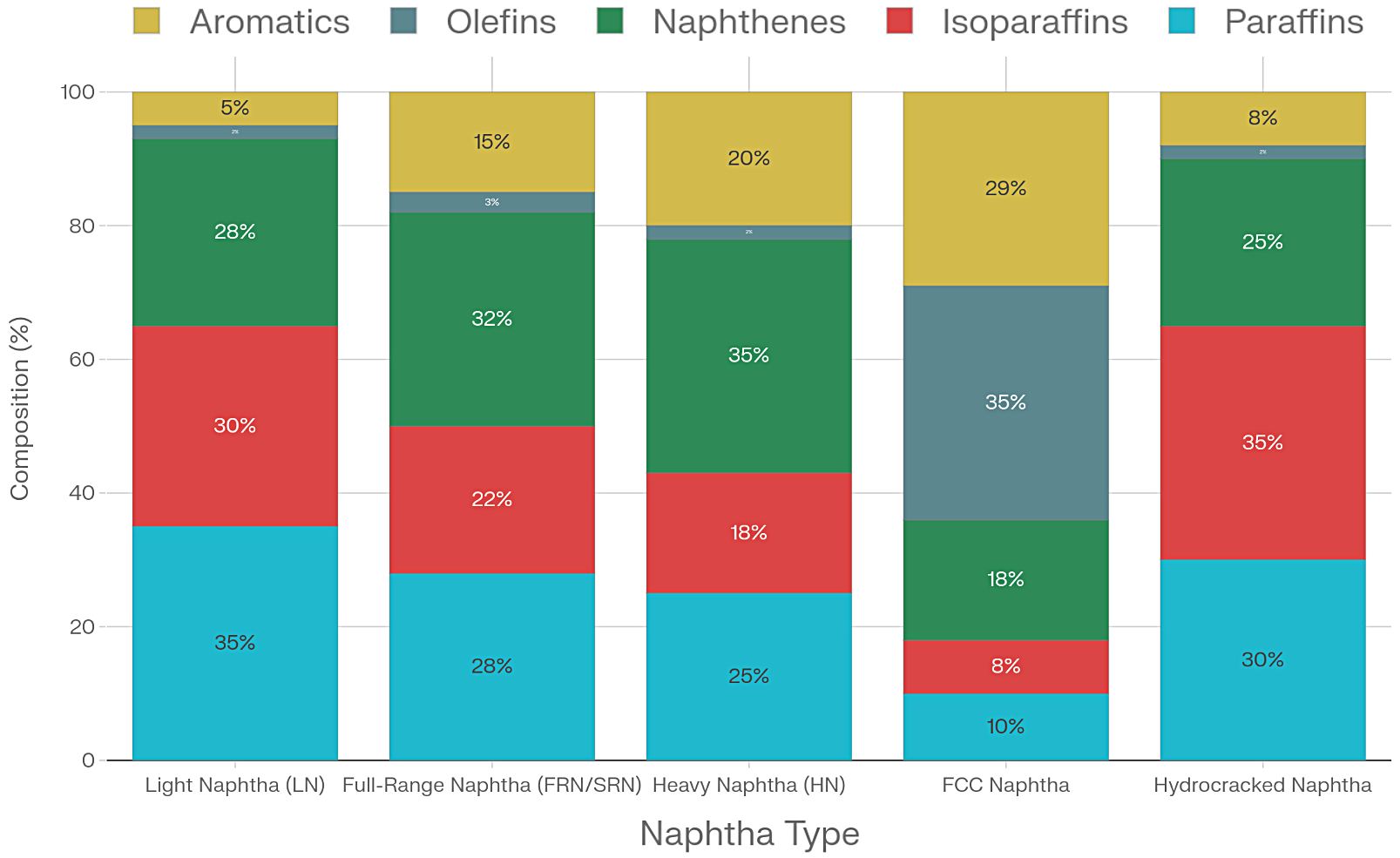
Figure 2 shows typical PIONA compositions for various types of naphtha:
Figure 2 — Naphtha PIONA composition by type

Key Characterization Parameters
The different naphthas are distinguished by several analytical measures:
- Density (g/ml or specific gravity), which correlates broadly with aromatic content and molecular weight
- Boiling range / distillation curve (ASTM D86), defining the IBP (initial boiling point) to FBP (final boiling point) cut
- PONA, PIONA, or PIANO analysis, measuring hydrocarbon class composition, typically in volume percent or weight percent: Paraffins, Isoparaffins (in PIONA/PIANO), Olefins, Naphthenes (cycloparaffins), and Aromatics
- Research Octane Number (RON) and Motor Octane Number (MON), relevant for gasoline blending streams
- Sulfur content (ppm or wt%), critical for downstream processing and regulatory compliance
- Reid Vapor Pressure (RVP), reflecting volatility and handling/safety requirements
Principal Applications
Naphtha serves as a crucial intermediate across multiple industries:
- Gasoline production: Heavy naphtha is the primary feedstock for catalytic reforming, upgrading low-octane naphthenes and paraffins into high-octane aromatics and hydrogen
- Petrochemicals — olefins: Light and full-range naphtha are major feedstocks for steam crackers, producing ethylene, propylene, butadiene, and pyrolysis gasoline
- Petrochemicals — aromatics: Catalytic reformate derived from heavy naphtha feeds BTX extraction units supplying benzene, toluene, and xylenes to the chemical industry
- Hydrogen production: Naphtha can be steam-reformed to produce hydrogen or syngas supplied to ammonia or methanol plants
- Solvents and cleaning agents: Light petroleum naphthas are widely used as industrial solvents, degreasers, and diluents in paints, adhesives, and dry-cleaning formulations
References
- New World Encyclopedia — Naphtha (June 2, 2025)
- Wikipedia — Petroleum Naphtha (edited on May 13, 2026)
- Patsnap Eureka — Straight-Run vs. Cracked Naphtha: Key Differences in Composition (June 19, 2025)
- ECHA Chemical Registry — Naphtha (petroleum), light straight-run (accessed Jun 3, 2026)
- Chandra Asri — What Is Naphtha? Properties, Functions, & How to Process It (Jun 8, 2025)
- Energies (MDPI) / Loyola University — Naphtha Characterization (PIONA, Density, Distillation Curve and Sulfur Content) (Jan 1, 2023)
- Mihail Editoiu (YouTube) — Naphtha Splitter - Letter of Award & Basis of Design (Sep 17, 2021)