
Introduction
Short Linear Alpha Olefins (LAOs) namely 1-butene, 1-hexene and 1-octene represent more than 60 % of the overall LAO production given their use as comonomer for polyethylene grades. In contrast, longer LAOs are used for the synthesis of plasticizers, detergents and diesel fuel additives market.
LAOs are produced by ethylene oligomerization via full-range and on-purpose technologies.
Full-Range Processes
Full-range processes are based on catalytic systems that afford a mixture of LAOs (Table 1).
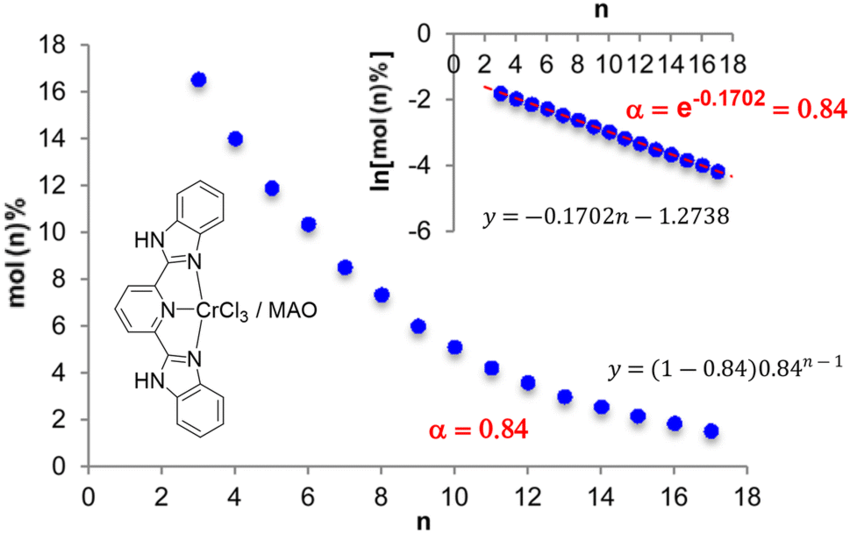
This non-selective oligomerization involves a Cossee-Arlman mechanism where transfer reactions are favored over propagation reaction. Indeed, β-H elimination is strongly promoted compared to coordination and insertion of ethylene. This specific kinetic feature leads to the production of short hydrocarbon chains from C4 to C30 in a decreasing yield sequence, most commonly following a Schulz-Flory distribution (Fig. 1) or by a Poisson distribution depending on process configuration.
Figure 1 - Schulz–Flory α-olefin distribution as mol % (n) vs n (units of ethylene) obtained with the depicted catalyst (1 μmol). Conditions: 4 bar of ethylene pressure, 30 °C, cocatalyst MAO (8 mmol), toluene, 70 min. The inset shows ln[mol %(n)] vs n, where α = e–0.1702 = 0.84[3]

The main full-range processes are based on Aluminum or Nickel species:
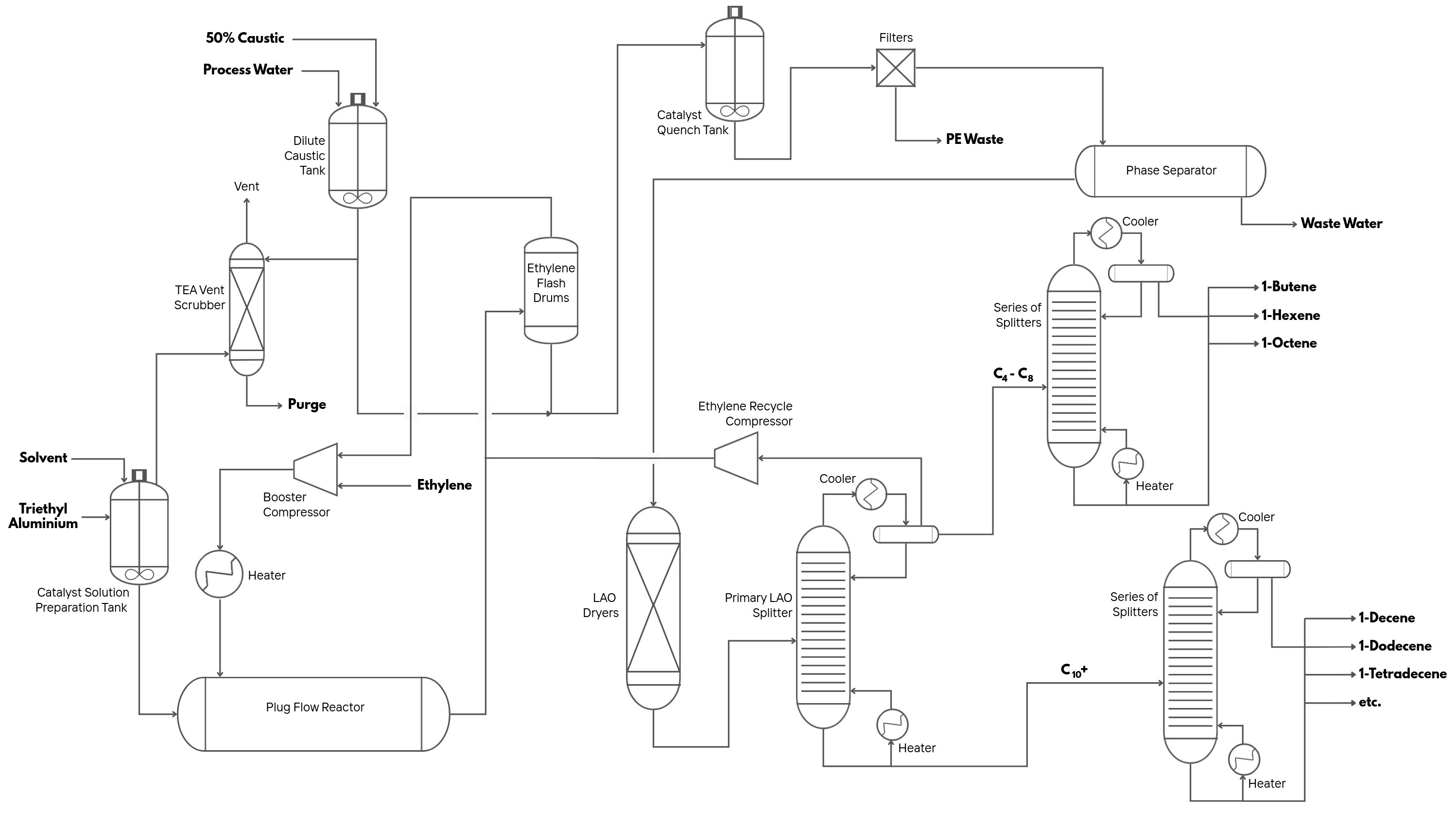
- The Ethyl Process of Ineos and the originally named Gulf Process developed by Gulf Oil, now owned by Chevron Phillips Chemical (CPChem), using Alkylaluminum compounds such as Al(Et)3 as catalysts, provide a mixture of C4-C30.
- Shell Higher Olefin Process (SHOP) employs a Nickel catalyst to oligomerize ethylene into C4 to C40 products.
Figure 2 - Simplified flow diagram of the former AlEt3-catalysized oligomerization Gulf process (now CPChem)

Group 4 metals are also implemented in several non-selective oligomerization processes:
- Both Alpha-Sablin of Sabic/Linde and Idemitsu processes rely on Zirconium complexes activated by trialkylaluminum or a mixture of chloroalkylaluminum with trialkylaluminum, respectively.
- Although the Alphaselect Process of IFPEN/Axens gives access to a restricted range of short LAOs, it has not yet been commercialized.
Table 1 - Industrial statistical ethylene oligomerization processes
| Company |
Process name |
Catalyst system |
Temperature (°C) |
Olefin composition |
Working pressure (MPa) |
| Ineos |
Ethyl |
AlR3–modifier |
100–120 |
C4–C30+ |
10–12 |
| BP |
|
AlR3 |
130–140 |
C4–C18 |
19 |
| Chevron Phillips |
Gulfene |
Al–organic compound + Ni-complex |
40–100 |
C4–C30+ |
3–6 |
| Idemitsu |
|
Zr + Al-organic compound (mixture) + thiophene derivative |
100–150 |
C4–C20 |
10–15 |
| Shell |
Shop |
Ni-complex |
50–120 |
C6–C30+ |
2–15 |
IFP-
Axens |
AlphaSelect |
Zr + Al-organic compound + modifier |
40–150 |
C4–C10 |
0.5–15 |
| UOP |
Linear-1 |
Ni-complex |
30–80 |
C4–C10 |
6–14 |
| Sabic-Linde |
α-Sablin |
Zr + Al-organic compound |
60–100 |
C4–C18 |
2–3 |
On-Purpose Processes
Contrary to Full-Range processes, on-purpose processes employ a catalytic system that produces one specific 1-olefin. Among selective catalysts, Nickel-based species follow a coordination/insertion mechanism for the production of 1-butene while Chromium and Titanium-based metallacycle species are involved in the formation of 1-butene, 1-hexene and 1-octene. For each Linear Alpha-Olefin, several on-purpose processes were developed since the 1990’s mainly driven by the increasing demand of LLDPE and HDPE.
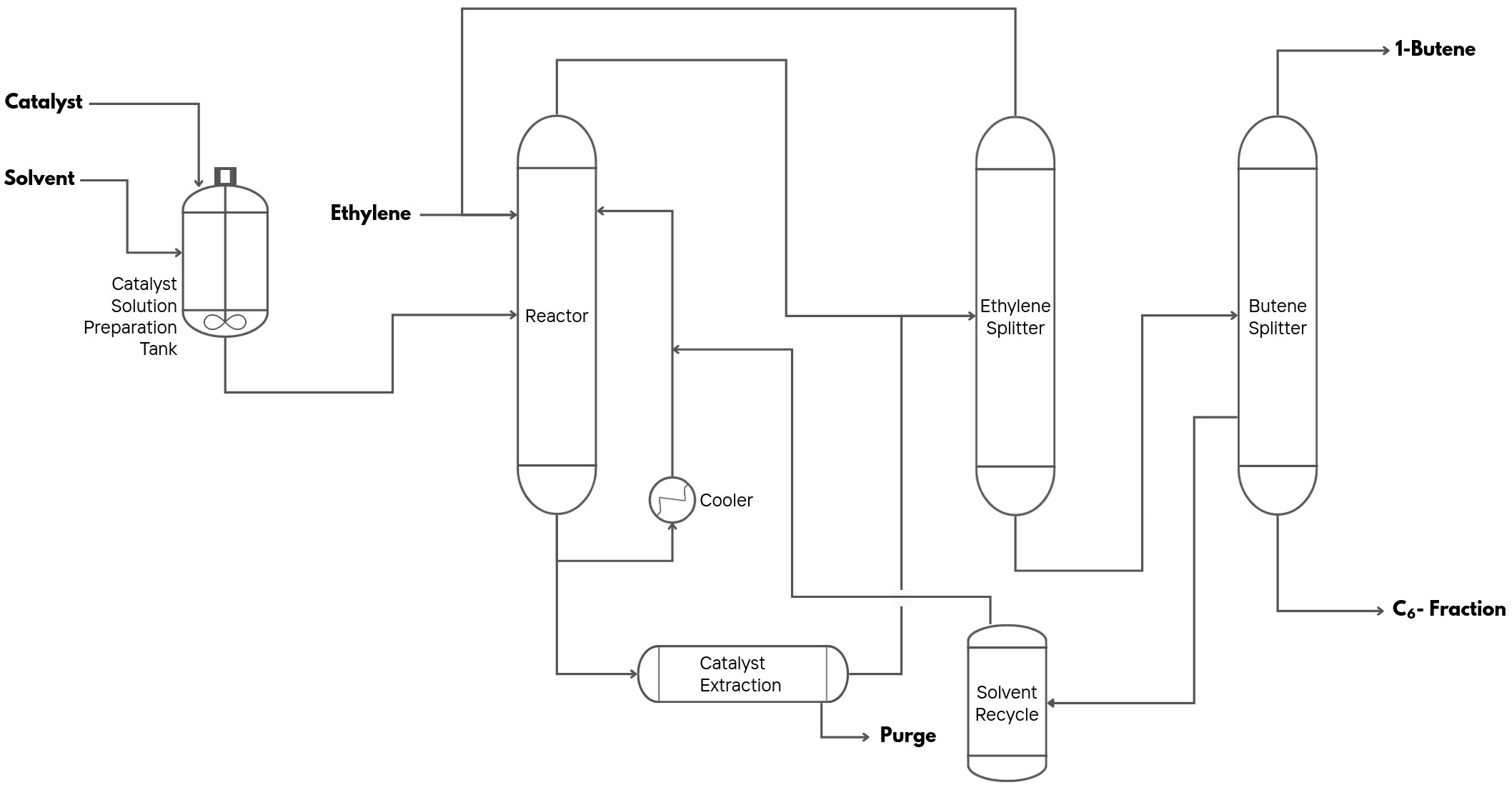
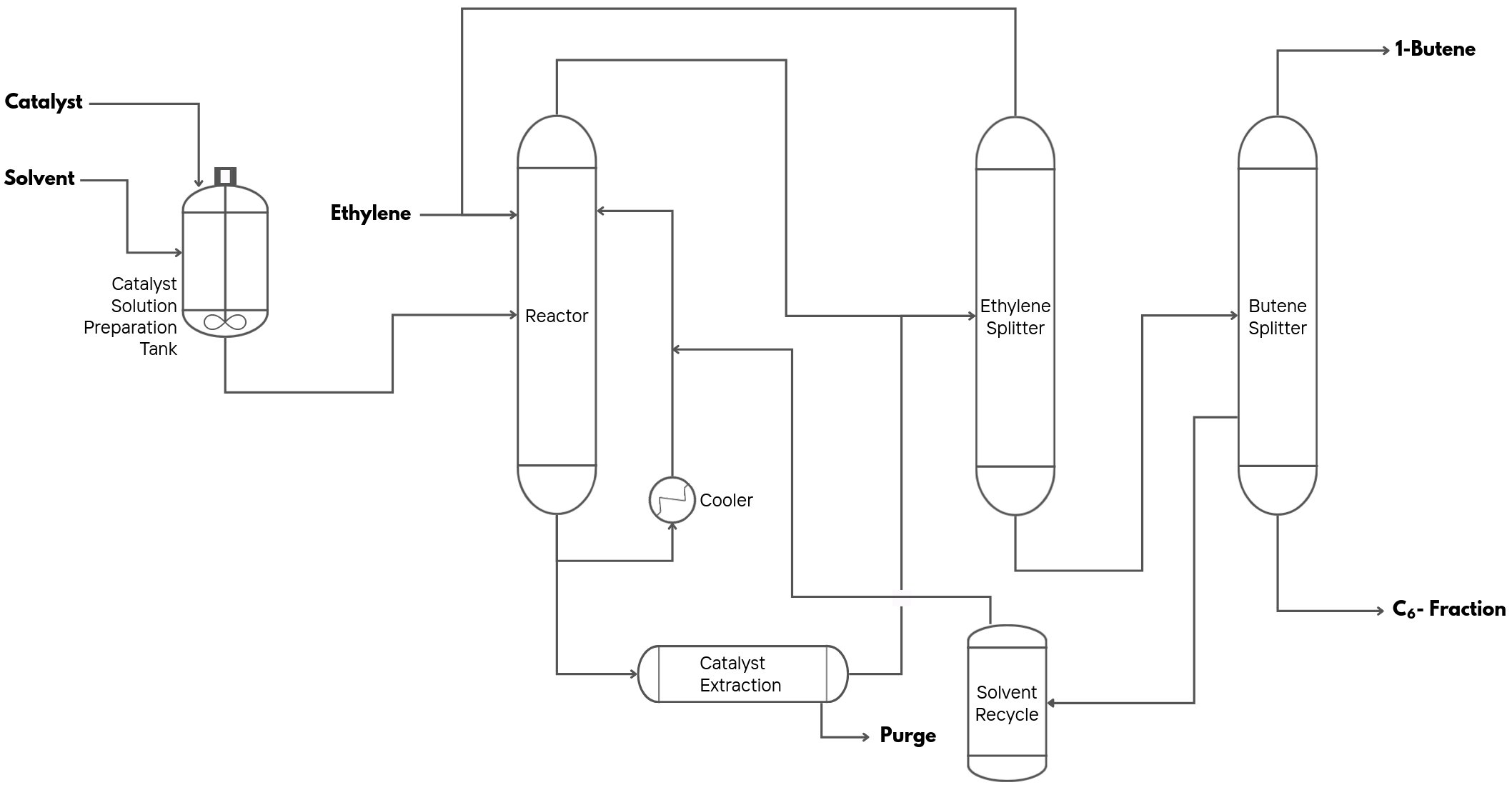
Figure 3 - Oligomerization of ethylene in 1-butene - Simplified PFD, adapted from Belov and Matkovsky[2]

References
- Astrid Cordier, 15th Nov 2019, Oligomerization and polymerization of ethylene by phenoxy-imine titanium catalysts, PhD Thesis, Université de Lyon, NNT: 2019LYSE1229.
- G. P. Belov and P. E. Matkovsky. Jan 29, 2019. Processes for the Production of Higher Linear αOlefins. Petroleum Chemistry, 2010, Vol. 50, No. 4, pp. 283–289. ISSN 09655441. DOI: 10.1134/S0965544110040055.
- G.J.P. Britovsek et al. Nov 6, 2015. Ethylene Oligomerization beyond Schulz–Flory Distributions. ACS Catal., 2015, Vol. 5, Issue 11, 6922-6925, DOJ 10.1021/acscatal.5b02203.