Process History
Caustic sweetening was developed to address the problem of mercaptans (thiols, RSH) in petroleum fractions — sulfur compounds that impart foul odor, cause copper-strip corrosion test failures, and degrade product stability. Early methods (1920s–1940s) relied on simple caustic washing, which extracted light mercaptans but was ineffective for heavier mercaptans and generated large volumes of spent caustic waste.
The breakthrough came in 1958–1959, when UOP (Universal Oil Products) commercialized the Merox (Mercaptan Oxidation) process, developed by UOP researchers. Merox combined caustic extraction with a cobalt-based chelate catalyst that enabled oxidation of extracted mercaptans to disulfides using air, allowing the caustic to be regenerated and recycled — dramatically reducing caustic consumption and waste. Merox rapidly became the industry standard and remains so today, with over 1,500 units licensed worldwide. Subsequent variants addressed different boiling ranges:
- Extractive Merox (LPG, light naphtha): extraction + oxidation/regeneration
- Merox sweetening (non-extractive) for heavier fractions (jet fuel, kerosene, diesel): fixed-bed catalytic oxidation, where disulfides remain in the product (acceptable since total sulfur spec is met)
- Minalk and other caustic-wash variants for specific services
Alternative and competing technologies were later introduced: Merichem's THIOLEX/REGEN systems (using proprietary fiber-film contactors, 1970s onward), Axens offerings, and various caustic scrubbing packages from Chinese (Sinopec SEI/RIPP), Indian (EIL), and Russian (VNIPIneft/Grozny institutes) licensors, often integrated into refinery standard designs.
Process Summary and Chemistry
Purpose:
Remove or convert mercaptan sulfur (RSH) in LPG and light distillates so that the product passes the doctor test and copper strip corrosion test (ASTM D130, rating 1a/1b), with residual mercaptan sulfur typically < 5–10 wt-ppm.
Chemistry — two key reactions:
Extraction (mercaptide formation):
RSH + NaOH → RSNa + H2O
The mercaptan reacts with caustic soda to form a sodium mercaptide, which is soluble in the aqueous caustic phase, extracting the sulfur compound from the hydrocarbon.
Regeneration (oxidation):
4 RSNa + O2 + 2 H2O → 2 RSSR (disulfides) + 4 NaOH
Air, in the presence of the Merox catalyst (cobalt phthalocyanine-type chelate), oxidizes mercaptides to disulfides, which separate as an oil phase, while caustic is regenerated for recycle. For extractive Merox on LPG, disulfides are decanted; for fixed-bed Merox on jet fuel, disulfides remain dissolved in the product.
Preceding step:
Amine treatment removes H2S first — essential, because H2S consumes caustic irreversibly (forming NaHS/Na2S, which cannot be regenerated by air oxidation) and poisons the Merox catalyst.
Detailed Process Description — Extractive Merox for LPG
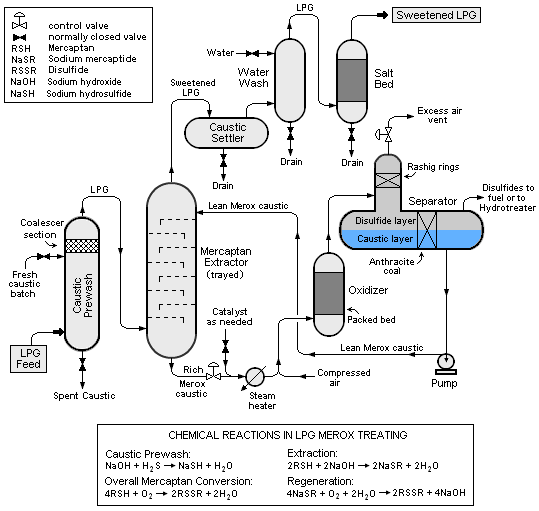
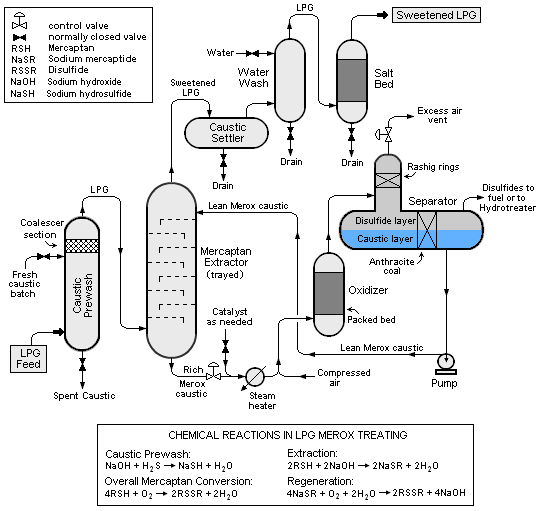
Figure 1 — Conventional LPG Caustic Sweetening (Merox) process flow diagram with chemical reactions
Step 1 — Caustic Pre-wash (optional but common)
- Feed LPG (amine-treated, H2S-free) is contacted with a dilute caustic solution (5–10 wt% NaOH) in a small pre-wash vessel to remove residual H2S, CO2, and naphthenic acids that would otherwise degrade the treating caustic.
- Pre-wash caustic is periodically drawn off as spent caustic.
Step 2 — Extraction
- The LPG flows up through an extraction column (packed or trayed, or a fiber-film contactor in Merichem designs) countercurrent to a circulating caustic solution (typically 10–20 wt% NaOH) containing dissolved Merox catalyst.
- Conditions: 30–45 °C, at sufficient pressure to keep LPG liquid (typically 10–20 bar for C3/C4 service).
- Mercaptans transfer into the caustic phase as mercaptides. Extraction efficiency is high for methyl/ethyl mercaptans; heavier mercaptans (C3+) extract less readily — design typically achieves treated product mercaptan sulfur of < 5–10 ppm.
- Treated LPG leaves overhead to a settler/coalescer for caustic entrainment removal, then to water wash (to remove trace caustic) and drying.
Step 3 — Caustic Regeneration (Oxidizer)
- Rich caustic from the extractor is heated (steam or heat exchange) to 40–60 °C and enters the oxidation column (regenerator), where air is injected (typically 1.5–2.5× stoichiometric oxygen requirement).
- Pressure: 3–7 bar; residence time: 15–40 minutes.
- The Merox catalyst (cobalt chelate, dosed continuously at ppm levels to make up for losses) catalyzes mercaptide oxidation to disulfides.
Step 4 — Disulfide Separation
- The oxidizer effluent flows to a disulfide separator (settler), where the disulfide oil (immiscible, lighter than caustic) is decanted overhead and routed to disposal — typically to the hydrotreater feed, FCC, or fuel oil blending.
- Spent air (nitrogen-rich, containing trace hydrocarbons and disulfides) is vented through a caustic scrubber or carbon bed / incineration for VOC and odor control — an important environmental consideration.
Step 5 — Caustic Recycle
- Regenerated lean caustic is cooled and pumped back to the extractor. A continuous small caustic blowdown and fresh caustic/catalyst makeup maintains solution strength and purges accumulated salts (Na2CO3, Na2SO4).
Key process parameters (LPG extractive Merox)
| Parameter |
Typical Value |
| Extraction temperature |
30–45 °C |
| Extraction pressure |
10–20 bar (liquid-phase LPG) |
| Caustic concentration |
10–20 wt% NaOH |
| Caustic circulation ratio |
0.05–0.15 m³ caustic per m³ LPG |
| Oxidizer temperature |
40–60 °C |
| Oxidizer pressure |
3–7 bar |
| Air rate |
1.5–2.5× stoichiometric |
| Treated product mercaptan S |
< 5–10 wt-ppm |
| Copper strip test |
1a/1b (pass) |
| Doctor test |
Negative (sweet) |
Fixed-Bed Merox variant (jet fuel/kerosene):
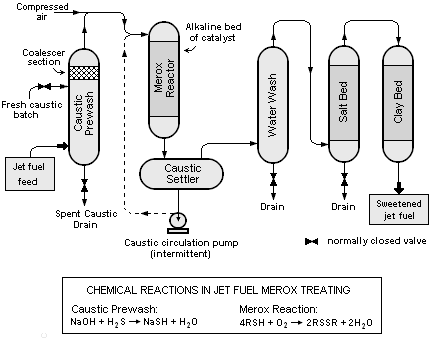
Figure 2 — Jet fuel/kerosene Caustic Sweetening (Merox) process flow diagram with chemical reactions
The hydrocarbon, caustic, catalyst, and air pass co-currently over a fixed bed of catalyst-impregnated activated carbon in a reactor at 40–50 °C; mercaptans oxidize in situ to disulfides which remain in the product. No extraction loop is needed. Product meets jet fuel sulfur and copper strip specs; a salt filter/coalescer follows for caustic removal.
Technology Performance
- Mercaptan removal/conversion: 95–99.9%; treated LPG mercaptan sulfur < 5–10 ppm typical, doctor-sweet.
- Selectivity: Total sulfur is not reduced in fixed-bed Merox (disulfides remain in product) — only in extractive Merox is sulfur physically removed. For ultra-low-sulfur requirements (e.g., cracker feed < 1 ppm), hydrotreating may be required instead.
- Product yield: Essentially 100% — no hydrocarbon loss beyond trace disulfide draw and water-wash losses.
- Caustic consumption: Very low vs. straight caustic washing (regenerated); typical makeup 1–5 kg NaOH per 100 m³ LPG treated.
- Safety considerations:
- Caustic handling (corrosive; PPE, materials: carbon steel adequate below ~50 °C at low concentration, with caustic embrittlement controls — stress relief, caustic service design per NACE where applicable).
- Air injection into hydrocarbon-containing equipment — oxidizer design ensures hydrocarbon content stays outside flammable limits; LPG systems operate liquid-full.
- Disulfide oil handling and spent air vent treatment (odor/VOC).
- Exothermic oxidation — modest temperature rise, controlled by circulation and cooling.
- Environmental: Spent caustic blowdown requires treatment (wet air oxidation or neutralization); Merox dramatically reduces spent caustic volumes vs. non-regenerative washing — historically its principal advantage.
Licensors and Commercial Technologies
| Licensor / Source |
Technology |
Notes |
| UOP (Honeywell UOP) |
Merox™ (extractive, fixed-bed, MinAlk variants) |
Original and dominant licensor; >1,500 units; standard for LPG, naphtha, jet fuel |
| Merichem (now part of PE/energy technology groups) |
THIOLEX™ / REGEN® with FIBER FILM® contactors |
Mass-transfer-efficient fiber-film extraction; very compact; widely used for LPG and light ends |
| Axens |
Caustic sweetening packages (Merox-type) |
Offered within integrated treating blocks |
| Sinopec (SEI / RIPP) |
Proprietary Merox-equivalent designs |
Standard Chinese refinery packages; cobalt phthalocyanine catalysts domestically produced |
| EIL (Engineers India Ltd.) |
Merox-based designs under license / indigenous revamps |
Implemented across Indian refineries; IOCL/BPCL/HPCL standard units |
| Russian licensors (VNIPIneft, VNIIPNeftekhim, GrozNII) |
Merox-analog caustic sweetening units |
Domestic designs across Russian/CIS refineries; similar chemistry, locally sourced catalysts |
| Lummus Technology |
Treating packages including caustic sweetening |
Integrated light-ends treating offerings |
| Shell (proprietary) |
Sulfinol-adjacent and caustic treating for own refineries |
Internal use mostly |
Note: The core Merox chemistry (cobalt chelate-catalyzed caustic oxidation) is now mature and partly off-patent; many engineering contractors build Merox-type units, while UOP and Merichem retain the leading proprietary designs, catalysts, and guarantees.
Role in the Integrated Refinery
In the refinery treating train, caustic sweetening sits between amine treating and final product finishing: amine treating removes H2S (protecting the Merox catalyst and caustic), Merox removes/converts mercaptans, and water wash + drying deliver the finished sweetened/refined LPG or distillate. For petrochemical-integrated complexes requiring ultra-low sulfur feedstocks (steam cracker LPG/naphtha < 1 ppm S), Merox sweetening is supplemented or replaced by hydrotreating, but for commercial LPG and jet fuel production it remains the most economical, reliable, and globally dominant sweetening technology.