A Mercury Removal Unit (MRU) is a fixed-bed adsorption process that removes elemental mercury and mercury compounds from natural gas, condensate, and NGL streams prior to cryogenic processing, liquefaction, or fractionation. Mercury is a naturally occurring trace contaminant in hydrocarbons produced from certain geological formations, present at concentrations ranging from below 1 ng/Nm³ to several thousand ng/Nm³ depending on the field.
Mercury removal is critical because mercury causes liquid metal embrittlement (LME) of aluminium heat exchangers — including the brazed aluminium heat exchangers (BAHX) used universally in cryogenic NGL recovery units, turboexpander cold boxes, and LNG main cryogenic heat exchangers (MCHE). Mercury amalgamates with aluminium at cryogenic temperatures, causing catastrophic and rapid structural failure of heat exchanger cores. Several major incidents of BAHX failure attributed to mercury contamination have been documented in the industry, most notably at the Skikda LNG plant in Algeria and at facilities in Southeast Asia.
Beyond equipment protection, mercury removal is also required for environmental and occupational health compliance — mercury is a persistent bioaccumulative toxin subject to increasingly stringent emission limits globally, including under the Minamata Convention on Mercury (2017).
Mercury Species in Natural Gas
Mercury occurs in natural gas and associated liquids in several chemical forms, each requiring specific removal mechanisms:
| Mercury Species |
Form |
Typical Concentration |
| Elemental mercury (Hg°) |
Vapour |
Dominant species
in gas phase |
| Ionic mercury (Hg²?) |
Dissolved in aqueous phase |
Minor in dry gas |
| Organomercury compounds |
Dimethylmercury, diethylmercury |
Trace; more common
in condensate |
| Particulate mercury |
Adsorbed on solids |
Minor; removed by
upstream filtration |
Process Description
Mercury removal is achieved by passing the hydrocarbon stream through one or more fixed-bed adsorber vessels packed with a mercury-specific sorbent. The process is non-regenerative in most designs — the sorbent bed is replaced when its mercury capacity is exhausted, typically after 2–10 years of operation depending on mercury loading and sorbent capacity.
Adsorber Configuration
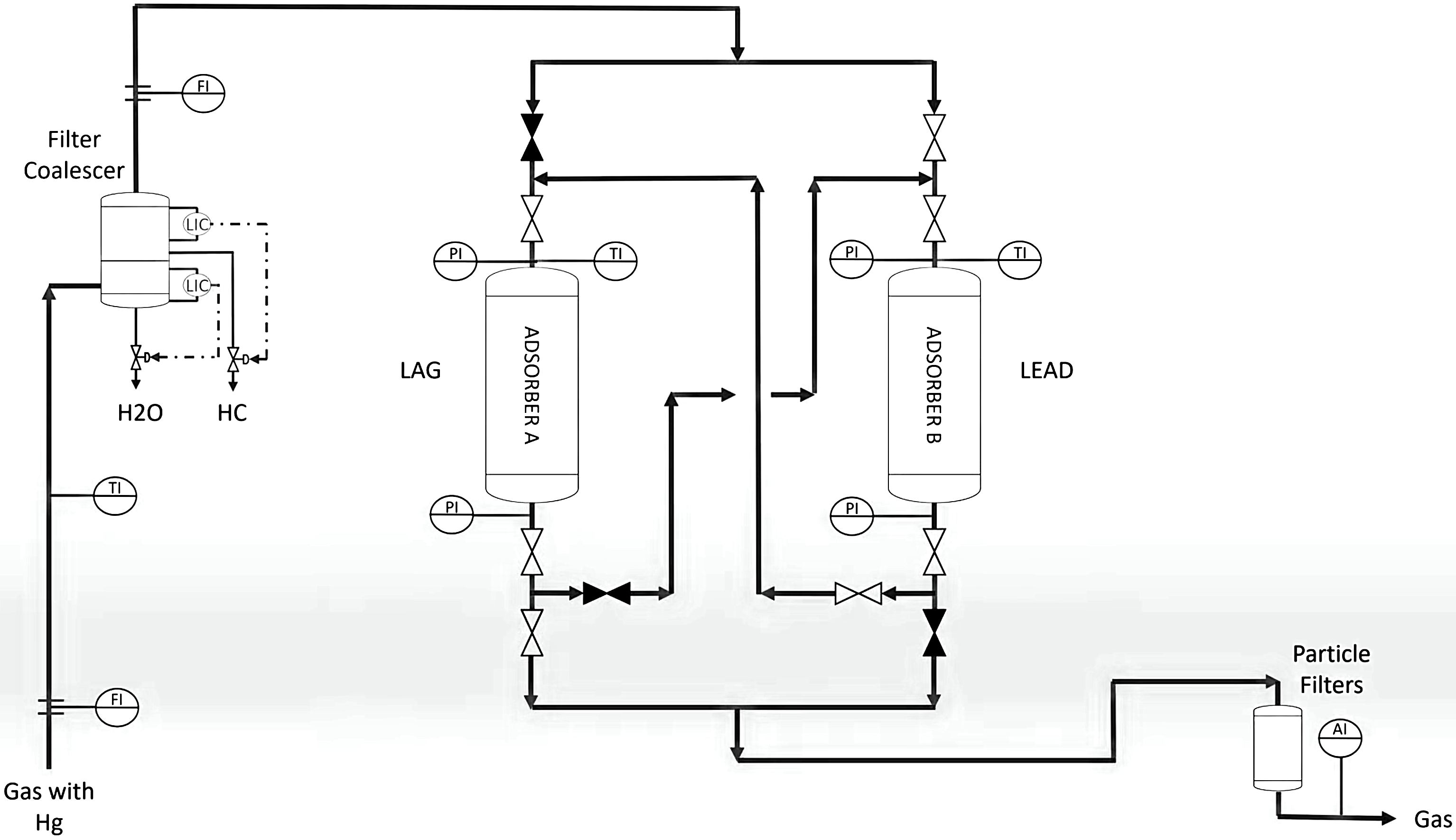
MRU vessels are typically installed as lead-lag pairs (two vessels in series) or as parallel duty/standby vessels:
- Lead-lag configuration — the lead vessel removes the bulk of mercury; the lag vessel acts as a polishing guard and provides early warning of lead vessel breakthrough via outlet monitoring. When the lead vessel is exhausted, it is isolated for sorbent changeout while the lag vessel becomes the new lead
- Parallel duty/standby — one vessel online, one on standby; simpler operation but less efficient sorbent utilisation
Gas or liquid enters the top of the adsorber vessel and flows downward through the fixed sorbent bed. The treated stream exits from the vessel bottom and proceeds to downstream cryogenic processing. Operating conditions are typically:
| Parameter |
Typical Value |
| Operating pressure |
30–100 bara (gas service) |
| Operating temperature |
15–50°C (ambient; no heating required) |
| Superficial velocity |
0.1–0.3 m/s (gas); 0.002–0.005 m/s (liquid) |
| Outlet mercury specification |
<1 ng/Nm³ (LNG service); <10 ng/Nm³ (general) |
| Bed design life |
2–10 years |
Sorbent Technologies
Several proprietary sorbent technologies are available, differing in active phase, mercury capacity, and selectivity:
| Sorbent Type |
Mechanism |
Notes |
| Sulphur-impregnated activated carbon |
Hg° reacts with S to form HgS |
Widely used; high capacity; risk of carbon fines entrainment |
| Metal sulphide sorbents (CuS, ZnS on alumina) |
Chemisorption forming stable HgS |
High selectivity; low fines risk; preferred for gas service |
| Silver-based sorbents (Ag on zeolite or alumina) |
Amalgamation |
Very high efficiency; used for polishing to <1 ng/Nm³ |
| Promoted metal oxide sorbents |
Oxidation + adsorption |
Effective for organomercury compounds |
| Regenerable sorbents |
Thermal or chemical regeneration |
Emerging technology; not yet widely commercialised |
Licensors & Technology Providers
The vessel design, instrumentation, and process flow are not inherently novel — what differs between vendors is primarily the adsorbent chemistry and, in regenerative systems, the regeneration cycle design. Most major suppliers compete on the sorbent itself, each with distinct chemistries:
| Supplier |
Product / Brand |
Chemistry |
Key Features |
| Honeywell UOP |
HgSIV™ |
Silver-impregnated molecular sieve (zeolite) |
Regenerable; simultaneous Hg + water removal; full licensed process package ? |
| GB |
Copper-based active component on high pore volume substrate; oxidized or sulfided form |
Non-regenerable; "fit and forget"; wet gas capable; high capacity → smaller vessel footprint; gas and liquid streams |
| Axens |
AxTrap™ 273, 277, 283 |
Metal sulfide on alumina (273, 283); S-based (277) |
Non-regenerable; alumina support pioneered 1970s; high porosity; D2D™ service offering ? |
| BASF |
Durasorb™ HG / HGS |
Mixed metal oxide with dispersed copper sulfide |
Non-regenerable; engineered for wet gas; launched 2019 ? |
| Selexsorb® HG |
Activated alumina-based |
Mercury removal from gas and hydrogen streams; complementary to Selexsorb® family ? |
| Clariant |
ActiSorb™ GP 402 |
Sulfur-impregnated carbon |
Gas phase; broad applicability ? |
| ActiSorb™ GP 405 / GP 418 |
Advanced mixed-metal |
All mercury forms incl. organic; 2–3× vs. conventional; dry gas |
| ActiSorb™ Hg 2 |
Sulfur + activated carbon granules |
All feed types; non-detectable Hg output ? |
| Johnson Matthey |
PURASPEC™ |
Metal sulfide on alumina |
Non-regenerable; 100+ installations globally; gas and liquid phase |
| Calgon Carbon (Cabot) |
HGR® /
HGR®-P |
Sulfur-impregnated bituminous coal-based activated carbon |
Granular (4×10 mesh) and pellet (4mm) forms; removes elemental and organic Hg; 5 continents installations; LNG protection |
| Nucon International |
MERSORB® (W, LH, LW, CR grades) |
Sulfur-impregnated activated carbon pellets |
Gas and liquid phase versions; sub-0.01 µg/Nm³ outlet achievable; also nuclear-grade iodine removal variants |
| SLB (Schlumberger) |
SELECT Hg™ |
Porosity-controlled metal sulfide adsorbent |
Gas, condensate, and LNG streams ? |
Placement in the Process Train
The MRU is positioned downstream of the AGRU and dehydration unit but upstream of all cryogenic equipment — turboexpanders, cold boxes, NGL fractionation, and LNG liquefaction trains. This placement ensures:
- The gas stream is dry (no liquid water that could damage sorbent beds)
- Acid gases have been removed (H2S can compete with mercury for sorbent active sites)
- All downstream aluminium heat exchangers are fully protected
In condensate and NGL liquid service, a separate liquid-phase MRU is installed downstream of the condensate stabiliser to treat the stabilised condensate before fractionation or export.
Equipment List
| Equipment / Device |
Notes |
Adsorber vessels
(×2 minimum) |
Vertical fixed-bed pressure vessels; carbon steel with internal coating or stainless steel lining |
| Inlet gas filter / coalescer |
Removes liquid droplets and particulates protecting the sorbent bed |
| Outlet mercury analyser |
Continuous online monitoring (cold vapour atomic fluorescence, CVAF); tracks breakthrough |
Inlet / outlet
isolation valves |
Block valves for vessel isolation during sorbent changeout |
| Switching valves |
For lead-lag or duty/standby changeover |
| Differential pressure indicators |
Monitor bed pressure drop as indicator of sorbent loading and fines accumulation |
| Sorbent containment screens |
Top and bottom bed support screens preventing sorbent fines carryover |
| Spent sorbent handling system |
Classified as hazardous waste; requires inert atmosphere handling and specialist disposal contractor |
Health, Safety & Environmental Considerations
Spent mercury sorbent is classified as hazardous waste under most national and international regulations. Its handling and disposal require:
- Inert atmosphere (nitrogen blanketing) during vessel opening and sorbent removal
- Specialist PPE and mercury vapour monitoring for maintenance personnel
- Licensed hazardous waste contractor for transport and disposal or retorting/mercury recovery
- Compliance with the Minamata Convention on Mercury (in force since 2017) and national implementing regulations
References
- GPA Midstream Association. GPSA Engineering Data Book, 14th edition (2017). Section 21: Mercury Removal
- Kidnay A.J., Parrish W.R., & McCartney D.G. (2011). Fundamentals of Natural Gas Processing, 2nd edition. CRC Press, Boca Raton, FL. Chapter 5
- Wilhelm S.M., & Bloom N. (Mar 2000). Mercury in Petroleum. Fuel Processing Technology, 63(1), 1–27. DOI: 10.1016/S0378-3820(99)00068-5
- United Nations Environment Programme (UNEP). Minamata Convention on Mercury (Accessed Mar 22, 2017)
- Honeywell UOP. UOP Mercury Removal for Natural Gas Production Brochure (Document version: Mar 5, 2020)
- Cameron (May 2015). PURASPECJM Mercury Removal Technology from Cameron
- Johnson Matthey (JM). Mercury Removal Absorbents (Accessed Mar 22, 2026)
- Axens (Jul 14, 2020). How to Remove Mercury from Extracted Natural Gas?
- BASF (Jun 19, 2019). BASF launches Durasorb™ HG, a new product for mercury removal from Natural Gas
- BASF. Product Data Sheet: Selexsorb® HG (Rev. Feb, 2026).
- Clariant. Adsorbent for Mercury Removal in Gas-Phase Applications: ActiSorb™ GP 402 (Accessed Mar 22, 2017)
- Clariant. Catalysts and adsorbents for gas processing (Accessed Mar 22, 2017)
- Clariant (Mar 9, 2017). Clariant highlights sustainability- and efficiency-focused gas processing adsorbents at GPA GCC 2017
- Clariant. Adsorbent for Removal of Trace Mercury Contaminants: ActiSorb™ Hg 2 (Accessed Mar 22, 2017)
- CalgonCarbon (Feb, 2015). Product Bulletin: HGR® P for Mercury Removal
- CalgonCarbon (2016). Product Bulletin: HGR® for Mercury Removal in Natural Gas
- CalgonCarbon (2016). Technology Bulletin: Mercury Removal from Natural Gas (Document date: Sep 24, 2014)
- NUCON International Inc. Specialty Adsorbents (Accessed Mar 22, 2017)
- NUCON International Inc. Bulletin 11B28 2010: MERSORB® Mercury Adsorbents (Document version: Apr 26, 2020)
- NUCON International Inc. Activated Carbons for Mercury Removal (Accessed Mar 22, 2017)
- slb. SELECT Hg mercury removal adsorbents (Accessed Mar 22, 2017)