Technology History
Aromizing™ is the aromatics-oriented expression of Axens’ continuous catalyst regenerative (CCR) reforming technology, a process family with roots in IFP (now IFPEN)’s long-standing catalytic reforming developments dating back to the semi-regenerative reforming era of the 1960s–1970s. As demand grew for low-pressure, high-severity operation to maximize aromatics and hydrogen, IFP commercialized its moving-bed CCR concept, characterized by a distinctive side-by-side reactor arrangement (as opposed to vertically stacked reactors) coupled with a dedicated continuous regeneration loop.
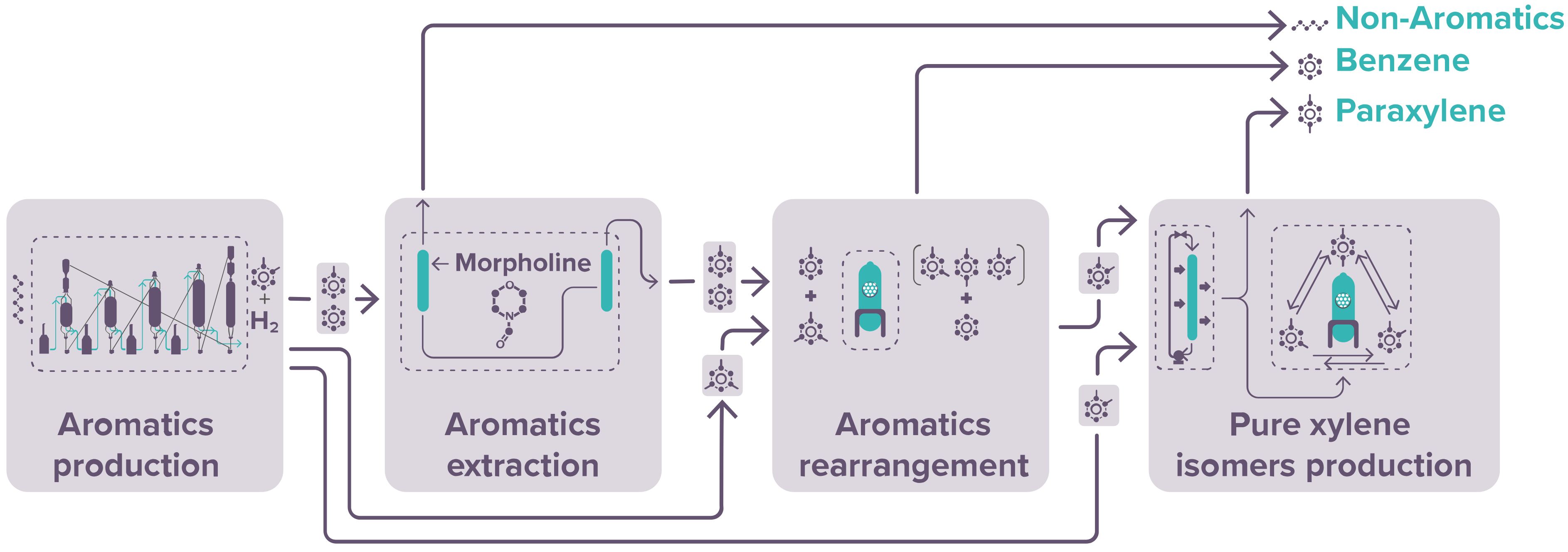
When Axens was established in 2001 (consolidating IFP’s process licensing and the catalyst manufacturing heritage of Procatalyse), the CCR reforming offer was branded under the twin names Octanizing™ (gasoline/octane objective) and Aromizing™ (aromatics/BTX objective). The two share identical hardware philosophy but differ in operating severity and catalyst selection. Within the broader ParamaX® aromatics suite, Aromizing™ is positioned as the “aromatic rings production” front-end block.
The catalyst line has evolved continuously through several generations — from the early AR-series multipromoted catalysts (e.g., AR-501) to the lower-platinum, higher-stability AR-700 series (AR-701) and the current Symphony® portfolio. This trajectory reflects a steady trend of improving activity, selectivity and stability while reducing precious-metal loading (the AR-701, for example, retained activity while improving selectivity and stability at ~25% lower platinum load and reduced coke make versus AR-501).
Technology Summary
Purpose
Aromizing™ converts hydrotreated naphtha into a high-aromatics reformate (the principal source of benzene, toluene, xylenes and C9+ aromatics — “BTX/A9+”) while co-producing large quantities of hydrogen for the overall complex. It is the upstream “engine” of a ParamaX® aromatics complex:
Configuration in brief
- Four radial-flow, moving-bed reactors in series, arranged side-by-side.
- Catalyst flows by gravity through the reactors, is withdrawn, lifted to a continuous regenerator, and returned fully reactivated to the first reactor — enabling steady operation at low pressure and high severity without the cyclic decline of semi-regenerative units.
Reaction chemistry
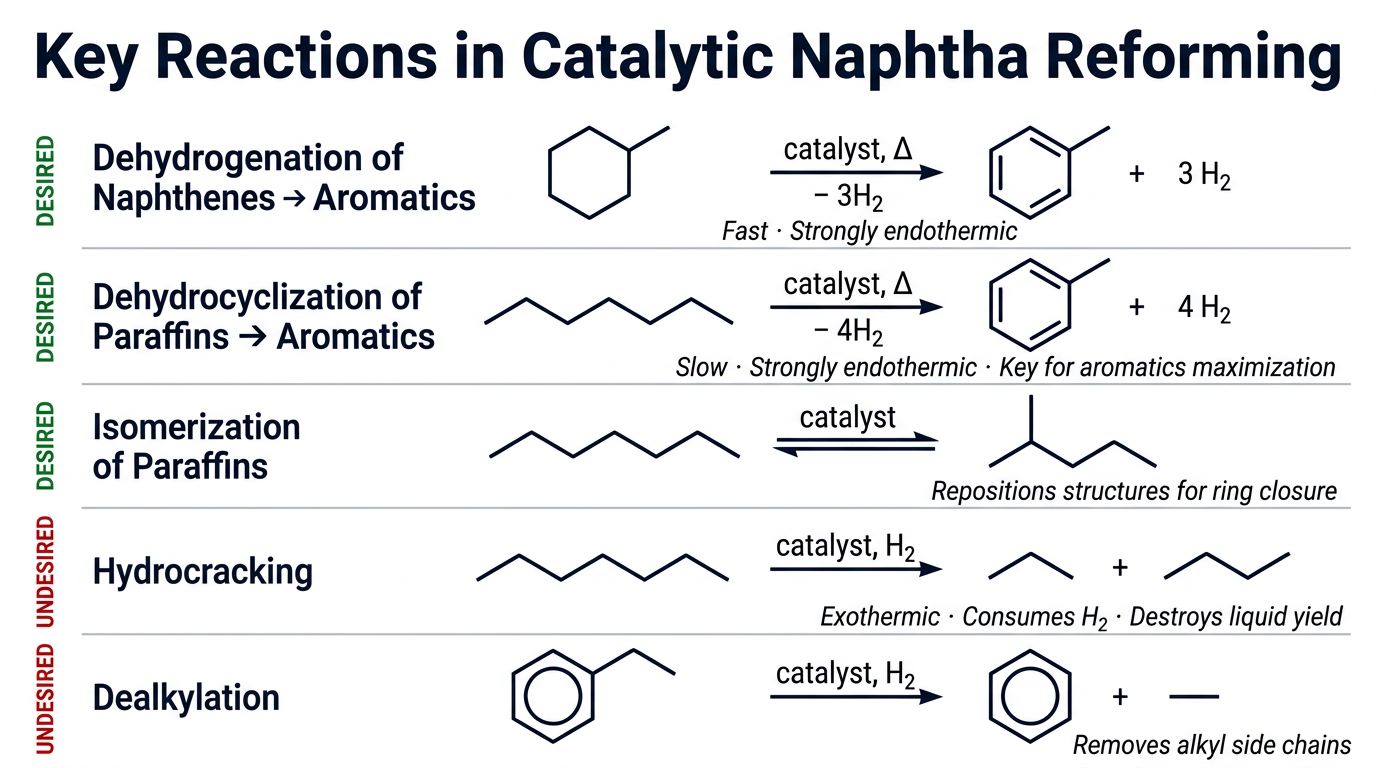
Reforming over a bifunctional Pt-based, chlorided-alumina catalyst proceeds through several competing reactions:
Desired (aromatics-forming, hydrogen-producing):
Undesired (yield-destroying):
- Hydrocracking and hydrogenolysis → light ends (C1–C4), consuming hydrogen and destroying liquid/aromatic yield (exothermic).
- Dealkylation of side chains.
- Coke formation on the catalyst (necessitating continuous regeneration).
Operating logic for aromatics
Because the desired ring-forming reactions are favored by low pressure, high temperature, and low hydrogen-to-hydrocarbon ratio (Le Chatelier: each ring made releases multiple H₂ molecules), Aromizing™ runs at the most severe, lowest-pressure end of the CCR envelope. Continuous regeneration is essential because the resulting accelerated coking would otherwise rapidly deactivate a fixed-bed catalyst.
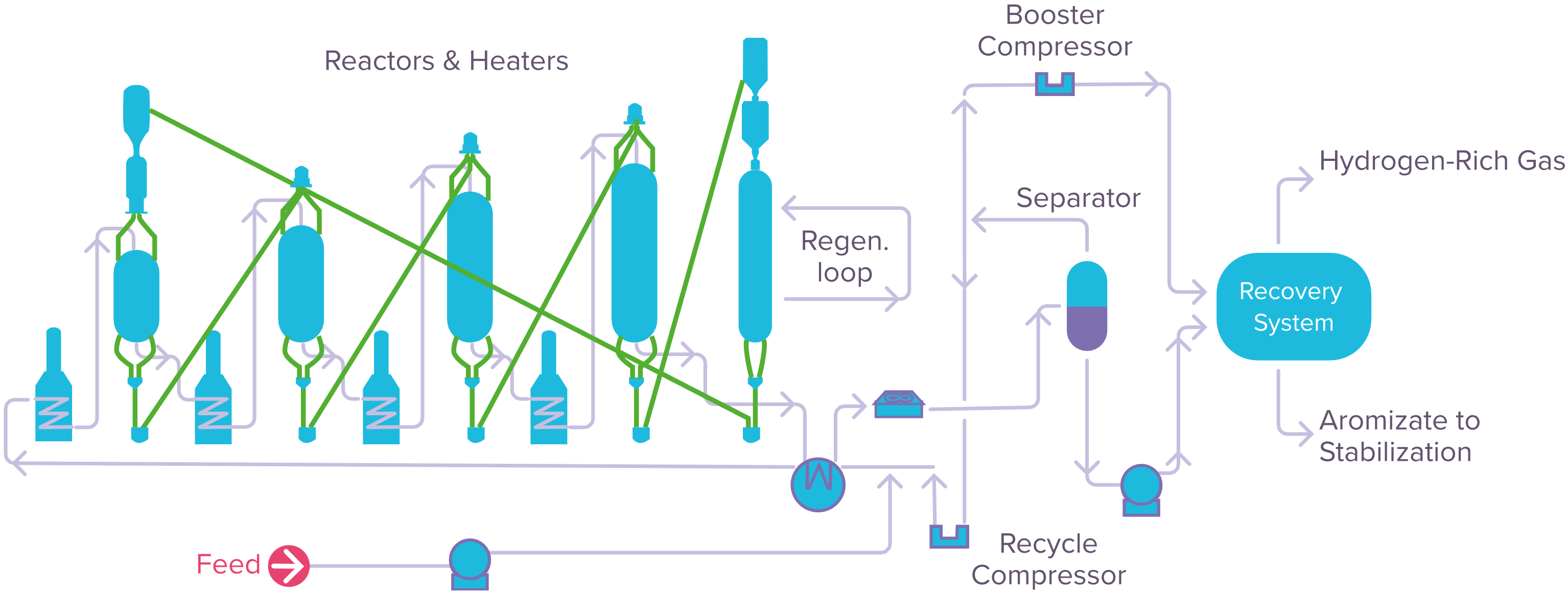
The process is best understood as two coupled loops: a reaction/recovery loop and a catalyst regeneration loop.
Axens' Aromizing technology simplified process flow diagram
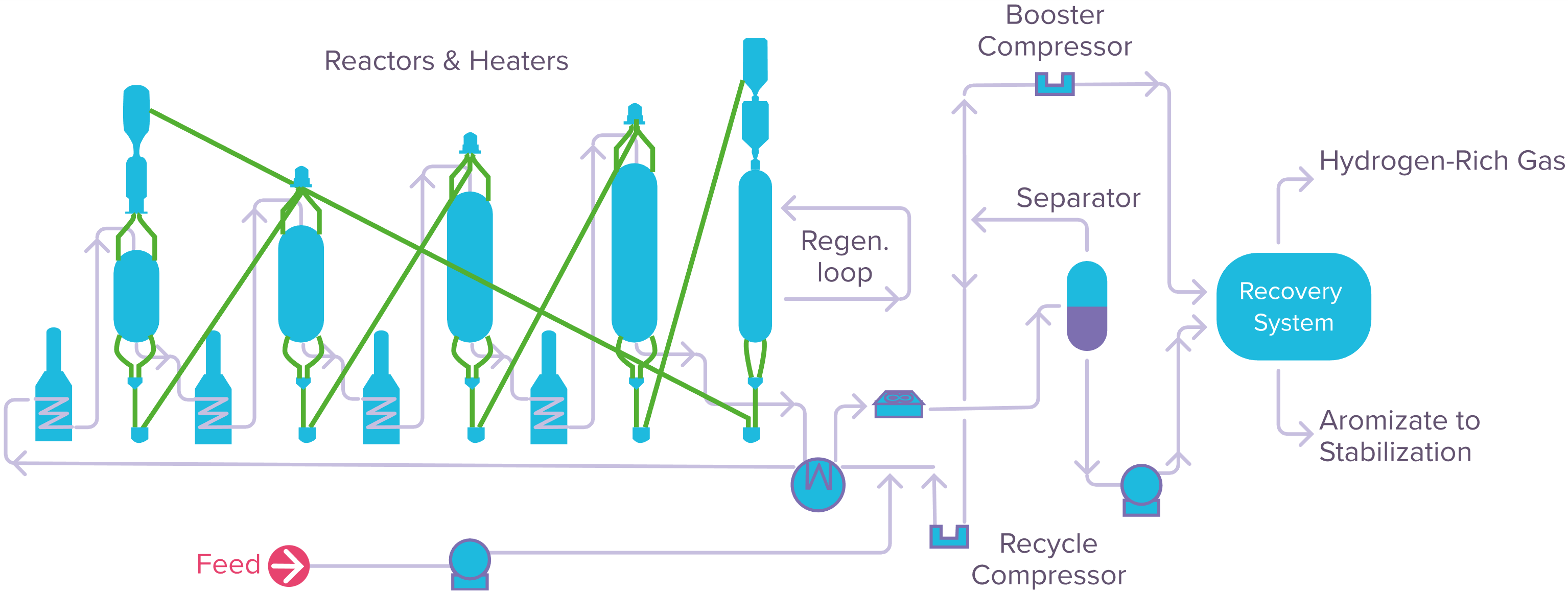
Green lines correspond to the catalyst circulation system
A detailed equipment list is provided in the Appendix.
A. Feed preparation (upstream of the unit)
Naphtha (typically a heavy-naphtha cut, with the C7–C9 fraction being most valuable for BTX) is first hydrotreated (NHT) to remove sulphur, nitrogen, oxygenates and metals to the very low levels (sub-ppm S and N) required to protect the Pt/Cl catalyst, then fractionated to the target boiling range (roughly ~85–150°C for an aromatics objective).
B. Reaction section
- Feed/effluent heat exchange: The combined feed (fresh naphtha + recycle hydrogen-rich gas) is preheated against hot reactor effluent in a high-efficiency exchanger, recovering the bulk of the reaction-section heat.
- Charge heater: A fired heater raises the feed to the first-reactor inlet temperature.
- Reactor 1 → Interheater → Reactor 2 → Interheater → Reactor 3 → Interheater → Reactor 4: The charge passes through four radial-flow moving-bed reactors in series. Because the dominant dehydrogenation/dehydrocyclization reactions are strongly endothermic, the temperature drops sharply across each bed; a fired interheater reheats the stream between reactors back to target inlet temperature. Catalyst loading is distributed (smaller first reactor where fast naphthene dehydrogenation dominates; larger downstream reactors for the slower paraffin dehydrocyclization).
- Effluent cooling and separation: The last reactor effluent gives up heat in the feed/effluent exchanger, is further cooled, and flows to a separator where a hydrogen-rich vapor is split from the liquid reformate.
- Recontacting section: To raise net hydrogen purity (typically to >90 mol%) and recover light liquids, the gas and liquid are recontacted/recompressed and re-separated. A portion of the hydrogen-rich gas is taken as recycle gas (returned via the recycle compressor to the reactor feed to maintain the target H₂/HC ratio and limit coking); the balance is exported as net hydrogen to the complex.
- Stabilization: The separator liquid is sent to a stabilizer/debutanizer to strip light ends (C1–C4 + dissolved H₂), yielding a stabilized, aromatics-rich reformate that feeds the downstream aromatics extraction/fractionation and rearrangement blocks of the ParamaX® complex.
C. Continuous catalyst regeneration loop
Catalyst moves continuously by gravity from Reactor 1 through to Reactor 4, then:
- Withdrawal and lift: Coked catalyst is withdrawn from the bottom of the last reactor and lifted (gas lift) to the top of the regenerator.
- Combustion (coke burn) zone: Coke is burned in two distinct burning zones under controlled, mild conditions, ensuring complete and gentle coke combustion.
- Oxychlorination zone: Chlorine and oxygen are introduced to re-disperse the platinum and restore catalyst acidity/chloride balance — critical to selectivity and yield.
- Drying / calcination zone: A proprietary dry-burn loop strictly limits moisture exposure, preserving catalyst specific surface area, minimizing chloride loss and maintaining mechanical strength.
- Reduction zone: Catalyst is reduced (in hydrogen) to the active metallic state before re-injection.
- Return: Fully regenerated catalyst is returned to the top of Reactor 1, closing the loop.
Environmental note: The regenerator vent gas complies with stringent emissions standards — no chlorine, no dioxins, no particulate matter in the released stream.
Table 1 —Typical operating conditions (aromatics severity)
| Parameter |
Typical range (aromatics objective) |
Reactor inlet
(WAIT) |
~500–540°C |
Operating
pressure |
Low
(modern CCR low-pressure regime, single-digit barg) |
H₂/HC
molar ratio |
Low — on the order of ~2
(recycle minimized to favour aromatization) |
Reactor
configuration |
4 radial-flow moving beds,
side-by-side |
| Catalyst |
Pt-based multipromoted chlorided alumina
(AR-700 / Symphony® series) |
| Regeneration |
Fully continuous, dry-burn loop,
two combustion zones + oxychlorination |
Technology Performance and Efficiency
Yields and selectivity (defining strengths):
- Claimed superiority in hydrogen, aromatics and liquid yields versus competing regenerator designs, driven by low-pressure/high-severity operation enabled by continuous regeneration.
- The Symphony®/AR-700 catalysts deliver high selectivity toward aromatics and octane, increased hydrogen production, and improved stability, while operating at reduced platinum loading.
Catalyst life and stability:
- The dry-burn regeneration loop is the key performance differentiator. In Axens’ comparative case study, the same catalyst run in a “wet” versus “dry” regeneration environment showed markedly slower specific-surface-area loss with the dry-burn design — translating into better-maintained performance over time and extended catalyst life, hence lower annual catalyst cost.
- Two distinct burning zones achieve complete coke combustion under the mildest conditions; controlled oxychlorination preserves Pt dispersion and acidity for sustained yield and selectivity.
Operability and design flexibility:
- The side-by-side reactor layout offers easy/low-structure construction, minimal thermal expansion, short transfer lines, easy maintenance and access, and ready scalability to large capacities.
- Demonstrated readiness for world-scale, high-capacity designs and high on-stream reliability/availability.
Digital optimization:
- Connect’In™ provides automated data collection, analysis and “what-if” prediction (RON, product yields, WAIT, coke production) for proactive optimization — cited at >USD 40 M/y value potential for a 60,000 BPSD CCR unit (via the dry-burn loop and digital advisory benefits).
- ParamaX® APC on the reforming section (capacity maximization, regeneration/coke control, yield maximization) is credited with ~USD 14 M/y benefit for a 1,500 kTA reformer as of 2013.
Economic Performance
- Axens positions Aromizing™/Octanizing™ as delivering the most efficient solutions in terms of capital and operating cost, owing to the simple side-by-side hardware, low precious-metal catalyst loading, and superior yield structure.
- Third-party validated competitiveness: In a grassroots Octanizing™ project (~12,000 BPSD, U.S.), independent competitive FEED studies concluded Axens’ solution was the most economically attractive option, as reported in Oct 2020.
- Catalyst cost: The continuous, low-moisture (dry-burn) regeneration minimizes catalyst attrition and surface-area loss, lowering annual catalyst replacement cost.
- Energy efficiency: As the most energy-intensive block of the complex (powering the complex is ~10–15% of operating cost overall), the reforming section benefits from Axens’ CEED™ “Custom and Efficient Early Design” and second-generation Energy-Efficient engineering — e.g., halving energy losses through air coolers at essentially no CAPEX increase, and recovering heat at higher thermal levels (contributing to reported overall complex energy-expense savings of the order of ~45% in enhanced heat-conservation schemes).
- As the hydrogen and aromatic-ring source, Aromizing’s yield performance directly drives the economics of the whole ParamaX® complex, where net feed cost represents ~85% of operating cost — making aromatic-ring efficiency the single largest lever on PX production cost.
Market Experience and Deployments
- Track record: More than 135 Octanizing™/Aromizing™ units licensed, with particularly strong success over the past decade.
- Capacity / feedstock range: References span a wide range of capacity and severity — from ~7,000 BPSD to ~90,000 BPSD — covering diverse naphtha feeds (2020).
- Within ParamaX®, Aromizing™ is the standard reforming front-end of Axens’ aromatics complexes; Axens has licensed more than 30 ParamaX® aromatics complexes and more than 400 aromatics-related process units, with ParamaX® capturing close to half of awarded global PX capacity since the alliance’s early-2000s successes.
- Integrated / crude-to-paraxylene: Aromizing™ features in Axens’ first-of-its-kind complete crude-to-paraxylene complex design, emphasizing maximum liquid yield with highest heavy-naphtha selectivity and using only proven technologies for high availability.
Caveat: Specific quantitative set-points (exact pressures, WAIT, space velocities) are project- and catalyst-grade dependent; figures given reflect Axens’ published operating philosophy and representative CCR-reforming ranges rather than a single guaranteed datasheet.
References
- Axens — Catalytic Reforming
- Axens — Octanizing™ / Aromizing™: Continuous Catalytic Regeneration Reforming (Commercial bulletin, document dated Oct 15, 2020)
- Axens — ParamaX®: Processes Towards Aromatics (Solutions brochure, document dated Feb 4, 2021)
- Axens — AR-700 Series (Solutions brochure, document dated Mar 4, 2024)
- Axens — Connect'In® (Horizon brochure, document dated Nov 4, 2022)
- Axens — CEED™ Studies
- Axens — Maximizing the Production and the Transformation of Aromatics (Nov 25, 2021)
- Antos G.J. & Aitani A.M. (Eds.) — Catalytic Naphtha Reforming, 2nd Ed., Marcel Dekker, New York (2004). DOI: 10.1201/9780203913505
- Meyers R.A. (Ed.) — Handbook of Petroleum Refining Processes, 4th Ed., McGraw-Hill, New York (2016) — Chapter on Axens (IFP) Catalytic Reforming / Aromatics
- Le Goff P.-Y., Kostka W. & Ross J. — Catalytic Reforming. In: Springer Handbook of Petroleum Technology, Springer (2017)
- Axens — Reforming Catalyst
- Axens — Symphony® Reforming Catalysts (Solutions brochure, document dated Jul 17, 2025)
- Axens | Souhir M. — Presentation: Advances in Paraxylene® Production with ParamaX Technologies (May 12, 2013). Pre-MEDW 2013, Abu Dhabi
Appendix — Equipment List
(back to Process Description)
The following equipment comprises a typical Aromizing™ CCR reforming unit:
REACTION SECTION
Reactors
Fired Heaters
-
F-101 — Charge heater (brings combined feed to first reactor inlet temperature)
-
F-102 — First interheater (reheats effluent between R-101 and R-102)
-
F-103 — Second interheater (reheats effluent between R-102 and R-103)
-
F-104 — Third interheater (reheats effluent between R-103 and R-104)
Heat Exchangers
-
E-101 — Feed/effluent exchanger (preheats combined feed against hot reactor effluent; main heat recovery)
-
E-102 — Reactor effluent cooler (further cooling before separation)
-
E-103 — Product cooler (final cooling of reformate)
SEPARATION & RECOVERY SECTION
Separators
-
D-101 — High-pressure separator (first gas/liquid separation; hydrogen-rich gas overhead, liquid reformate bottom)
-
D-102 — Low-pressure separator (recontacting/recovery section; further gas/liquid split to raise H₂ purity and recover light liquids)
Columns
Reboilers & Condensers
-
E-104 — Stabilizer reboiler
-
E-105 — Stabilizer overhead condenser
-
D-103 — Stabilizer reflux drum
COMPRESSOR SECTION
Compressors
-
K-101 — Recycle gas compressor (returns hydrogen-rich gas from separator to reactor feed; maintains target H₂/HC ratio)
-
K-102 — Net hydrogen compressor (optional; compresses exported net hydrogen to battery limits pressure)
CONTINUOUS CATALYST REGENERATION LOOP
Regenerator Vessel
Catalyst Handling Equipment
-
Catalyst withdrawal system — Controlled withdrawal from bottom of R-104
-
Catalyst lift system — Gas lift (typically inert gas or regeneration gas) to elevate spent catalyst to top of regenerator
-
Catalyst return system — Gravity flow of regenerated catalyst back to top of R-101
Regenerator Auxiliaries
-
Air blower (for combustion)
-
Chlorine injection system (oxychlorination)
-
Hydrogen supply (for reduction zone)
-
Regenerator effluent gas treatment (to meet emissions standards: no Cl₂, no dioxins, no particulates)
PUMPS
-
P-101 A/B — Naphtha feed pump
-
P-102 A/B — Stabilizer bottoms (reformate) product pump
-
P-103 A/B — Stabilizer reflux pump
-
P-104 — Recycle slop/seal oil pump (if applicable)
INSTRUMENTATION & CONTROL
Distributed Control System (DCS)
Advanced Process Control (APC)
Digital Services Platform
-
Connect’In™ — Automated data collection, analysis, what-if tools (RON, yields, WAIT, coke production prediction)
-
webPOS™ — Static process simulator for feed sourcing and production planning optimization
UTILITIES & AUXILIARIES
-
Hydrogen supply system (makeup hydrogen; recycle gas network)
-
Fuel gas system (for fired heaters)
-
Cooling water system (exchangers, condensers)
-
Steam system (reboilers, utilities)
-
Instrument air / plant air
-
Nitrogen system (purging, blanketing)
-
Flare system (relief, startup/shutdown)
TYPICAL EQUIPMENT COUNT SUMMARY
| Equipment Type |
Approximate Count |
| Reactors (moving-bed, radial-flow) |
4 |
| Fired heaters |
4 (charge + 3 interheaters) |
| Heat exchangers |
5+ |
| Separators/drums |
3+ |
| Distillation columns |
1 (stabilizer) |
| Compressors |
2 (recycle + net H₂) |
| Pumps |
6–8 (feed, product, reflux, auxiliaries) |
| Regenerator (multi-zone vessel) |
1 |
| Catalyst handling systems |
3 (withdrawal, lift, return) |
NOTES
-
Side-by-side reactor arrangement is the Axens signature design feature, offering:
-
Easy construction / low structure requirements
-
Minimal thermal expansion
-
Short transfer lines
-
Easy maintenance and access
-
Scalability to large capacities
-
Dry-burn regeneration loop is the key performance differentiator, preserving catalyst specific surface area and extending catalyst life.
-
Equipment designation (e.g., R-101, F-101) is illustrative; actual tags will follow project-specific nomenclature.
-
Capacity range for Aromizing™ references: ~7,000 to ~90,000 BPSD naphtha feed.
-
The equipment list above represents a standalone Aromizing™ unit. In an integrated ParamaX® aromatics complex, downstream equipment would include:
-
Naphtha hydrotreater (NHT) — upstream pretreatment
-
Reformate splitter (RS) — fractionation into BT cut, xylenes cut, heavy aromatics
-
Aromatics extraction (Morphylane) — BT purification
-
Xylenes loop (isomerization, adsorption, transalkylation) — PX production
Sources:
-
Axens Aromizing™/Octanizing™ process descriptions (2020 commercial bulletin, 2019 ParamaX brochure)
-
ParamaX® process block diagrams (2013 Pre-MEDW presentation, 2019 SlideShare)
-
Typical CCR reforming configurations (general industry practice)