

ppPLUS use cookies essential for this site to function well.
Learn about our use of cookies, and collaboration with selected social media and trusted analytics partners here.
Technologies are key to understanding the global Refining- and Chemicals operations.
ppPLUS has made a point from the design of its data-structure to model processes and operations,
based on their technolgies.
From Feedstock processing to recycling, ppPLUS is mapping out the whole process and value chain looking
at Technology specifics, the technology providers and the global deployment.
Join us to add, evaluate and complement the global picture of technology application in the industry.
Solution-Reference: #T139
ppPLUS Solutions - Expert Services
Enquire with us for information on the technology, processes and where it is deployed.
ppPLUS Experts cover a range of expertise providing insights for your enquiries
Explore ppPLUS Solutions for expert services
or monetize your own expertise
The Isomerization process in a petroleum refinery is the catalytic process that converts low-octane number straight-chain hydrocarbon molecules (C4, C5, C6) into branched-chain hydrocarbons with the same carbon number and high-octane number. The isomerization reaction rearranges the carbon skeleton of a molecule without adding or removing anything from the original material and transforms the normal paraffins into iso-paraffins. The table shows the difference in RON between normal and iso components.
Objectives of Isomerization Process in Oil Refinery
The isomerization process in oil refining is critical in the current scenario of clean fuels and serves the following purposes ;
Improves the RON (Research Octane Number) of light naphtha gasoline from 65 to 92, depending upon the Isomerization unit configuration, catalyst type, and requirement of the refiner.
Removes, benzene, and aromatics form the naphtha and make an ideal blending component for the gasoline pool.
In the case of isomerization of Butane, it is used to prepare feed for the alkylation unit.
Helps the oil refinery to manage the gasoline pool by providing high RON naphtha. Low-quality straight-run C5~C6 gasoline is difficult to blend with other gasoline streams, therefore creating a bottleneck for the refinery operation.
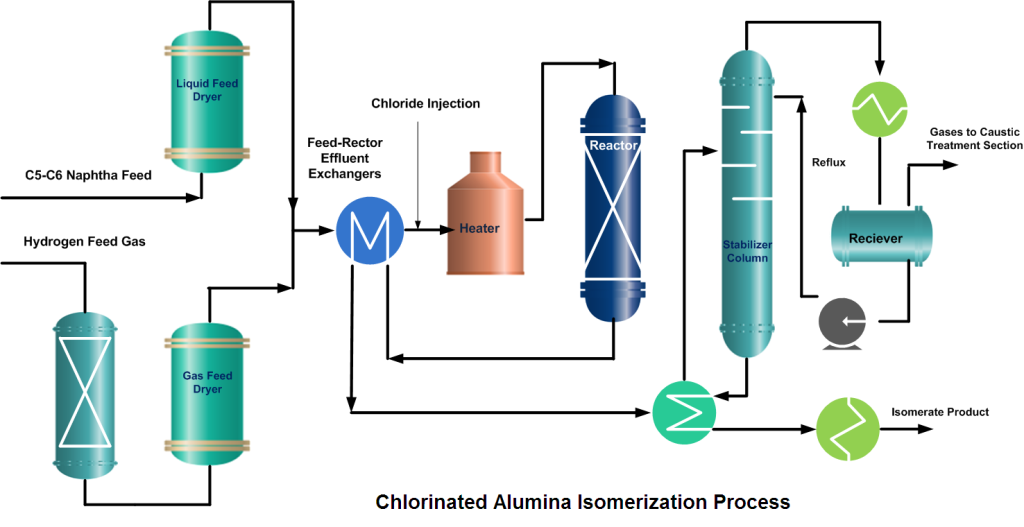
In a typical isomerization unit, light naphtha is first hydrotreated and then dried to remove any moisture content. Similarly, from the hydrogen gas stream, H2S is removed in the guard bed reactor and Oxygenates (CO, CO2) are converted to water (H2O) and methane (CH4) in a Methanator reactor. Afterwards, hydrogen gas is dried and mixed with naphtha feed. A small amount of organic chloride is injected into the combined feed stream and then heated to the reaction temperature. After mixing the dry and treated feed and gas streams, the combined feed is preheated by the reactor effluent and then finally heated in a heater up to the required reaction temperature. Process requirement determines whether one or more reactors are to be used.
Your exclusive gateway to integrated data in the Energy and Petrochemical industry —
without barriers
From refining and renewables to chemicals, we bring together market insights, operational metrics, and regulatory data in one seamless platform.
All we ask is a quick
register
and login to unlock full access and start making smarter decisions.
You can also use your LinkedIn-ID
to get full access. Click on symbol for login, using:
 
Communicator
Add Message
Notification
Message will be inserted here
Search Communicator
Your Donation will make a Difference
Open
We operate the only free, open-access platform dedicated to mapping the Energy and Petrochemicals industry.
Our mission: to create a holistic, integrated, and complete picture of the sector, its assets, processes, and players.
Community
This ambitious project thrives on community contributions.
Join our Expert-Community and benefit by bringing content to the platform.
Discover our flexible tools to adding your Insights to Technologies, Companies and industry trends.
Contribute and Support
If you believe in transparency, collaboration, and accessible knowledge.
With your payment you support the content contributors and the platform.
Every contribution fuels the development of this unique platform and will be shared between the Content-Authors and the platform.
Share your insights with the community
ppPLUS Communicator
Add company news, business events,
operational updates, etc
Collaborator Assigned with registration
Data Modelling
Update Descriptions of Companies, Technologies, Products...
Model Mass Balances and visualize Processes
Create Indicators and much more
Modeler
Insights
Create your own Expert-Profile
Publish comprehensive insights, new articles
Create ppPLUS Solutions Services (See Solutions)
Modeler with Expert-Status
Go here
if you haven't registered yet and we will contact you.
For any questions email us.
Earn Appreciation Directly From Your Audience
With the ppPLUS Donation Feature, your readers can show their appreciation by contributing a small monetary “thank you” for the insights you share. It’s a simple, transparent way to reward your expertise and support your work.