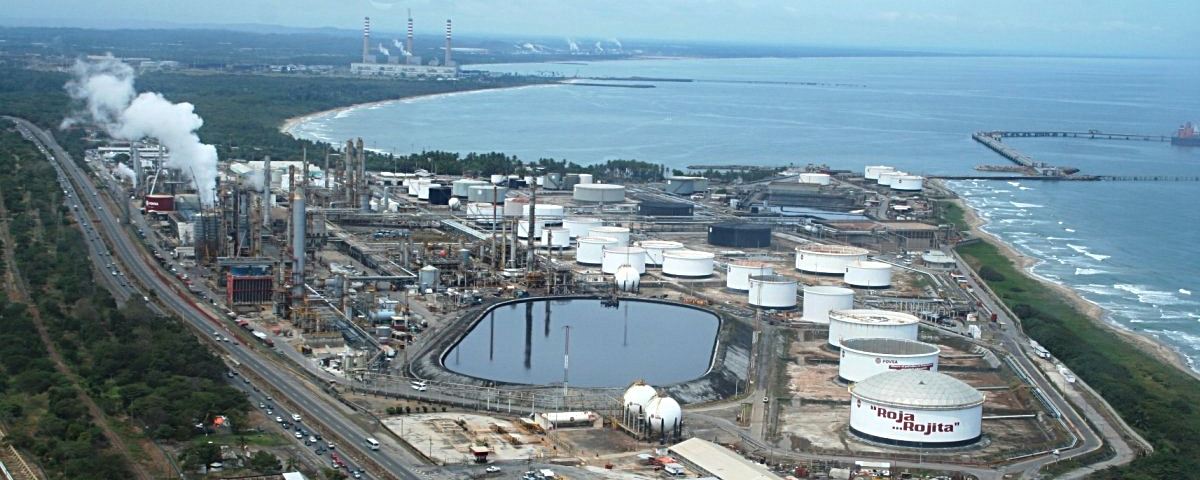
El Palito refinery in Puerto Cabello | Source: PortalPortuario (Dec 2023)
El Palito is a medium-conversion coastal refinery in central Venezuela, owned and operated by PDVSA, with a nominal processing capacity of about 140–146 thousand barrels per day of mainly medium crude oils around 28° API.
Location and role in PDVSA’s system
The refinery is located near the town of El Palito, in the municipality of Puerto Cabello, Carabobo state, along the Morón–Puerto Cabello national highway. It is PDVSA’s smallest refinery by nameplate capacity, but strategically important because it sits close to central Venezuelan demand centers and key ports, acting as a regional hub for fuels supply in Carabobo and neighboring states. Within PDVSA’s network (Paraguaná, Puerto La Cruz, José, El Palito), it ranks fourth in size after the larger complexes.
History and capacity evolution
Construction of the refinery started in 1954, and refining operations began on 23 June 1960 with an initial capacity of 55 thousand barrels per day using a crude distillation unit and a catalytic reformer. Capacity and configuration were progressively expanded, reaching about 140 thousand barrels per day by 2013, with later documentation and project material referring to 146 thousand barrels per day as the design throughput following expansion efforts. An upgrade project led by TOYO, Foster Wheeler and Y&V aimed to double effective throughput in tonnes per year and optimize processing of Orinoco Belt heavy crude, adding units such as vacuum distillation, hydrotreating, CCR reforming, sulfur recovery and hydrogen production.
Crude supply and configuration
El Palito is typically classified as a medium-conversion refinery processing predominantly ~28° API crude, with feedstock coming from fields in Apure and Barinas via a crude pipeline of over 600 km (one of the longest in Venezuela) and from Monagas and Anzoátegui via tanker. The process configuration includes atmospheric and vacuum distillation, hydrotreaters, a continuous catalyst regeneration reformer, a fluid catalytic cracking (FCC) unit, sulfur recovery and hydrogen production, enabling production of gasoline, diesel and other clean fuels as well as naphtha and LPG.
Recent operational status and Iranian involvement
In May 2022 PDVSA signed a €110 million refurbishment contract with Iran’s state-owned refining company NIORDC, covering modernization and partial rehabilitation of El Palito’s process units. By June 2023 Iranian and Venezuelan officials reported the refurbishment to be about 70% complete, with fuel production reaching the refinery’s nominal maximum of 140 thousand barrels per day. Iranian-supplied catalysts have been used in the cracking unit since at least July 2024, and Iranian engineering firms (NIORDC, NIOEC) have been directly involved in both FCC and broader unit upgrades.
Operationally, the refinery has experienced cycles of shutdown and restart: the FCC unit was offline for roughly 11 months before a restart in late 2024–mid‑2025, reaching around 26 thousand barrels per day of catalytic naphtha, with a ramp-up target of 35 thousand barrels per day of gasoline blendstock. PDVSA and Venezuela’s oil ministry highlighted the FCC restart as critical for reducing domestic fuel shortages, though the unit has struggled to consistently hit design rates due to equipment defects and sanctions-related constraints on spare parts.
Incidents and environmental record
El Palito has had several notable incidents: a fire triggered by lightning in 2012, a significant oil spill in July 2020 that released an estimated 20 thousand barrels of oil into the Triste Gulf, and another spill in late December 2023 affecting coastal areas near Puerto Cabello. These events, combined with chronic operational instability and PDVSA’s broader financial stress, have made El Palito a focal point for environmental and industrial safety concerns in Venezuela’s refining sector.