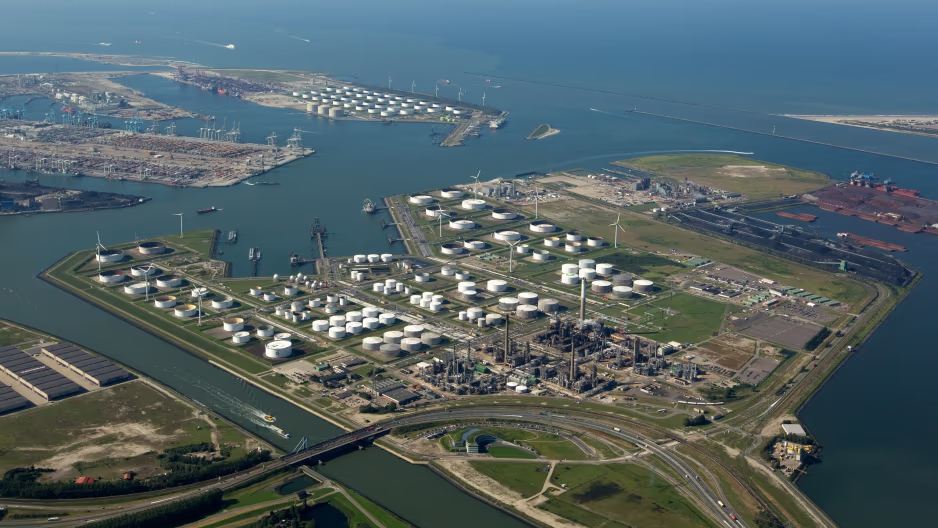


Aerial view of the Rotterdam refinery | Source BP, bp raffinaderij (accessed June 11, 2026)
BP Refinery Rotterdam (bpRR) is one of the largest oil refineries in Western Europe, located at the 6th Petroleum Port (Europoort), Rotterdam, Netherlands. It has been in continuous operation since 1967, and BP has held 100% ownership since 2007 following the buyout of the former Nerefco joint venture with Texaco. The site covers approximately 390 hectares at Europoort, with a secondary loading/offloading facility formerly operated at Pernis.
Processing Units & Nameplate Capacities

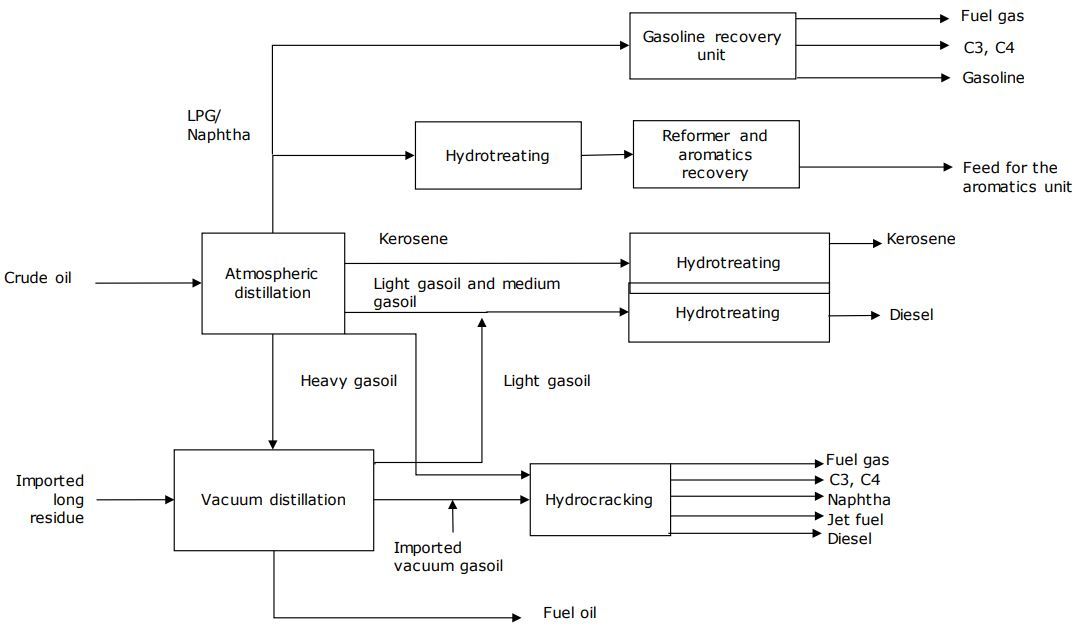
Simplified flow diagram of the Rotterdam refinery | Source: MIDDEN 2020 Decarbonisation Report
| |
| Atmospheric Crude Distillation |
20,000 kt feed/yr (400,000 bpd);
2 × 200,000 bpd |
Backbone of the refinery;
2 trains |
| Vacuum Distillation |
4,900 kt feed/yr |
Downstream of CDU
for heavy fraction separation |
| Visbreaker |
2,100 kt feed/yr |
Thermal cracking of vacuum
residue to reduce fuel oil viscosity;
no hydrocracker present |
| Fluid Catalytic Cracking |
3,500 kt feed/yr |
Large FCC unit; processes
vacuum gasoil; residue cracking
configuration |
| Hydrotreating |
16,500 kt feed/yr (combined) |
Multiple trains covering naphtha HT, kerosene HT, and gas oil desulphurisation |
| Catalytic Reforming |
1,200 kt feed/yr |
Naphtha upgrading for octane
(gasoline quality); hydrogen
byproduct: 52 kt H₂/yr |
| Alkylation Unit |
330 kt feed/yr |
Combines C3/C4 olefins with
isobutane for high-octaneisobu
gasoline blending |
Hydrogen (byproduct
from Platforming) |
52 kt H₂/yr |
Recovered from catalytic reformer
off-gas |
Products
The refinery produces a wide range of finished and intermediate products:
Logistics & Export
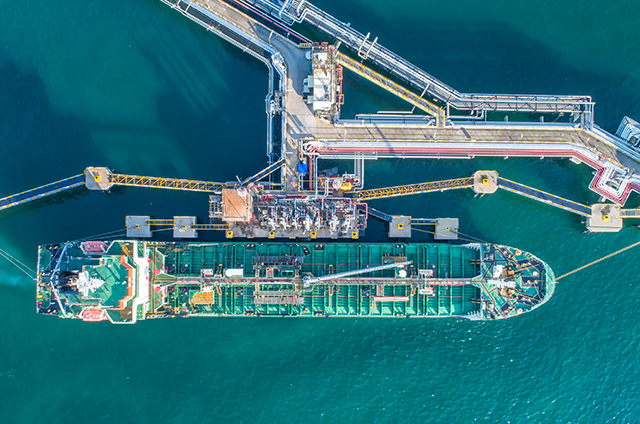
Products leave the site by road, water, rail, and pipeline and are distributed to all BP service stations in the Netherlands as well as exported to Germany, Belgium, Luxembourg, Switzerland, Italy, the UK, and the USA. The Europoort site handles deep-sea crude tanker arrivals, while the former Pernis terminal (sold to Koole Terminals in 2015) handled road tanker loading at an average of 125 trucks per day.