
Product
Naphthalene
Names
White Tar; Camphor Tar; Tar Camphor; Naphthalin; Naphthaline; Albocarbon; Hexalene; Bicyclo[4.4.0]deca-1,3,5,7,9-pentaene
Insight Articles
#PS315
Main Product
Polycyclic Aromatic Hydrocarbons (PAHs)
Segment
Chemicals
Main-Family
Aromatics
Sub-Family
Polycyclic Aromatic Compounds
Physical State

Solid

Description

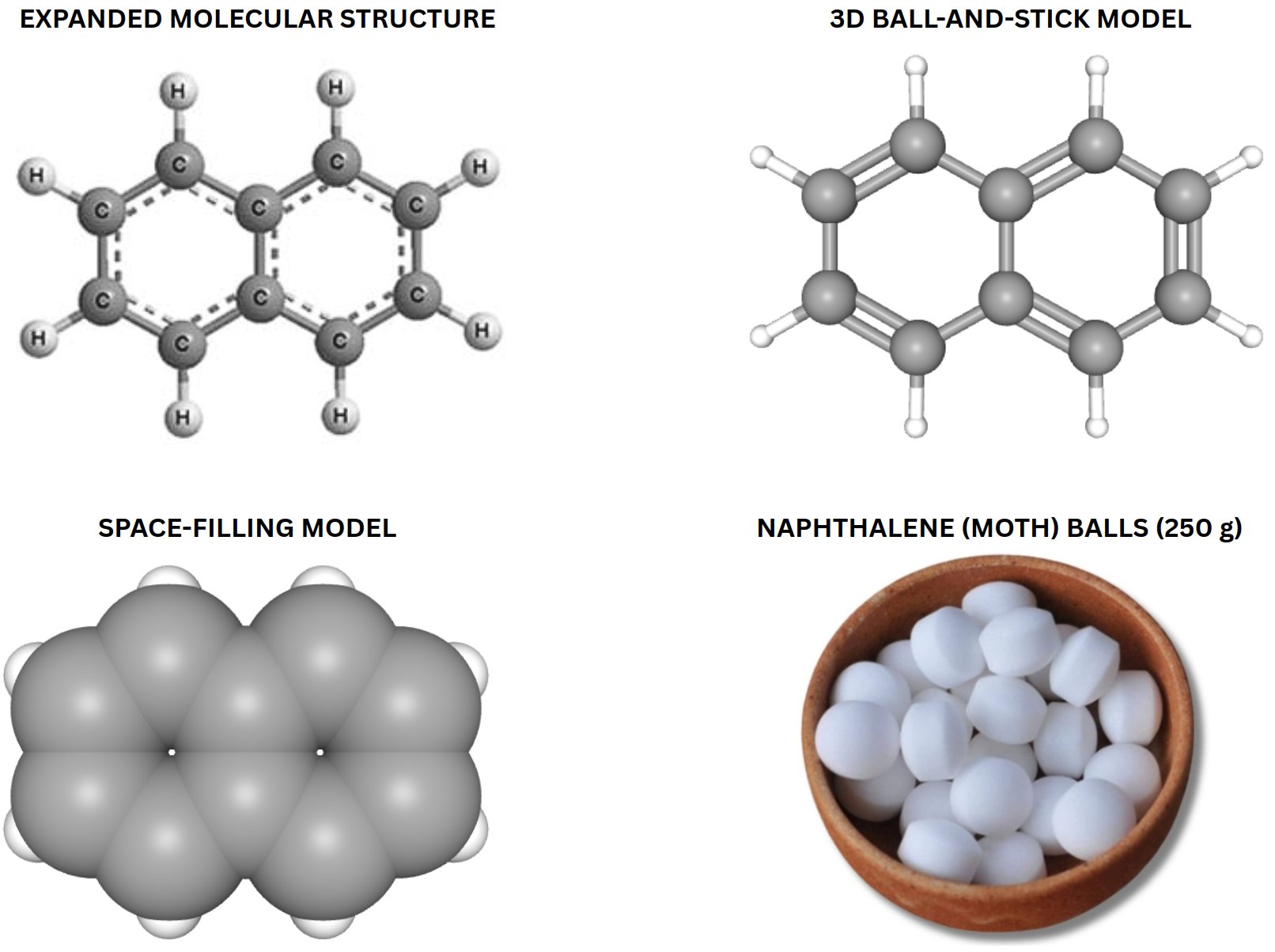
Naphthalene is a two-ring polycyclic aromatic hydrocarbon (PAH), the simplest and most common member of its class, consisting of two fused benzene rings sharing two carbon atoms, giving a planar, fully conjugated aromatic structure, and with the molecular formula C₁₀H₈. It is best known industrially as an alternative feedstock to ortho-xylene for phthalic anhydride production and popularly as the classic ingredient in mothballs.


Physical Properties

Naphthalene is a white crystalline solid with a strong, characteristic "mothball" odor, arising from its tendency to sublime readily at room temperature.

  • Melting point: ~80.2°C

  • Boiling point: ~218°C

  • Density: 1.14–1.145 g/cm³ (sinks in water)

  • Vapor pressure: ~0.1 mm Hg (10 Pa at 25°C), the most volatile PAH

  • Solubility in water: Low, ~32 mg/L

  • Solubility in organics: Readily soluble in alcohol, acetone, and other organic solvents


Chemical Behavior

Naphthalene is chemically stable and resistant to oxidation under normal conditions, but it undergoes classic aromatic substitution reactions including nitration, sulfonation, and halogenation. Under controlled catalytic oxidation with air, it can be converted to phthalic anhydride, though this reaction requires more oxygen input than the equivalent ortho-xylene route due to naphthalene's second ring being fully consumed as CO₂/CO byproduct. It also forms naphthalenesulfonates and other derivatives (e.g., decalin) used in surfactant and specialty chemical manufacturing.


Production and Sources

Naphthalene is produced industrially in large volumes from either coal tar (which contains roughly 10% naphthalene) or from petroleum hydrocarbon streams as a byproduct of catalytic cracking and reforming processes. Commercial naphthalene is typically graded and sold according to its freezing/solidification point, since this correlates with purity and residual impurity content.


Applications

More than 60% of naphthalene's industrial use goes into producing phthalic anhydride (an intermediate for phthalate plasticizers used in PVC, polyurethane, and rubber products). Other applications include surfactants (naphthalene sulfonates for paint, dye, and paper-coating formulations), insecticides, explosives, fuel additives, corrosion inhibitors, driveway sealant formulations, and its classic historical use as a moth repellent in mothballs. Some legacy uses — in tanneries, textiles, and toilet bowl deodorizers — have been phased out.


Health and Safety

Naphthalene is classified as toxic and flammable, and the U.S. National Toxicology Program lists it as "reasonably anticipated to be a human carcinogen". Acute exposure is associated with hemolytic anemia (particularly in individuals with G6PD deficiency), cataracts, and retinal damage, while the World Health Organization notes it has a short atmospheric half-life of 3–8 hours. It requires careful handling due to both its toxicity profile and flammability, and OSHA maintains specific occupational exposure limits for it.


Insight Articles
Your insights will be shown here

Molecular structure of naphthalene and moth balls | Sources: NPIC, PubChem, Chennai Online Shopping
Identifiers

logo CAS Number
91-20-3
logo EC Number
214-552-7
logo ECHA InfoCard
100.001.863
logo IUPAC Name
Naphthalene
logo PubChem ID
931
Chemical Data

Chemical Formula

C10H

Molecular Weight (g/mol)
28.9647
Boiling Point (°C)
217.97
Melting Point (°C)
78.2
Sulfur Content (wt%)
0
Specific Gravity
1.15
Crude Data

API Gravity
-7.92
Country
Product Settings

Default
Status
A
Content provided by
Transaction Name Date
Modified by UserPic   Kokel, Nicolas 7/28/2026 9:26 AM
Added by UserPic   Kokel, Nicolas 3/11/2022 8:35 AM