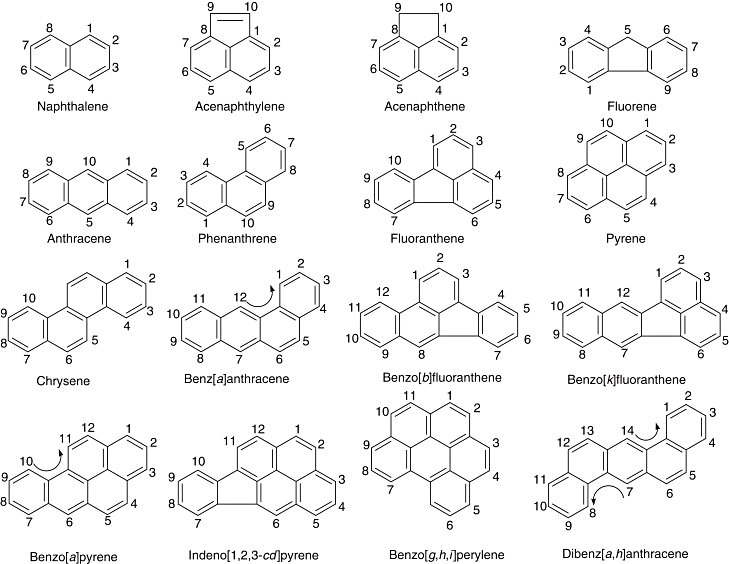
Polycyclic aromatic hydrocarbons (PAHs) are a large class of organic compounds made up of two or more fused benzene rings, ranging from simple two-ring naphthalene to complex structures containing up to ten rings.
Structure and Classification
PAHs consist solely of carbon and hydrogen atoms arranged in fused aromatic rings, without heteroatoms or substituent groups in their pure form. They are classified by size and ring arrangement:
-
Small PAHs: Up to six fused aromatic rings (e.g., naphthalene, anthracene, pyrene)
-
Large PAHs: More than six fused rings
-
Alternant PAHs: Composed solely of fused six-membered benzene rings
-
Nonalternant PAHs: Contain a mix of six-membered benzene rings and five-membered carbon rings
There are more than 100 different individual PAH compounds, and they typically occur as complex mixtures rather than single chemicals in real-world environments.
Physical and Chemical Properties
In their pure state, PAHs are solid at room temperature, generally colorless, white, or pale yellow-green, with a faint, sometimes pleasant odor. They characteristically exhibit:
-
Low volatility and low vapor pressure
-
High melting and boiling points
-
Very limited solubility in water (hydrophobic)
-
Susceptibility to photooxidation, allowing environmental breakdown into simpler compounds
Most PAHs are non-polar and planar, and many exhibit characteristic UV absorbance and fluorescence due to their extended π-electron conjugated structure, a property exploited in analytical detection methods.
Formation and Sources
PAHs form primarily through incomplete combustion of organic material — coal, oil, gas, wood, garbage, tobacco, and char-grilled food — via pyrolysis, where high heat generates free radicals that recombine (pyrosynthesis) into larger fused-ring structures. They also occur naturally in fossil fuels such as crude oil, coal, and coal tar, and are released into the environment through oil spills and other petrogenic sources. Common environmental exposure routes include vehicle exhaust, cigarette smoke, wood smoke, asphalt road fumes, and grilled or charred foods.
Priority Pollutant List
The U.S. EPA has designated 16 PAHs as priority pollutants due to their toxicity, prevalence, and environmental persistence, including naphthalene, acenaphthylene, anthracene, fluoranthene, pyrene, chrysene, benzo(a)pyrene, and benzo(g,h,i)perylene, among others. Benzo(a)pyrene is particularly notable as a recognized human carcinogen and is commonly used as a biomarker for overall PAH exposure.
Health Effects
Human exposure occurs primarily through inhalation of contaminated air, ingestion of PAH-laden food, or skin contact, after which the body converts PAHs into metabolites excreted via urine and feces. Several PAHs and specific PAH mixtures are classified as cancer-causing chemicals, and high-level occupational exposure (e.g., to naphthalene) has been linked to blood and liver abnormalities. PAHs are also implicated in DNA damage — for instance, benzo(a)pyrene, a major mutagen in tobacco smoke, forms covalent adducts with DNA that can initiate carcinogenesis.
Environmental Persistence and Occurrence
Because of their chemical stability, low water solubility, and high sorption capacity, PAHs persist in the environment and are commonly found in air, water, and soil, often bound to particulate matter that settles into soil and sediment "contaminant sinks". They rank among the most common contaminants of concern at U.S. Superfund sites, with roughly 40% of source remedies addressing PAH contamination in recent years. Interestingly, PAHs are not confined to Earth: they have also been detected in interstellar space, glowing in emission from regions illuminated by nearby stars.