Product
Kerosene
Segment
Refined Products
Main-Family
Refinery Liquids
Sub-Family
Middle Distll. & Proc. Hydroc.
Link
Insight Articles
#PS47

Description

Kerosene is a flammable hydrocarbon liquid distillate primarily derived from crude petroleum, consisting of a mixture of hydrocarbons with carbon chain lengths ranging from C₉ to C₁₆. It is a thin, clear to pale-yellow liquid with a characteristic, not-unpleasant odour, boiling between 150°C and 275°C (302°F–527°F). While kerosene can be extracted from alternative sources such as coal, oil shale, and wood, the overwhelming majority is produced via fractional distillation of crude oil in petroleum refineries.

Production

Kerosene is recovered during fractional distillation at temperatures intermediate between naphtha/gasoline (more volatile) and diesel fuel (less volatile). In the United States, kerosene accounted for approximately 8.5% by volume of petroleum refinery output in 2021, of which nearly all (8.4%) was kerosene-type jet fuel. Further refining and treatment steps — such as hydrotreatment — are applied to meet specific product grade specifications for smoke point, freeze point, and sulphur content.​

Composition

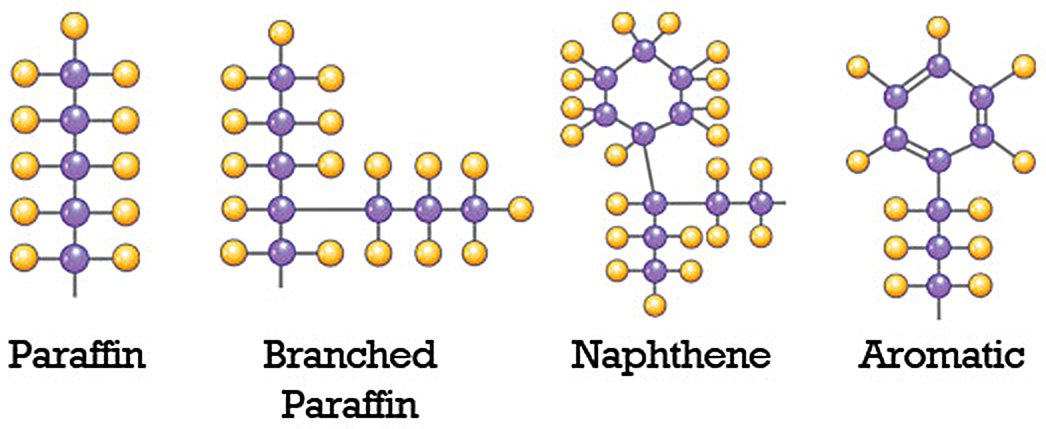
Kerosene is not a single chemical compound but a complex mixture of hydrocarbons, predominantly consisting of straight-chain and branched-chain alkanes (paraffins), cycloalkanes (naphthenes), and aromatic hydrocarbons with carbon numbers ranging from C₉ to C₁₆.

Figure 1 - Hydrocarbon types 

  • Paraffins typically make up the largest fraction and contribute positively to energy density and clean combustion
  • Naphthenes provide good cold-flow properties and stability.
  • Aromatic compounds, including alkylbenzenes and naphthalenes, are also present, though their concentration is deliberately limited in aviation-grade kerosene — typically to a maximum of 25% by volume — because high aromatic content increases smoke formation, reduces the smoke point, and can degrade elastomeric seals in fuel systems.
  • In addition, trace amounts of sulphur compounds, nitrogen compounds, and dissolved oxygen may be present in unrefined kerosene, and these are largely removed during hydrotreatment to meet product specifications for thermal stability and corrosion protection.

Physical & Chemical Properties

Property Value
Boiling Range 150°C – 275°C ​
Carbon Chain Length C₉ – C₁₆ ​
Flash Point 38°C – 72°C ​
Energy Density ~43 MJ/kg ​
Appearance Clear to pale yellow, low viscosity ​
Volatility Less volatile than gasoline; more volatile than diesel ​

Kerosene's relatively high flash point compared to gasoline makes it safer to handle and store, while its high energy density makes it highly efficient as a fuel. It is less explosive and more stable than lighter hydrocarbon fractions, reducing the risk of accidental ignition.​

Primary Uses

Aviation Fuel

Today, kerosene's dominant commercial application is as aviation turbine fuel. Standard commercial jet fuel (Jet A and Jet A-1) is essentially a high-quality straight-run kerosene, while many military jet fuels are kerosene-based blends. A highly refined form, RP-1, is used as rocket fuel, burned in combination with liquid oxygen. These aviation-grade kerosenes must meet strict specifications for smoke point, freeze point, and energy content.

Heating & Domestic Use

Kerosene remains a widespread heating and cooking fuel in many parts of the world, particularly in developing countries and off-grid communities. It is also used in domestic heaters, furnaces, and kerosene lamps. Before the widespread adoption of electric lighting, it was one of the most critical refinery products globally.​

Industrial & Solvent Applications

As a petroleum-miscible product, kerosene serves as an effective solvent capable of removing other petroleum products such as chain grease, and as a lubricant in conditions where the combustion risk of gasoline is unacceptable. Industrial uses include metal cleaning and degreasing, paint thinning, and as a coolant in metal production under oxygen-free conditions. In the petroleum industry itself, kerosene is used as a synthetic hydrocarbon for corrosion experiments to simulate crude oil in field conditions.

Other Applications

  • Power generation: Used in backup generators and off-grid power systems due to its stability and energy density​
  • Agriculture: Historically used in pesticide and insecticide formulations, and to fuel irrigation pumps​
  • Construction: Used in asphalt and bitumen production to enhance workability and durability of road mixtures​
  • Automotive maintenance: Applied as a lubricant and penetrating oil to loosen corroded components​


References

  1. Wikipedia. Kerosene (page version: Dec 22, 2025)
  2. Encyclopedia Britannica. kerosene (page version: Dec 12, 2025)
  3. UK Health Security Agency (Oct 14, 2024). Kerosene: general information
  4. Taki A, Alliance Chemical (Dec 2, 2024). The Versatility of Kerosene
  5. Bellman Oil Co. (Apr 12, 2024). What is Kerosene?
  6. Hudson M., Invest Oil (Jun 5, 2023). What Are the Main Use of Kerosene Oil? (Industrial to Agricultural Applications)

Insight Articles
Your insights will be shown here

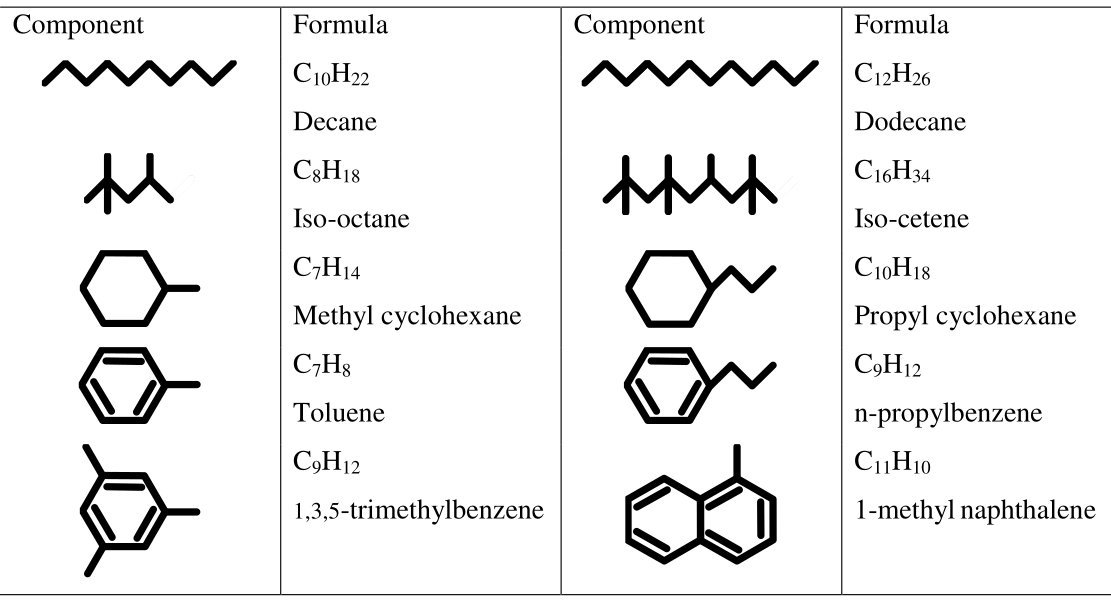
Typical components of jet fuels https://www.researchgate.net/figure/Suggested-components-for-the-formulation-of-the-surrogates-for-jet-fuels-Proposed_tbl1_286448688
Settings

Status
A
Unit of Measure
Barrels
Physical State

Liquid

Content provided by
Transaction Name Date
Modified by UserPic  Kokel, Nicolas 2/18/2026 8:02 PM
Added 2/18/2021 11:16 AM
Map of Kerosene Products producing locations in ppPLUS

ppPLUS Insights: Please register to view the Map!
Production Analysis