Product
Iron Ores
Segment
Extractive Industry Products
Main-Family
Ores
Sub-Family
Metallic Ores
Link
Insight Articles
#PS761

Description

Iron ores are naturally occurring rocks and minerals from which metallic iron can be economically extracted and refined. They are the foundational raw material for the global iron and steel industry, which consumes over 2 billion tonnes of iron ore annually. An ore qualifies as economically viable when its iron (Fe) content — determined by the mineralogy and degree of gangue (waste mineral) dilution — is sufficient to justify mining, beneficiation, and smelting costs.​

Definition & Qualifying Criteria

Not all iron-bearing rocks constitute ore. Commercial viability depends on three factors:​

  • Fe grade — direct-shipping ores (DSO) typically require ≥58% Fe; lower-grade ores require beneficiation
  • Mineralogy — the iron-bearing phase determines reducibility, beneficiation route, and sinter/pellet behaviour
  • Gangue composition — silica, alumina, phosphorus, and sulphur content must meet steelmaking specifications

Principal Ore-Forming Minerals

The iron minerals currently used as commercial ores are:

Mineral Formula Theoretical Fe% Typical Ore Fe% Notes
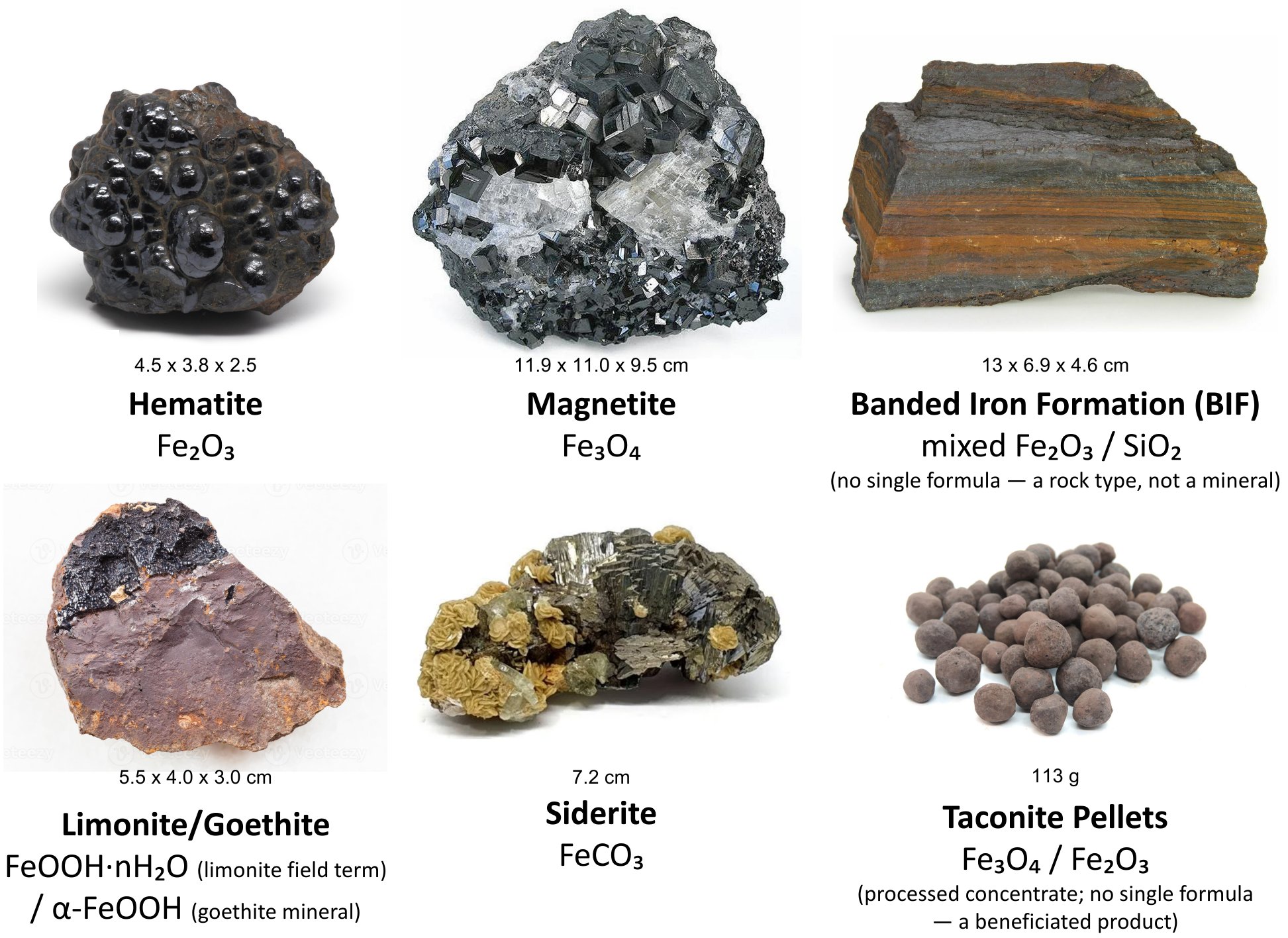
Hematite α-Fe₂O₃ 70% 58–65% Primary DSO ore; best reducibility
Magnetite Fe₃O₄ 72.4% 25–40% (concentrate
65–68%)
Requires beneficiation; superior for DRI
Goethite α-FeOOH 63% 50–60% Major component of limonite/pisolitic ores
Limonite FeOOH·nH₂O Up to 60% 45–55% Field term for mixed goethite assemblages
Siderite FeCO₃ 48.2% 30–40% Iron carbonate; less common commercially


Deposit Types

Iron ore deposits are classified into four principal geological types:

  • Banded Iron Formations (BIFs) — Precambrian sedimentary sequences of alternating iron oxide and silica bands; the world's largest iron ore resource, hosting the great deposits of the Pilbara (Australia), Carajás (Brazil), and Kryvyi Rih (Ukraine)
  • Massive hematite / DSO deposits — high-grade, largely unprocessed hematite derived from enriched BIFs; mined directly without beneficiation
  • Magnetite deposits — typically lower Fe grade at the mine but upgradeable to superconcentrates (>68% Fe) via magnetic separation; formed by magmatic segregation, BIF metamorphism, or contact metasomatism
  • Pisolitic ironstone / laterite — goethite-dominated ores formed by deep tropical weathering; significant in Australia's Pilbara region

Hematite vs. Magnetite — Key Distinctions

These two ore types dominate global iron ore trade and have distinctly different processing requirements:

Property Hematite Ore Magnetite Ore
Run-of-mine Fe grade 58–62% 25–40%
Processing required Minimal (DSO) Extensive beneficiation
Product Fe grade 58–65% 65–68% (concentrate)
Reducibility Good Moderate
Suitability for H₂-DRI Moderate Excellent (high concentrate purity)
Key deposits Pilbara, Carajás, Sishen Kiruna, Zanaga, Sino Iron


Relationship to Iron Oxides

Iron ores are the geological and economic manifestation of iron oxides — they are not chemical compounds in their own right but mineral assemblages dominated by one or more iron oxide phases. Hematite ore is essentially massive α-Fe₂O₃ with gangue impurities; magnetite ore is Fe₃O₄-dominant rock requiring physical upgrading. Goethite and limonite ores reflect α-FeOOH-dominated weathering profiles. Siderite (FeCO₃) is the only major iron ore mineral that is not an oxide.

Global Significance

World iron ore production exceeds 2.5 billion tonnes per year, with Australia and Brazil alone accounting for over 60% of global exports. Iron ore is the second most traded commodity in the world by volume after crude oil, and hematite and magnetite together underpin virtually all primary steel production globally.


References

  1. The Assay (May 2, 2023). The Assay Guide to Iron Ore
  2. LANScientific (Sep 22, 2021). Take you to understand the types of iron ore in one minute!
  3. David, 911Metallurgist (Oct 6, 2016). Different Types of Iron Ore
  4. Wikipedia. 2.1 billion-year-old rock with black-band ironstone
  5. M. Pistilli, Investing News Network (Feb 4, 2025). Types of Iron Ore: Hematite vs. Magnetite
  6. JXSC (Jun 12, 2024). Mastering Hematite vs Magnetite: Expert Guide
  7. Government of South Australia — Department for Energy and Mining (Apr 8, 2022). Iron Ore
  8. Fortune Business Insights Feb 9, 2026). Report FBI108698: Iron Ore Market Size, Share & Industry Analysis

Insight Articles
Your insights will be shown here

Typical iron ore specimens | Various sources
Settings

Status
A
Unit of Measure
Metric Ton
Physical State

Solid

Content provided by
Transaction Name Date
Modified by UserPic  Kokel, Nicolas 2/28/2026 7:56 PM
Added 2/27/2026 8:40 PM