
Product
Magnetite
Insight Articles
#PS760
Main Product
Iron Ores
Segment
Extractive Industry Products
Main-Family
Ores
Sub-Family
Metallic Ores
Physical State

Solid

Description

Magnetite is the world's most magnetic naturally occurring mineral and one of the two primary iron ores, alongside hematite. Named after the ancient region of Magnesia (Greece) where it was first described, it is the natural mineral form of iron(II,III) oxide (Fe₃O₄) and the ore with the highest theoretical iron content of any commercially mined mineral at 72.4% Fe.

Ore Identity

Property Value
Mineral Name Magnetite
Chemical Formula Fe₃O₄ (FeO·Fe₂O₃)
Theoretical Fe Content 72.4%
Typical Run-of-Mine Fe Grade 25–40%
Concentrate Fe Grade 65–68%
Color Jet black
Streak Black
Hardness (Mohs) 5.5–6.5
Density 5.18–5.20 g/cm³
Luster Metallic to submetallic
Magnetism Strongly ferrimagnetic
Crystal System Cubic (inverse spinel)
Crystal Habit Octahedral; massive; granular
Cleavage None; uneven fracture


Geological Occurrence

Magnetite forms across igneous, metamorphic, and sedimentary environments and is one of the most widely distributed iron oxide minerals on Earth. Its principal ore-forming settings are:

  • Banded Iron Formations (BIFs) — the dominant source of commercial magnetite ore; Precambrian metasedimentary sequences in which magnetite and hematite alternate with chert/silica bands; major BIF-hosted magnetite deposits include Zanaga (Congo), Sino Iron (Australia), and the Labrador Trough (Canada)
  • Magmatic/skarn deposits — magnetite segregated from cooling igneous intrusions or formed by metasomatic reaction between igneous rocks and carbonate country rocks; examples include Kiruna (Sweden), El Laco (Chile), and Kachar (Kazakhstan)
  • Taconite — low-grade BIF ore (~25–30% Fe) containing a mixture of magnetite, hematite, and chert; once considered waste, now the dominant iron ore type in North America after high-grade DSO deposits were depleted​
  • Placer / heavy mineral sand — concentrations of detrital magnetite in fluvial and beach sands; exploited on a limited scale in some regions
  • Volcanic accumulations — magnetite phenocrysts concentrated in volcanic flows; significant deposits in the Atacama Desert, Chile

Key Global Deposits

Deposit Country Notes
Kiruna Sweden ~28 Mt/yr; magmatic
apatite-magnetite ore
Sino Iron Australia ~24 Mt/yr; Pilbara BIF-hosted;
world's largest magnetite project
Labrador Trough Canada Major BIF-hosted; primary
North American source
Zanaga Congo Large undeveloped
BIF deposit
Kachar & Sarbai Kazakhstan Large skarn-hosted
magnetite deposits
El Laco Chile Volcanic magnetite;
Atacama Desert


Distinguishing Characteristic: Lodestone

Naturally magnetised specimens of magnetite — known as lodestone — were humanity's first encounter with magnetism, used in primitive compasses as early as 600 BC in China and Greece. Lodestone forms when magnetite is struck by lightning or subjected to the geomagnetic field during slow cooling, permanently magnetising the mineral.​

Mining & Beneficiation

Unlike hematite's direct-shipping ores, magnetite typically requires extensive beneficiation before use in steelmaking:

  1. Crushing & grinding — ore is ground to liberate magnetite grains from silica gangue
  2. Wet magnetic separation (LIMS/MIMS) — low/medium-intensity magnetic separators exploit magnetite's ferrimagnetism to separate it from non-magnetic gangue minerals
  3. Flotation / reverse flotation — further removal of silica and other contaminants
  4. Filtration & drying — concentrate dewatered to ~8–10% moisture
  5. Pelletising — concentrate balled into ~10–12 mm pellets and indurated (hardened) for blast furnace or DRI use

The beneficiation process is energy-intensive but yields high-purity concentrates (65–68% Fe), which are superior to most hematite DSO ores for hydrogen-based direct reduction ironmaking (H₂-DRI) — making magnetite concentrates strategically important for green steel production.​

Steel Industry Role

Magnetite ore is reduced to metallic iron through the same stepwise sequence as hematite:

Fe₃O₄ → FeO → Fe

In blast furnaces, magnetite pellets are a premium burden material due to their high Fe grade and low impurity levels. In DRI reactors (Midrex, HYL/Energiron), high-purity magnetite pellets are the preferred feedstock for natural gas and hydrogen reduction.

Applications Beyond Steelmaking

  • Dense media separation (DMS) — finely ground magnetite suspended in water creates a dense medium for gravity separation of coal and minerals; easily recovered by magnetic separation for reuse​
  • Pigments — black iron oxide pigment (PBk11) for paints, coatings, and construction materials
  • Water treatment — magnetic separation of contaminants and heavy metals from wastewater
  • Catalysis — catalyst and support in Haber–Bosch and Fischer–Tropsch processes
  • Biomedical — superparamagnetic nanoparticles used as MRI contrast agents and in targeted drug delivery


References

  1. Siim, Sandatlas. Magnetite: A Magnetic Iron Ore (Page version Jul 30, 2025)
  2. Hapugoda S., Manuel J.R., Lu L., Peterson M. J., & Donskoi, E. (2013). Characterisation of magnetite iron ore. The Australasian Institute of Mining and Metallurgy (AusIMM)
  3. King H.M., Geology.com. Magnetite and Lodestone (Accessed Feb 28, 2026)
  4. Wikipedia. Magnetite (Page version Feb 24, 2026)
  5. JXSC (Jun 12, 2024). Mastering Hematite vs Magnetite: Expert Guide
  6. de Jesus Andrade Fidelis, R., Pires, M., de Resende, D. S., Costa Lima, G. F., de Paiva, P. R. P., & da Silva Bezerra, A. C. (Feb 15, 2025). Magnetite: Properties and applications – A reviewJournal of Magnetism and Magnetic Materials, 614, 172770. DOI: 10.1016/j.jmmm.2025.172770

Insight Articles
Your insights will be shown here

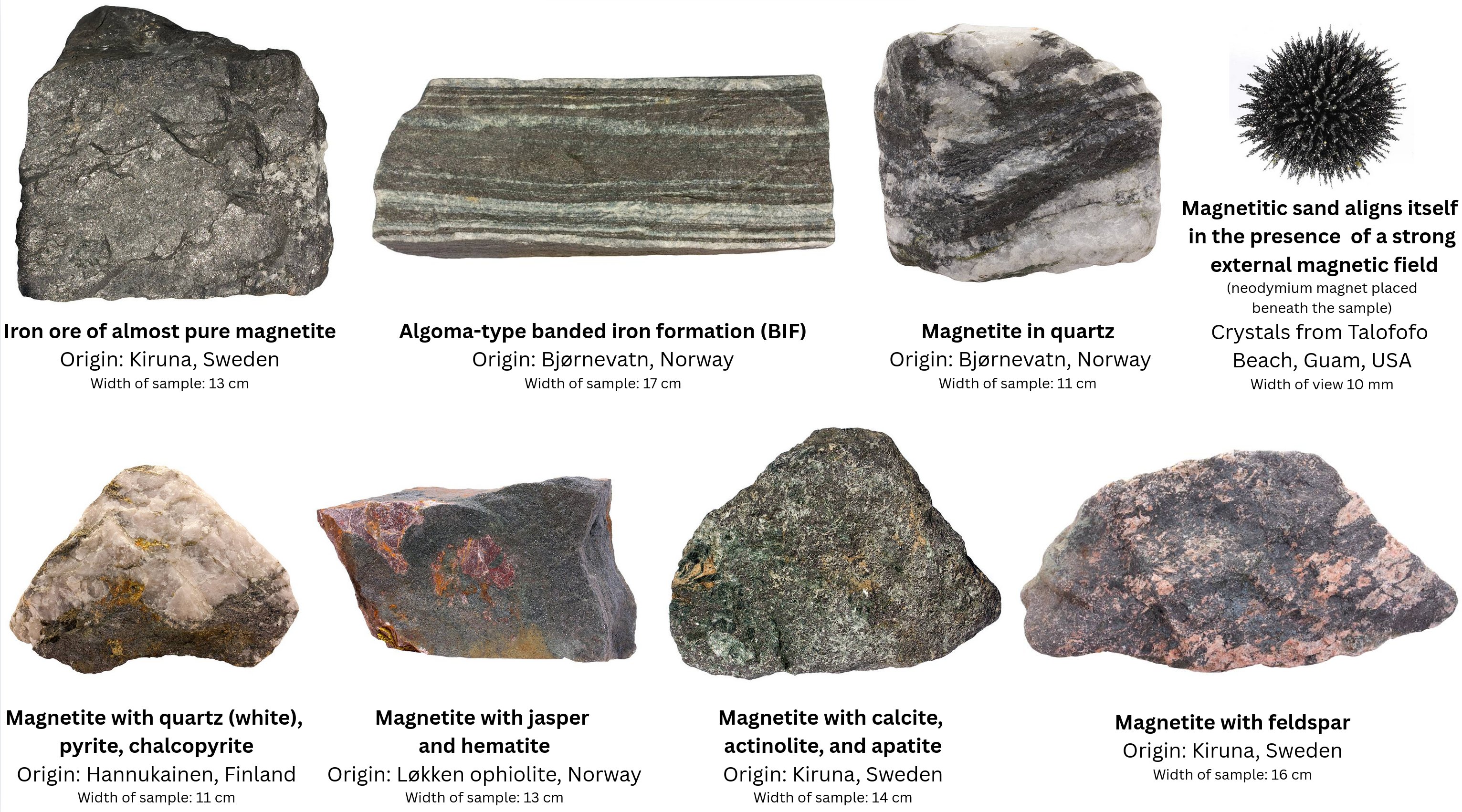
Various magnetite specimens https://sandatlas.org/magnetite/
Identifiers

logo CAS Number
1317-61-9
logo EC Number
215-277-5
logo ECHA InfoCard
100.013.889
logo IUPAC Name
Triiron tetraoxide
logo PubChem ID
16211978
Chemical Data

Chemical Formula

Fe3O4

Molecular Weight (g/mol)
231.53
Melting Point (°C)
1597
Specific Gravity
5.19
Crude Data

API Gravity
-104.24
Country
Product Settings

Default
Status
A
Content provided by
Transaction Name Date
Modified by UserPic   Kokel, Nicolas 2/28/2026 7:57 PM
Added by UserPic   Kokel, Nicolas 2/27/2026 8:40 PM