Product
Coke
Segment
Refined Products
Main-Family
Refinery Residues
Sub-Family
Coal & Petroleum Residues
Link
Insight Articles
#PS244

Description

Coke is a solid, high-carbon fuel and industrial reductant produced by the thermal treatment of carbonaceous feedstocks — primarily coal or petroleum — in the absence of air, a process known as destructive distillation or carbonisation. The process drives off volatile matter (water, hydrocarbons, tar, and gases), leaving behind a dense, porous carbon mass with a carbon content typically ranging from 85% to over 99% depending on the type and degree of processing.​

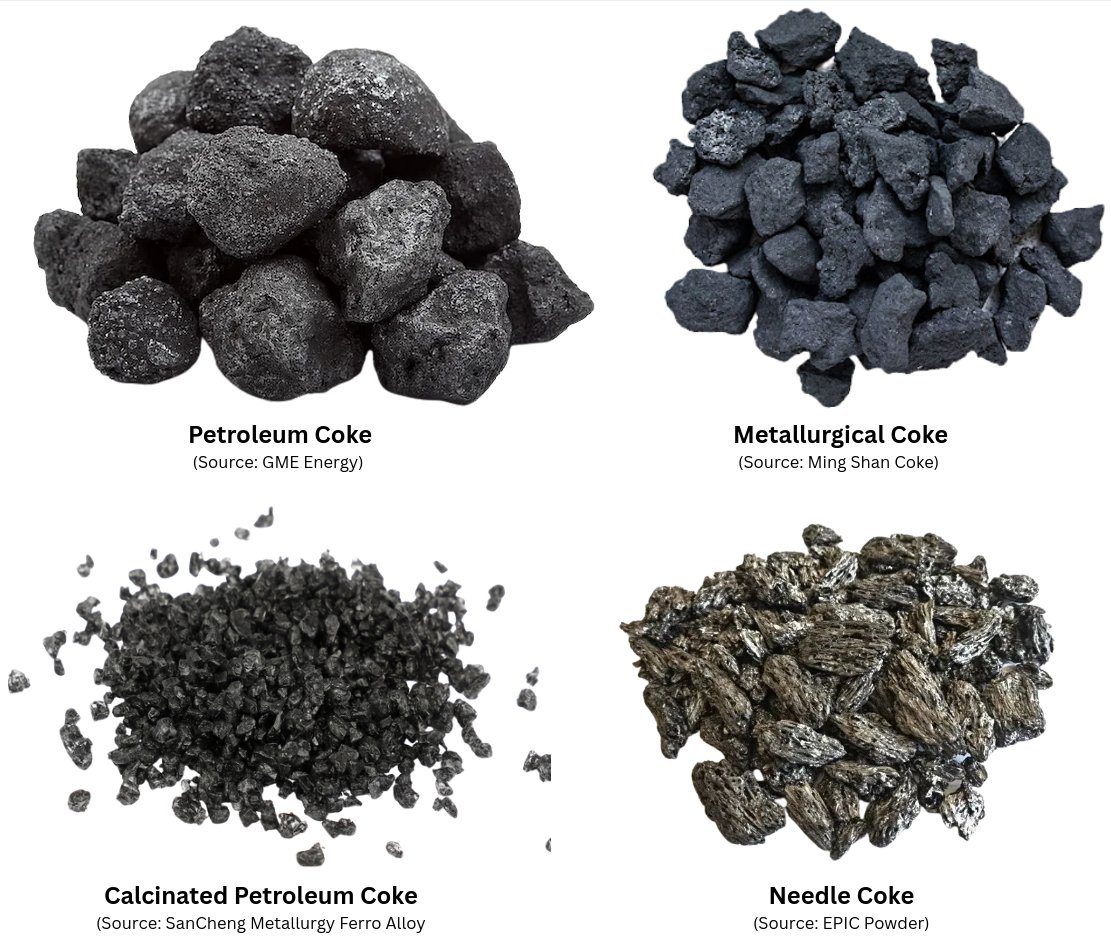
The term "coke" covers a family of distinct products with significantly different origins, properties, and end uses. The unqualified term generally refers to metallurgical coke — produced from bituminous coal and used primarily as a reductant and structural support medium in blast furnaces for iron and steel production. However, the broader coke family also includes petroleum coke (a refinery by-product of crude oil processing) and needle coke (a premium grade used in graphite electrode manufacture), each with distinct characteristics and markets.

Principal Types

Type Feedstock Primary Use
Metallurgical coke Bituminous coal Blast furnace ironmaking;
foundry
Petroleum coke (green) Heavy crude oil residues Fuel; feedstock for
calcined coke
Calcined petroleum coke Green petroleum coke Carbon anodes;
aluminium smelting
Needle coke Coal tar / decant oil Graphite electrodes;
EAF steelmaking


Common Properties

Across all types, coke is characterised by:

  • High carbon content — ranging from ~85% (metallurgical coke) to >99% (calcined petroleum coke)
  • Porosity — the release of volatile matter during carbonisation leaves a porous, sponge-like structure
  • High mechanical strength — particularly in metallurgical coke, which must support the burden of iron ore and flux in the blast furnace
  • Low reactivity — essential for applications requiring stable, predictable combustion or reduction behaviour
  • Low sulphur and ash — critical quality parameters for high-grade applications; sulphur transfers to the metal in steelmaking and aluminium production

Industrial Significance

Coke is one of the most strategically important industrial materials globally. Metallurgical coke is consumed at a rate of approximately 340–380 kg per tonne of pig iron produced in blast furnaces, making it indispensable to the iron and steel industry. Petroleum coke is generated in volumes exceeding 150 million tonnes per year globally as an unavoidable refinery by-product, and its upgrading to calcined coke underpins the entire primary aluminium industry. Needle coke is a critical material for the graphite electrodes that power electric arc furnaces — the cornerstone of the growing scrap-based steelmaking route.


References

  1. British Academy for Training & Development (Jan 1, 2024). Petroleum Coke Explained: Production, Types, and Key Applications in Industry
  2. Wikipedia. Coke (fuel) (Page version Mar 2, 2026)
  3. Britannica. coke (Page version Aug 28, 2008)
  4. Wikipedia. Petroleum coke (Page version Jul 6, 2025)
  5. China Petrochemical Corporation (SINOPEC). Petroleum Coke (Accessed Mar 3, 2026)
  6. Falih S., Al-Mustaqbal University College. Properties of Petroleum Fuels — Petroleum Coke (Document date: May 12, 2020)
  7. Spherical Insights (Dec 2025). Report SI16754: Global Petroleum Coke Market
  8. World Steel Association (AISBL) (Mar 2023). Fact sheet: Steel and raw materials

Insight Articles
Your insights will be shown here

Coke types: petcoke, metallurgical coke, calcinated petcoke, needle coke
Settings

Status
A
Unit of Measure
Metric Ton
Physical State

Solid

Content provided by
Transaction Name Date
Modified by UserPic  Kokel, Nicolas 3/3/2026 2:02 PM
Added 11/9/2021 11:11 AM
Map of Coke Products producing locations in ppPLUS

ppPLUS Insights: Please register to view the Map!
Production Analysis