The Sinopec new-generation ED of butadiene removes the 2nd distillation/stripper systems
- Technology
- Sinopec Butadiene ED

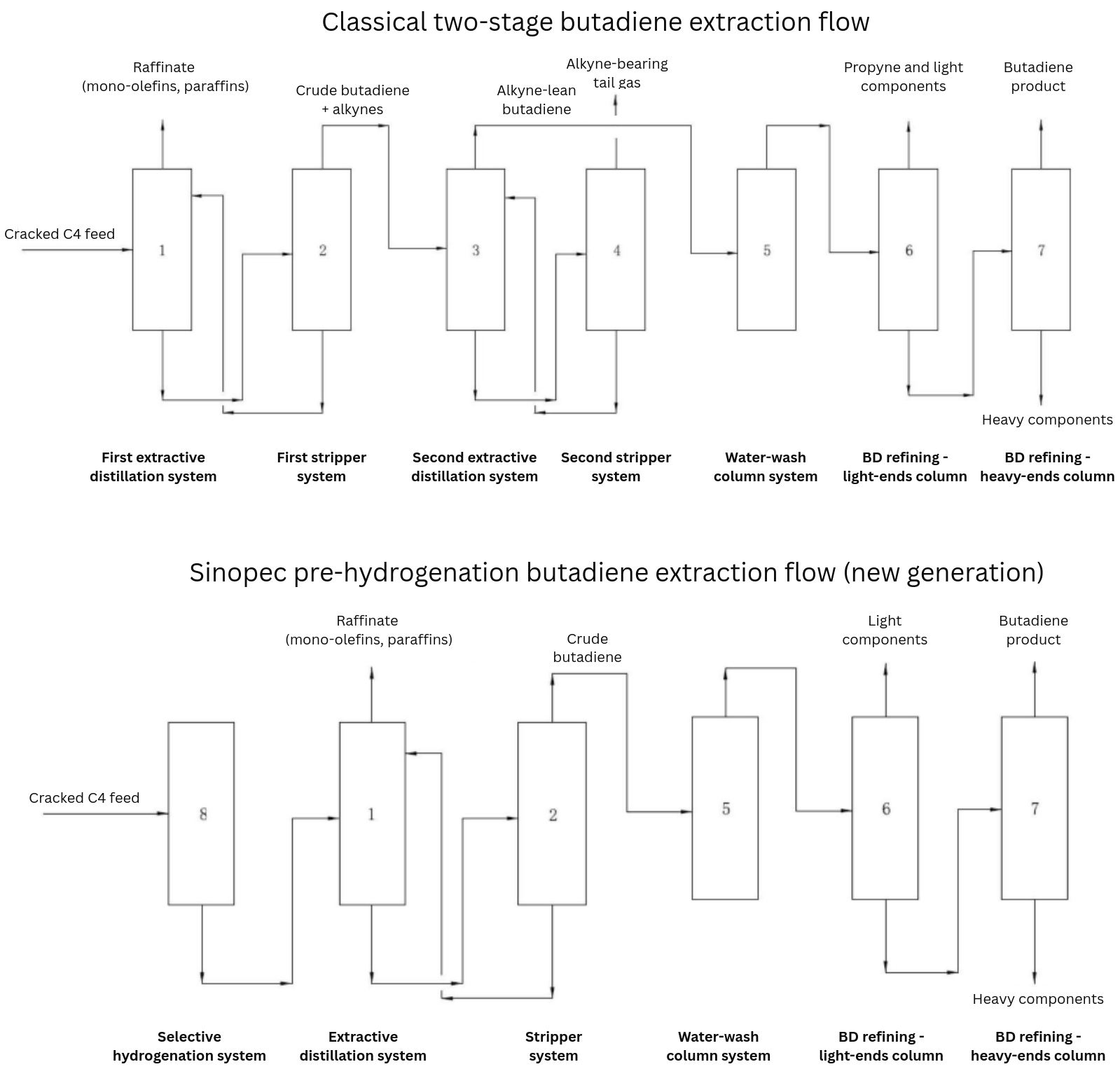
Sinopec New Generation vs Two-stage Extractive Distillation of Butadiene with Acetonitrile
Sinopec's butadiene extraction technology is the new-generation acetonitrile (ACN) extractive-distillation process developed and owned within the Sinopec system — the process and solvent-regeneration innovations by Sinopec Engineering (SEI) / Sinopec Engineering Group (SEG) under granted patents CN115925504B (2025) and CN116217434B (2026), and the hydrogenation catalysts by Sinopec Beijing Research Institute of Chemical Industry (BRICI) and its Yanshan Branch under the C4 selective-hydrogenation patent CN102731240B (2014) and the YN-series nickel-based catalyst family.
Building on China's first ACN extraction unit (Lanzhou, 1971), the technology's defining advances over the classical ACN flow are architectural: a selective-hydrogenation step converts vinyl acetylene to butadiene before extraction, allowing the second extractive-distillation and second stripping systems of the traditional design to be deleted (≈15% of unit energy, or 33 kgEO/t on a 220 kgEO/t base, per the patent example), while an independent low-pressure solvent-regeneration unit holds circulating acetonitrile free of alcohols, ketones and polymers without vacuum operation or periodic solvent replacement.
Polymer-grade product reaches 99.5–99.9 wt% purity, with a modern design benchmark of ≤240 kg standard-oil-equivalent per tonne of butadiene. This profile compares the route neutrally and agnostically with the three classic imported technologies — ZEON's GPB (DMF), BASF's NMP and JSR's improved ACN — on verifiable parameters only.
Continue reading here.
#acetonitrile #butadiene #extraction #extractivedistillation #raffinate #sinopec #selectivehydrogenation