Sinopec's butadiene extraction technology is the new-generation acetonitrile (ACN) extractive-distillation process developed and owned within the Sinopec system — the process and solvent-regeneration innovations by Sinopec Engineering (SEI) / Sinopec Engineering Group (SEG) under granted patents CN115925504B (2025) and CN116217434B (2026), and the hydrogenation catalysts by Sinopec Beijing Research Institute of Chemical Industry (BRICI) and its Yanshan Branch under the C4 selective-hydrogenation patent CN102731240B (2014) and the YN-series nickel-based catalyst family.
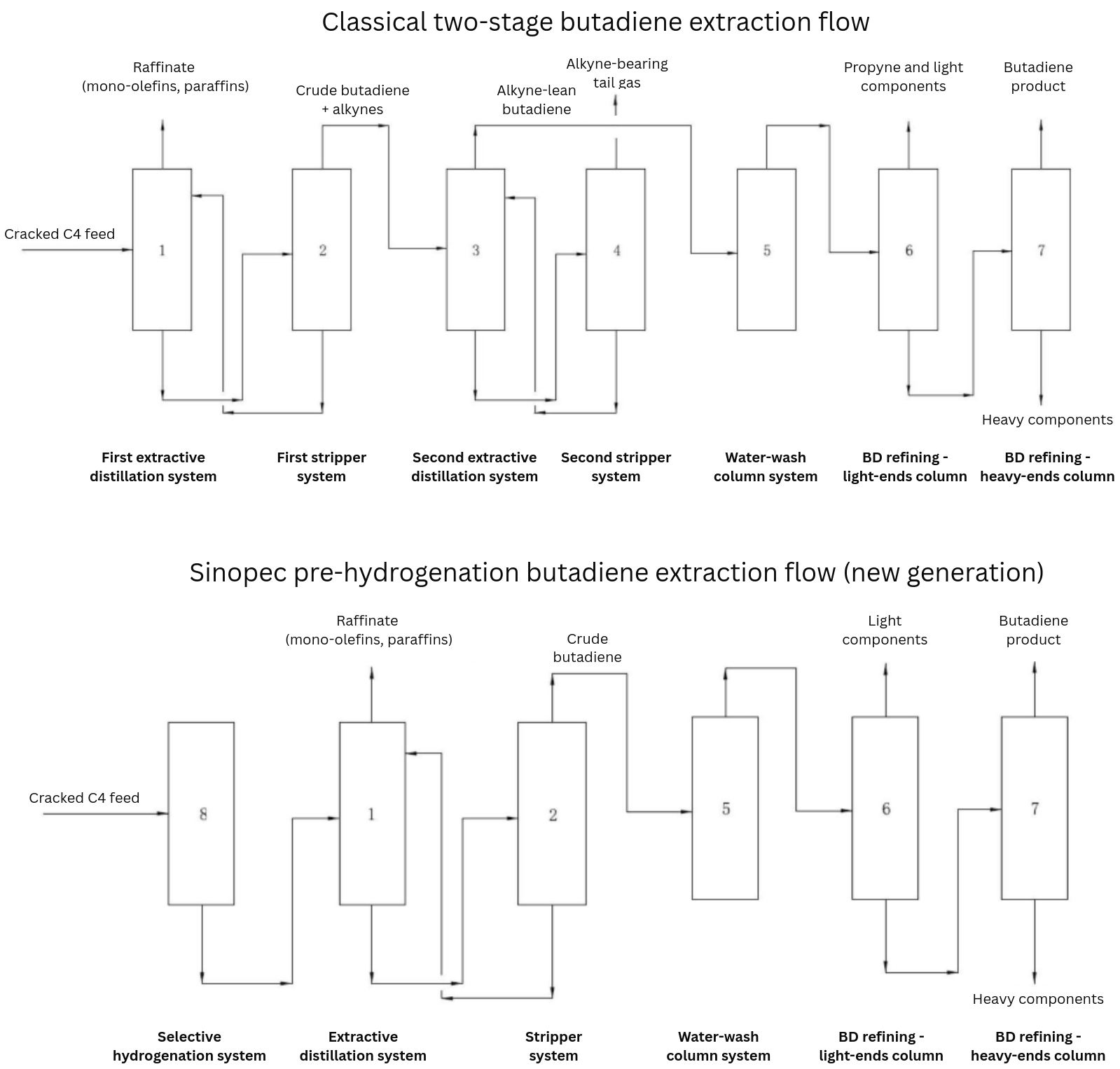
Building on China's first ACN extraction unit (Lanzhou, 1971), the technology's defining advances over the classical ACN flow are architectural: a selective-hydrogenation step converts vinyl acetylene to butadiene before extraction, allowing the second extractive-distillation and second stripping systems of the traditional design to be deleted (≈15% of unit energy, or 33 kgEO/t on a 220 kgEO/t base, per the patent example), while an independent low-pressure solvent-regeneration unit holds circulating acetonitrile free of alcohols, ketones and polymers without vacuum operation or periodic solvent replacement.
Polymer-grade product reaches 99.5–99.9 wt% purity, with a modern design benchmark of ≤240 kg standard-oil-equivalent per tonne of butadiene. This profile compares the route neutrally and agnostically with the three classic imported technologies — ZEON's GPB (DMF), BASF's NMP and JSR's improved ACN — on verifiable parameters only.
1. Ownership and Licensing Position
The new-generation ACN extraction technology is owned within the Sinopec system by three complementary holders, documented by granted Chinese patents:
- Sinopec Engineering Inc. (SEI) / Sinopec Engineering Group — assignee of the pre-hydrogenation extraction patent CN115925504B (filed 2021-09-27, granted 2025-07-25; inventors Geng Qiang, Wang Xinquan, Ma Liguo, Hou Xiahui) and of the ACN solvent-regeneration patent CN116217434B (filed 2021-12-06, granted 2026-05-15; inventors Yang Guangyao, Chen Gang, Jia Kun, Hou Xiahui, Pi Yuxi, Ding Wenyou)[1][2]. SEI is the process-engineering arm that packages Sinopec extraction technology; a formal, dated licensing announcement could not be located and is flagged as unverified.
- Sinopec Beijing Research Institute of Chemical Industry (BRICI) and its Yanshan Branch — owner of the C4 selective-hydrogenation patent family (CN102731240B, granted 2014; assignee BRICI + Sinopec Corp.) and developer of the YN-series nickel-based hydrogenation catalysts[3][4].
- Sinopec Corp. — co-assignee throughout.
The classical (first-generation) ACN technology in China predates these patents: China's first ACN extractive-distillation unit was designed by PetroChina Lanzhou Petrochemical and commissioned in 1971 at 12,500 t/a, followed by similar units at Yanshan, Jilin and Qilu; domestic ACN flows use water-containing (5–10 wt%) acetonitrile with two-stage extractive distillation[5]. Internationally, the ACN route originates with Shell (industrialised 1956) and was improved by Japan Synthetic Rubber (JSR), whose 10 wt%-water two-stage design is acknowledged in Sinopec's own patent literature as one of the three most competitive extraction routes[5][6].
2. Process History
- 1956 — Shell (ACN): acetonitrile extractive distillation of cracked C4 industrialised by Shell; US3772158A describes ACN with ~10 wt% water[5][8].
- JSR (improved ACN): JSR licensed Shell's ACN process and improved it through flow-integration/complex-column techniques; two-stage extractive distillation with 10 wt% water ACN — recognised by Sinopec patent CN103588609A as among the three most competitive routes[5][6].
- 1971 — first Chinese ACN unit: Lanzhou Petrochemical (CNPC) designs and commissions China's first ACN extraction unit, 12,500 t/a; Yanshan, Jilin and Qilu follow[5].
- 2011–2014 — selective hydrogenation of cracked C4: BRICI patents CN102731240A/B (filed 2011-04-02, granted 2014-05-28): two-stage fixed-bed selective hydrogenation of cracked C4 (0.5–2.0 wt% vinyl acetylene) over Pd-Pb/La-Al₂O₃, total acetylenes <15 ppm with minimal BD loss, explicitly to eliminate the second extractive distillation; the patent background credits DOW's KLP copper-catalyst technology as the pioneering commercial approach[3].
- 2019 — first BD tail-gas selective hydrogenation: Zhenhai Refining starts up China's first butadiene tail-gas (raffinate off-gas) selective-hydrogenation unit (18 kt/a BD recovery, first ACN-based tail-gas processing in China, October 2019) using BRICI's YN-2S catalyst[4][11].
- 2021–2026 — new-generation package: SEI files CN115925504B (pre-hydrogenation extraction, granted 2025) and CN116217434B (ACN solvent regeneration, granted 2026), integrating selective hydrogenation upstream of a single extraction train and adding an independent low-pressure solvent-regeneration unit[1][2].
- 2024 — Tianjin Nangang: 1.2 Mt/a ethylene complex one-shot startup 11 November 2024 including a 150 kt/a butadiene unit; extraction technology attribution unverified[7].
- 2026 — Zhongke (Guangdong) calibration: BRICI-led C4 alkyne-hydrogenation complete technology with YN-2S passes its 72-hour calibration at Zhongke Refining (110% load, vinyl-acetylene conversion >80%, 1,3-BD selectivity 11 points above design guarantee); third YN-2S application after Zhenhai and Tianjin[12][13].
- 2026 — Qilu 150 kt/a unit: EPC tender for Qilu Petrochemical's new 150 kt/a butadiene extraction unit (Luyou-Lulian transformation project) with contract estimate RMB 233.7306 million (tax excluded), bid opening 12 October 2026, 600-day schedule; no award result located[14].
3. Process Summary and Chemistry
Butadiene is recovered from steam-cracker mixed C4 by extractive distillation: a polar solvent changes the relative volatility of C4 components so that less-soluble alkanes/butenes (raffinate) separate from butadiene and alkynes (extract), which are then stripped, washed and refined. The three commercial solvents are acetonitrile (ACN, bp 81.6 °C), N,N-dimethylformamide (DMF, bp 152.8 °C) and N-methylpyrrolidone (NMP, bp 202 °C); published comparisons rank transport electricity demand ACN : DMF : NMP = 64 : 119 : 178 kWh/t, with NMP operated with ~8% water to prevent coking and DMF run anhydrous[15].
Selective hydrogenation (the new-generation differentiator): vinyl acetylene (VA) in cracked C4 is selectively hydrogenated to butadiene (and 1-butene) before extraction, so the alkyne load reaching the solvent loop drops and the classical second extraction + second stripping pair — whose function is alkyne rejection — can be removed:
CH≡C–CH=CH₂ (VA) + H2 → CH2=CH–CH=CH2 (1,3-BD) / CH2=CH–CH2–CH3 (1-butene)
Patent CN115925504B quantifies the design intent: VA effective removal (selectivity × conversion) ≥99 wt%, preferably ≥99.9 wt%; butadiene loss ≤5 wt%, preferably ≤3 wt%; hydrogenation at 20–40 °C, 0.5–1.0 MPaG, bed ΔT 5–25 °C, H₂/alkyne 0.5–5:1, recycle 0–3:1, WHSV 0.2–3 h⁻¹, over nickel-based (preferred, non-noble) or Pd catalysts; the stabiliser column removes ≥99% of C5s (a key polymerisation initiator) plus non-condensables[1].
Solvent chemistry (ACN): acetonitrile is fully water-miscible and forms a water azeotrope, hence the water-wash/solvent-recovery section. During circulation it accumulates C4, methanol/ethanol/isopropanol/acetone and butadiene di-/oligomers, which degrade extractive performance and cause foaming, flooding and tray fouling by polymer — the documented driver for the independent regeneration unit of CN116217434B[2].
4. Step-by-Step Process Description (reconstructed from CN115925504B and CN116217434B)
The classical ACN/DMF flow (patent background): first extractive distillation separates mono-olefins/paraffins from dienes+alkynes; second extractive distillation plus second stripping rejects alkynes; water wash removes solvent; refining (light-ends/heavy-ends columns) yields polymer-grade product[1]. The Sinopec new-generation flow is:
- Feed pre-treatment and selective hydrogenation. Cracked C4 (BD 20–70 wt%, typically 40–55; VA 0.1–10 wt%, typically 0.5–5) is mixed with hydrogen and fed to the selective-hydrogenation reactor over a nickel-based catalyst (patent example: 30 °C, 0.6 MPaG, ΔT 5 °C, H₂/(alkyne+diene) = 1 mol/mol, recycle 1:1, WHSV 0.5 h⁻¹). An optional recycle loop (separator, pump, cooler) dilutes reactor-inlet VA concentration, limiting temperature rise and extending catalyst regeneration cycles[1].
- Stabiliser. Reactor effluent enters the stabiliser (0.4–1.0 MPaG, top 35–80 °C, 20–80 trays, reflux 5–50): non-condensables (cracked gas, excess H₂) leave overhead; C5 and green-oil heavies leave bottoms (≥99% C5 removal — polymerisation risk reduction); the side draw, hydrogenated C4, feeds the extraction section[1].
- First extractive distillation (single stage). Aqueous ACN (5–10 wt% water) extracts butadiene; raffinate (butanes/butenes) leaves overhead. With alkynes largely pre-converted, the second extraction and second stripping systems of the classical flow are deleted[1][5].
- First stripping. Rich solvent is stripped; overhead mixed C4 (butadiene-rich) goes to the water wash; lean solvent returns to the extractor[1].
- Water wash and solvent recovery. Residual ACN is washed out; the ACN–water azeotrope is resolved in the solvent-recovery section[2].
- Refining. A light-ends column removes methyl acetylene and lights; a heavy-ends column removes 1,2-butadiene and C5s; polymer-grade 1,3-butadiene (patent example purity 99.9 wt%) leaves overhead[1].
- Independent low-pressure solvent regeneration (CN116217434B). A slipstream of circulating ACN (85–95 wt% ACN, 1–5 wt% lights, 0.2–2 wt% polymers, balance water) is fed mid-column to a light-removal tower (40–90 trays, reboiler 80–150 °C, top 0.01–0.5 MPaG, reflux 15–50): C4, alcohols and acetone leave overhead as azeotrope to waste. Bottoms feed a heavy-removal tower (6–20 trays, reboiler 85–155 °C, top 0.01–0.3 MPaG, no reflux): polymers leave bottoms; regenerated solvent returns to extraction. Operation is atmospheric/near-atmospheric (no vacuum), continuous or intermittent (annual campaign, 7–14 days). Verified example: 160 kt/a unit, 600 t solvent inventory, 332 t/h circulation, 3 t/h slipstream — alcohols/ketones 3.03 → 0.06 wt%, polymers 0.47 → 0.1 wt%, ACN loss 2.24% of regenerated solvent; regeneration cost RMB 478/t solvent vs RMB 9.0 M full-solvent replacement after four years (≈RMB 7.9 M saved over four years)[2].
Equipment appendix (key items per patents): selective-hydrogenation reactor (+optional recycle loop), stabiliser with side draw, single extractive-distillation column, stripper, water-wash column, ACN recovery column, light-ends and heavy-ends refining columns, light-removal and heavy-removal regeneration towers, plus condensers/reboilers/return pumps. All conventional carbon-steel-suitable services (NMP-class corrosion behaviour claimed for ACN loop per general literature; no Sinopec-specific metallurgy statement found — flagged).
5. Performance
Only verified figures are listed. Where public sources could not be located for a parameter, the row states this explicitly rather than quoting an estimate.
| Parameter |
Value |
Source quality |
| Product purity |
99.9 wt% (patent example); ACN-product range 99.5–99.9 wt% (Sinopec CN103588609A) |
Primary (patents)[1][6] |
| VA effective removal / BD loss (pre-hydrogenation) |
99.95% / 2% (example; claim ≥99% / ≤5%) |
Primary[1] |
| Second-extraction deletion saving |
2nd extraction + 2nd stripping ≈ 15% of unit energy; patent example 33 kgEO/t on a 220 kgEO/t base |
Primary (patent example calc)[1] |
| Solvent regeneration |
ACN loss 2.24% of regenerated slipstream; alcohols/ketones to ≤0.06 wt%; polymers ≤0.1 wt%; atmospheric operation |
Primary[2] |
| Modern ACN design benchmark |
comprehensive energy ≤240 kgEO/t BD, recovery ≥98.5%, wastewater ≤0.95 t/t (COD<250 ppm), GB/T 13291 prime product |
Design-package page (Haicheng)[16] |
| Operating-cycle claim ">3–4 years continuous" |
Not verified. CN116217434B documents severe solvent fouling after four years without the new regeneration; no source states a verified cycle length. |
Flagged[2] |
| Consumption benchmarks per process (steam t/t; kWh/t; comprehensive kgEO/t figures of 316 for classical ACN / 230 DMF / 251 NMP / 188–220 new ACN) |
No single published same-basis comparison located. Retained verified anchors: GPB steam 1.8 t/t & 100 kWh/t; electricity ranking ACN:DMF:NMP = 64:119:178 kW/t (Liang Pengyun et al., 2008, quoted from the document text); Jilin 200 kt/a retrofit −23 kgEO/t YoY and −12.6% vs design. |
Flagged / partially verified[9][15][17] |
| Economics (EPC cost ranges; operating cost RMB/t; payback; carbon intensity) |
Not publicly verifiable. Only the Qilu 150 kt/a EPC estimate RMB 233.73 M is documented; the cost-model and payback figures could not be traced to accessible publications. |
Flagged[14] |
6. Comparative Assessment
The table compares the three imported/licensed routes and the Sinopec new-generation ACN route on verifiable parameters only. It deliberately avoids ranking "best" — each route reflects different solvent economics, feed slates and owner preferences, and head-to-head data from a single, independent, published basis do not exist in the reviewed sources.
| Parameter |
Sinopec new-generation ACN |
ZEON GPB DMF |
BASF
NMP |
JSR/improved ACN |
| Origin / year |
Sinopec (SEI/BRICI), classical Chinese ACN 1971; new package 2021–2026 |
Japan, 1965 (GPB = Geon Process of Butadiene) |
Germany, 1968 |
Shell ACN 1956; JSR improvement |
| Solvent (bp) |
ACN + 5–10% water (81.6 °C) |
DMF anhydrous (152.8 °C) |
NMP + ~8% water (202 °C) |
ACN + 10% water (81.6 °C) |
| Extractive-distillation stages |
1 (after pre-hydrogenation; classical 2) |
2 |
2 (single-ED variants exist in China, e.g. CN101172929) |
2 |
| Licensed plants |
Chinese domestic fleet (Sinopec/CNPC units; no public licence count) |
47 plants, 19 countries (ZEON official) |
~70 licences, ~⅓ of world plants (BASF official) |
limited count in open literature |
| Product purity (licensor data) |
99.5–99.9 wt% (patent) |
>99.6 wt%, <20 ppm acetylenes (licensor case data) |
>99.7 wt%, yield >98% (BASF official) |
n/a published |
| Steam (verifiable cases) |
patent example: −33 kgEO/t vs 220 kgEO/t classical by 2nd-ED deletion |
1.8 t/t (140 kt/a case study) |
not published on single basis |
not published on single basis |
| Electricity ranking (one published comparison) |
ACN 64 : DMF 119 : NMP 178 kW/t (Liang Pengyun et al., Refining and Chemical Industry, 2008 Issue 1, pp. 25–27) |
| Energy design benchmark |
≤240 kgEO/t (modern Chinese ACN design package) |
n/a public |
n/a public |
n/a public |
| Metallurgy |
no primary statement found |
high-alloy sections reported for regeneration (secondary) |
carbon steel sufficient (BASF official) |
n/a public |
| Solvent EHS |
ACN: flammable, water-miscible (biodegradable waste); water azeotrope needs wash/recovery |
DMF: EU Repr. 1B (H360D), IARC 2A; thermal decomposition to dimethylamine reported in literature (no primary citation located — flagged) |
NMP: REACH SVHC (toxic for reproduction) since 2011, restricted Annex XVII entry 71 (EU 2018/588); lowest solvent loss (BASF: up to −90% consumption) |
as ACN |
| Differentiator vs classical flows |
pre-hydrogenation deletes 2nd extraction/stripping; independent low-pressure ACN regeneration suppresses impurity accumulation without vacuum or solvent replacement |
mature, largest installed base of DMF route |
largest recent licence count; SELOP hydrogenation integration option |
original improved-ACN lineage |
Neutral reading. (1) The Sinopec route's genuine, patent-documented advances over its own classical ACN flow are architectural (fewer columns via pre-hydrogenation; solvent-quality control via independent regeneration) rather than a demonstrated universal superiority over DMF/NMP — no published independent same-basis energy or cost comparison between the new ACN package and ZEON/BASF licences was found, and published quantified superiority claims (45–50% savings vs named imports, 18–31% CAPEX advantage, 21–41% OPEX advantage) rest on unverifiable documents. (2) The imported routes hold advantages of installed-base maturity (ZEON 47 plants; BASF ~70 licences), published licensor guarantees (>99.7% purity BASF; <20 ppm acetylenes ZEON) and, for NMP, minimal solvent losses. (3) DMF and NMP carry regulatory toxicological burdens (DMF H360D/IARC 2A; NMP SVHC + EU restriction) that ACN-based flows avoid, which is a structural, citable differentiator favouring ACN on EHS grounds. (4) Choice between routes in practice correlates with licensor relationships, integration with the licensor's hydrogenation offerings, regional solvent logistics and existing units — not with a single published metric.
7. Safety and Operational Risk
All extractive routes share butadiene's intrinsic hazards: peroxide formation, exothermic self-polymerisation ( popcorn polymer), and flammability; C5 and green-oil heavies promote polymerisation — the reason CN115925504B's stabiliser is specified at ≥99% C5 removal[1]. Verified operational events in Chinese C4-extraction service include the 2007 Lanzhou flash explosion/fire during exchanger draining (6 injured) and the 2012 Zhenjiang Qimei waste-gas recovery tank flash explosion; neither has a publicly released investigation report, so cause-level lessons cannot be cited beyond contemporaneous notifications[20][21]. Solvent-specific risk profiles differ: DMF's reprotoxic classification and reported thermal degradation products, NMP's SVHC/restricted status and its low-loss but power-intensive hydraulics, and ACN's flammability/water-azeotrope handling with documented alcohol/ketone and polymer accumulation leading to foaming, flooding and tray fouling unless regenerated[2][23][24].
References
- Patent CN115925504B / CN202111138684.8A (filed 2021-09-27, granted 2025-07-25), "一种前加氢丁二烯抽提装置和前加氢丁二烯抽提方法" (Pre-hydrogenation butadiene extraction unit and method), inventors Geng Qiang et al.; assignees China Petrochemical Corp + Sinopec Engineering Inc — Google Patents full text (accessed 2026-11-07).
- Patent CN116217434B / CN202111479245.3A (filed 2021-12-06, granted 2026-05-15), "一种乙腈法1,3-丁二烯抽提工艺溶剂再生方法及装置" (ACN-method 1,3-butadiene extraction solvent regeneration method and device), inventors Yang Guangyao et al.; assignee Sinopec Engineering Inc/Group — Google Patents full text (accessed 2026-11-07).
- Patent CN102731240A/B (filed 2011-04-02, granted 2014-05-28), "碳四选择加氢生产1,3-丁二烯的方法" (Method for producing 1,3-butadiene by C4 selective hydrogenation), BRICI + Sinopec — Google Patents (accessed 2026-11-07).
- Sinopec BRICI Yanshan Branch — 产品介绍|裂解C4~C9+馏分加氢催化剂 (Hydrogenation catalysts for cracked C4–C9+ fractions) — YN series nickel-based catalysts; YN-2S first applied at Zhenhai's first-of-kind BD tail-gas selective hydrogenation unit (accessed 2026-11-07).
- 技术邻 (Jishulink, reprint of 化工活动家) — 《一文带你了解丁二烯的前世今生》, 2021-07-05 — Lanzhou 1971 12.5 kt/a first ACN unit; Shell 1956; JSR 10% water two-stage ACN; SIR 5% water; Yanshan/Jilin/Qilu ACN units (accessed 2026-11-07). Secondary.
- Sinopec patent CN103588609A (published 2014-02-19) — background section: "日本JSR公司改进的乙腈法(ACN)" named among the three most competitive extraction routes; 99.5–99.9 wt% product purity (accessed 2026-11-07).
- Tianjin Nangang: Sina Finance — Tianjin Nangang 1.2 Mt/a ethylene complex one-shot startup, 2024-11-13; SCI99 via Sina — 150 kt/a Nangang BD unit Q4-2024 startup expectation, 2024-07-17; 中国润滑油信息网 — Sinopec–INEOS Tianjin JV agreement, 2023-08-04 (accessed 2026-11-07). Extraction technology attribution: not verified.
- US patent US3772158A (Shell) — acetonitrile extraction with ~10 wt% water (accessed 2026-11-07).
- ZEON Corporation — Conducting a Broad Range of Businesses Leveraging C5 Fractions — GPB = Geon Process of Butadiene; 47 plants in 19 countries (accessed 2026-11-07); utility case (1.8 t steam/t, 100 kWh/t) per ppPLUS Technology #T61 (ZEON GPB), portfolio-pplus.com/Technologies/Details/61, updated 2023-10-08.
- BASF (Greater China) — 巴斯夫丁二烯抽提技术 (BASF Butadiene Extraction Technology) — onstream since 1968; ~70 licences; >99.7% purity, >98% yield; carbon steel; NMP hydrolysis/thermal stability → up to −90% solvent consumption (accessed 2026-11-07); UOP/BASF integrated process note: Chemical Online, 2001-01-17.
- SASAC (source: Sinopec) — 中国石化镇海炼化首套精细化工装置开车成功 (First fine-chemicals unit at Zhenhai starts up), 2019-10-15 — 18 kt/a BD tail-gas recovery unit, first ACN-based tail-gas processing in China (accessed 2026-11-07).
- BRICI Yanshan Branch — 北京化工研究院非贵金属加氢催化剂YN-2S在中科炼化一次开车成功, dated 2026-03-30 (page published 2026-04-15) — third YN-2S application after Zhenhai and Tianjin (accessed 2026-11-07).
- BRICI Yanshan Branch — 北化院碳四炔烃加氢技术在中科炼化通过72小时标定考核, information dated 2026-06-10 — 110% load, VA conversion >80%, BD selectivity +11 points vs design guarantee; flexible selective/full-hydrogenation modes (accessed 2026-11-07).
- 搜狐 (via 采招网/烯烃及高端下游) — Qilu Petrochemical Luyou-Lulian project: 150 kt/a butadiene extraction unit EPC tender, segment-1 estimate RMB 233.7306 million (tax excl.), 2026-09-16; bid opening 2026-10-12; no award result located (accessed 2026-11-07).
- Liang Pengyun (Daqing Petrochemical Chemical Plant No.1), Xiang Jinghui (Daqing Petrochemical Training Centre), Sui Yuanchun, Hong Jinhui, 《丁二烯抽提技术工艺路线的对比选择》 (Comparison and selection of process routes for butadiene extraction technology), Refining and Chemical Industry (炼油与化工), 2008, Issue 1, pp. 25–27, CLC TQ221.22 — electricity consumption of the three foreign processes ACN : DMF : NMP = 64 : 119 : 178 kW/t, quoted verbatim from the document text (Baidu Wenku deposit wenku.baidu.com/view/df650d697e21af45b307a826.html; full text behind Baidu login, verified via search-index excerpts; cited by CNKI CJFDTotal-SYHG202203015).
- 山东海成石化工程设计有限公司 — 丁二烯抽提 (Butadiene extraction design package) — ≤240 kgEO/t comprehensive energy, recovery ≥98.5%, wastewater ≤0.95 t/t, GB/T 13291 prime product (accessed 2026-11-07). Design-vendor page; used as the modern ACN benchmark.
- 中国石油新闻中心 via cppei.org.cn — 吉林石化20万吨/年丁二烯装置综合能耗较设计指标下降12.6%, 2026-10-29 — −23 kgEO/t YoY, −4 t/h steam (accessed 2026-11-07).
- Sina News (Xinhua) — Lanzhou Petrochemical 2007-02-06 C4 extraction unit flash explosion/fire, 6 injured (accessed 2026-11-07).
- 中国橡胶信息贸易网 — Zhenjiang Qimei 2012-04-27 waste-gas recovery unit flash explosion/fire, reported 2012-04-28 (accessed 2026-11-07).
- PubChem/ECHA — DMF classification Repr. 1B (H360D); IARC Monographs list (DMF Group 2A) via OEHHA listing notice (accessed 2026-11-07).
- ECHA REACH — NMP on SVHC Candidate List since 2011-06-20 (toxic for reproduction); restricted by REACH Annex XVII entry 71 (Reg. (EU) 2018/588); BASF page [10] for solvent-loss advantage (accessed 2026-11-07).