Phthalic acid is produced industrially by the catalytic oxidation of ortho-xylene or naphthalene
- Product
- Phthalic Acid
- Message Category
-

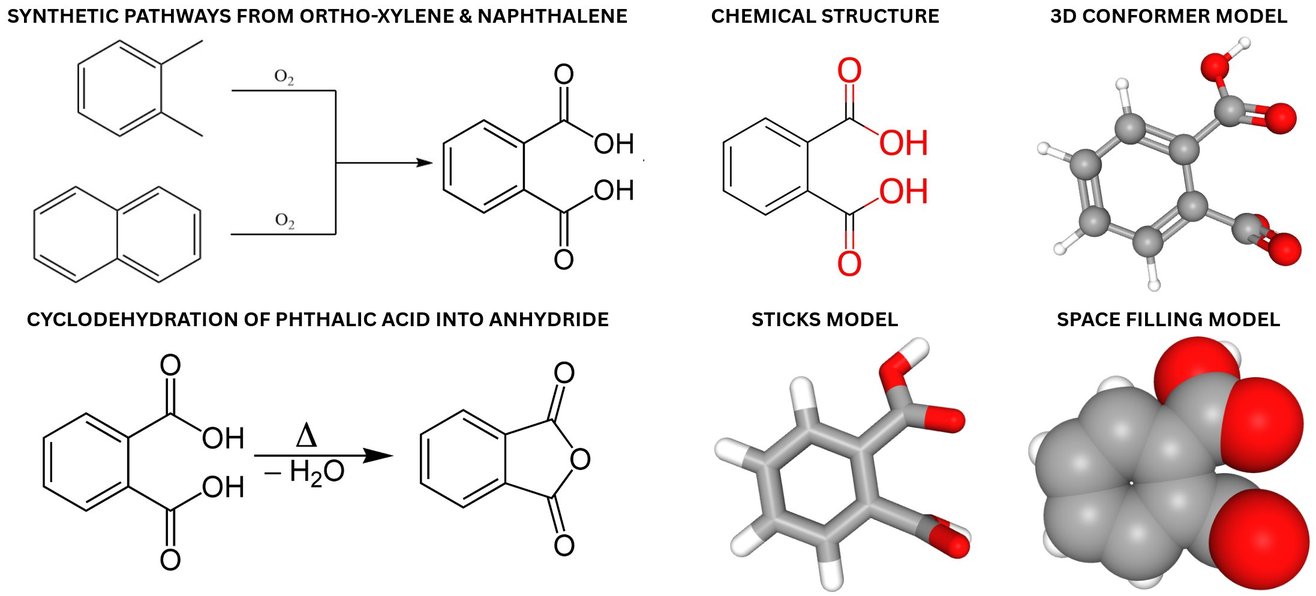
Synthesis and molecular structure of phthalic anhydride | Sources: Chemcess, ChEBI, PubChem
Phthalic acid is a white crystalline aromatic dicarboxylic acid, distinguished from its meta and para counterparts (isophthalic acid and terephthalic acid respectively) by having its two carboxylic acid groups positioned adjacent to each other on the benzene ring, with the expanded molecular formula C6H4(CO2H)2.
Phthalic acid's defining chemical characteristic is its strong tendency toward intramolecular cyclodehydration: because its two carboxylic acid groups sit adjacent (ortho) to one another, gentle heating readily drives off a water molecule and closes the five-membered ring, converting it into phthalic anhydride.
Phthalic acid itself is produced industrially by the catalytic oxidation of ortho-xylene or naphthalene, but because the anhydride forms so readily under the reaction and subsequent processing conditions, essentially all commercial output exists and is traded as phthalic anhydride rather than isolated free phthalic acid.
Because the free acid form has limited independent commercial demand, phthalic acid's practical applications are mostly realized through its anhydride and ester derivatives: phthalate ester plasticizers for PVC, alkyd resins, and unsaturated polyester resins.
Read the full profile here.