
Product
Phthalic Acid
Names
Benzene-1,2-dicarboxylic Acid; 1,2-Benzenedioic acid; Benzene-1,2-dioic acid; Ortho-phthalic acid
Insight Articles
#PS151
phthalicacid phthalicanhydride orthoxylene plasticizers
Main Product
Benzenedicarboxylic Acid
Segment
Chemicals
Main-Family
Functional Organic Products
Sub-Family
Carboxylic Acids
Physical State

Solid

Description

Phthalic acid  is a white crystalline aromatic dicarboxylic acid, distinguished from its meta and para counterparts (isophthalic acid and terephthalic acid respectively) by having its two carboxylic acid groups positioned adjacent to each other on the benzene ring, with the expanded molecular formula C6H4(CO2H)2


Physical Properties

  • Appearance: White crystals or crystalline powder

  • Melting/decomposition point: 210–211°C, decomposing rather than melting cleanly (some sources report sublimation/decomposition around 191°C onward)

  • Boiling point: ~289°C (decomposition)

  • Density: 1.59 g/cm³

  • Solubility: Slightly soluble in water (~5.74 g/L) and ether; more soluble in polar organic solvents

  • pH: Acidic, pH ~2 (5 g/L in water)


Chemical Behavior

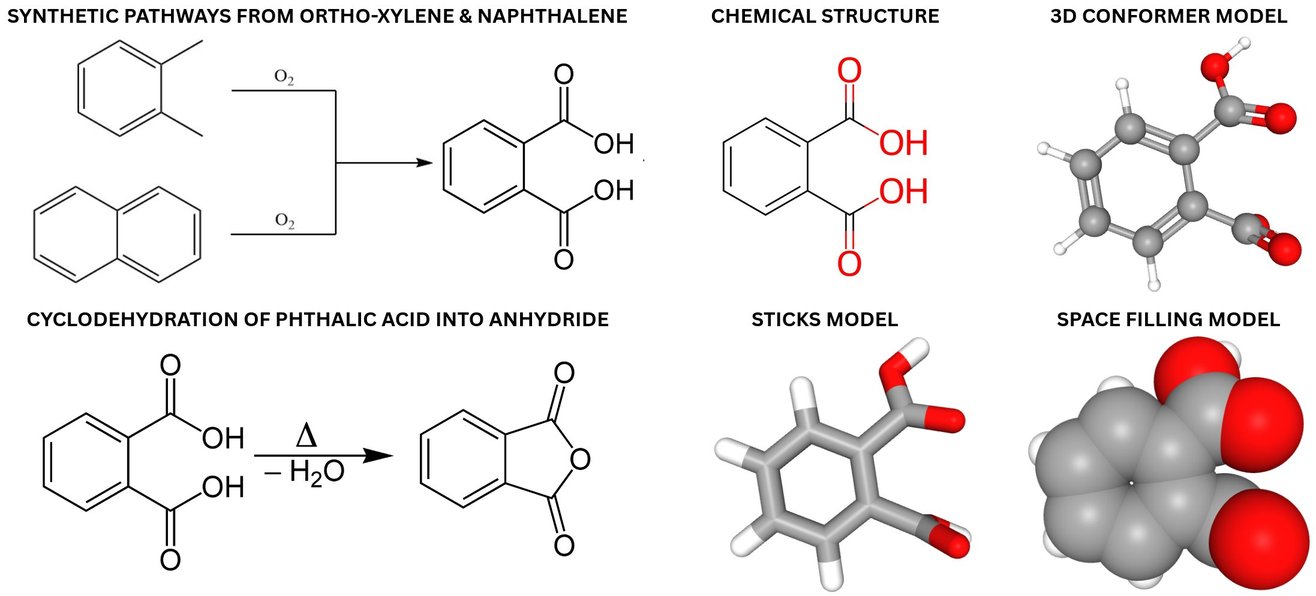
Phthalic acid's defining chemical characteristic is its strong tendency toward intramolecular cyclodehydration: because its two carboxylic acid groups sit adjacent (ortho) to one another, gentle heating readily drives off a water molecule and closes the five-membered ring, converting it into phthalic anhydride. This high reactivity toward dehydration is the central reason phthalic acid is rarely marketed or used directly in its free-acid form — instead, it is almost always produced and sold commercially as its anhydride. It also readily forms esters with alcohols (the basis of phthalate ester plasticizers).


Production

Phthalic acid itself is produced industrially by the catalytic oxidation of ortho-xylene or naphthalene, but because the anhydride forms so readily under the reaction and subsequent processing conditions, essentially all commercial output exists and is traded as phthalic anhydride rather than isolated free phthalic acid. 


Applications

Because the free acid form has limited independent commercial demand, phthalic acid's practical applications are mostly realized through its anhydride and ester derivatives: phthalate ester plasticizers for PVC, alkyd resins, and unsaturated polyester resins. Its wide industrial versatility stems directly from the high reactivity of its ortho-positioned carboxylic acid groups, which allow efficient conversion into anhydrides and esters under mild processing conditions.


Health and Safety

Phthalic acid is classified as causing serious eye damage (H318) and requires eye/face protection during handling. Toxicological studies indicate both in vitro and in vivo toxicity, and it has drawn some research interest for its environmental degradation behavior, including studies on its mineralization via TiO₂/UV photocatalysis. Its acute oral toxicity in rats is relatively low (LD50 ~7,900 mg/kg), and it is generally classified as an irritant rather than a severe systemic hazard.


Insight Articles
Your insights will be shown here

Synthesis and molecular structure of phthalic anhydride | Sources: Chemcess, ChEBI, PubChem
Identifiers

logo CAS Number
88-99-3
logo EC Number
201-873-2
logo ECHA InfoCard
100.001.703
logo IUPAC Name
Benzene-1,2-dicarboxylic acid
logo PubChem ID
1017
Chemical Data

Chemical Formula

C8H6O4

Molecular Weight (g/mol)
166.132
Melting Point (°C)
207
Sulfur Content (wt%)
0
Specific Gravity
1.59
Crude Data

API Gravity
10
Country
Product Settings

Default
Status
A
Content provided by
Transaction Name Date
Modified by UserPic   Kokel, Nicolas 7/28/2026 7:40 AM
Added by UserPic   Kokel, Nicolas 9/26/2021 7:03 AM