Two types of PVC resins originate from VCM suspension polymerization: paste resins & emulsion PVC
- Technology Type
- Emulsion Polymerization of VCM

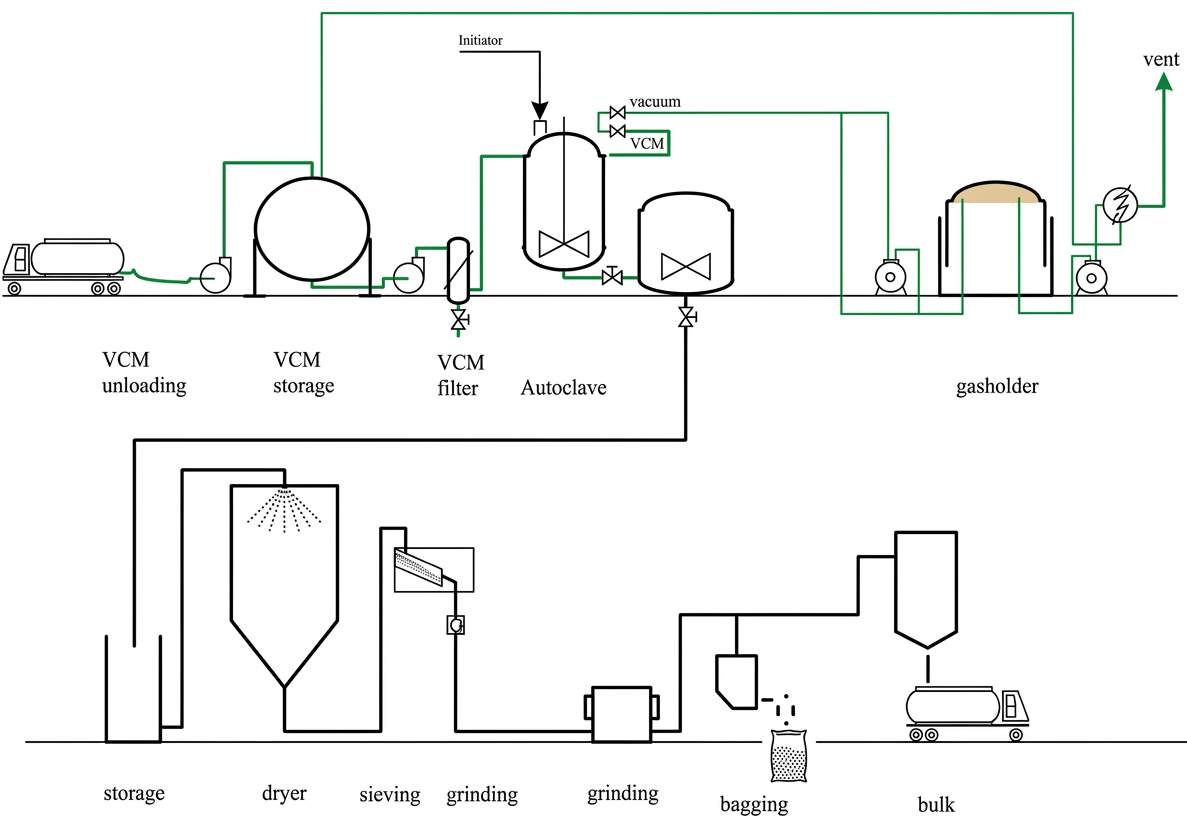
Simplified process flow diagram of VCM emulsion polymerization - adapted from BREF document (Aug 2007)
The emulsion polymerization of vinyl chloride monomer (VCM) process originated in West Germany and a substantial proportion of European E-PVC capacity remains located there. The process takes place in an aqueous medium stabilized by anionic surfactants (emulsifiers), using water-soluble initiators, in contrast to the suspension process which uses monomer-soluble initiators and protective colloids. Both batch and continuous reactor variants have been practiced, although the batch process is now strongly preferred due to its superior flexibility for grade production and more consistent particle size control.
Two resin types are distinguished by end-use, whereby particle size and its distribution are the defining technical output of the process and the principal variable controlled during polymerization:
- paste resins (P-PVC) produced via microsuspension or via seeded emulsion polymerization, with particles averaging 1–2 µm and a broad size distribution for low-viscosity plastisol applications.
- emulsion resins (E-PVC proper) produced via classical emulsion polymerization, with particles averaging 0.1–0.3 µm, used in dry blending, calendering, extrusion of precise profiles, and sintering applications such as battery separators.
Emulsion polymerization of vinyl chloride monomer (VCM) is the primary route — alongside microsuspension polymerization — for the production of paste-grade PVC resin, with the emulsion process alone accounting for approximately 10–12% of global PVC capacity, and the combined paste-grade production (emulsion + microsuspension) representing approximately 13–17% of total global PVC output.
While significantly smaller in scale than the dominant suspension process, the emulsion polymerization process occupies an irreplaceable niche: only the emulsion (and microsuspension) processes yield the ultra-fine particles — typically 0.1 to 2.0 µm in diameter — required to form stable plastisols and organisols when dispersed in liquid plasticizer.
Read the long form process description that includes an advanced PFD here.
#pvc #pastepvc #emulsionpolymerization #emulsionpvc