Sadara Chemical Company - A company behind the Strait of Hormuz - Q2 2026 Performance

- Entity
- Sadara Chemical Company

The conflict
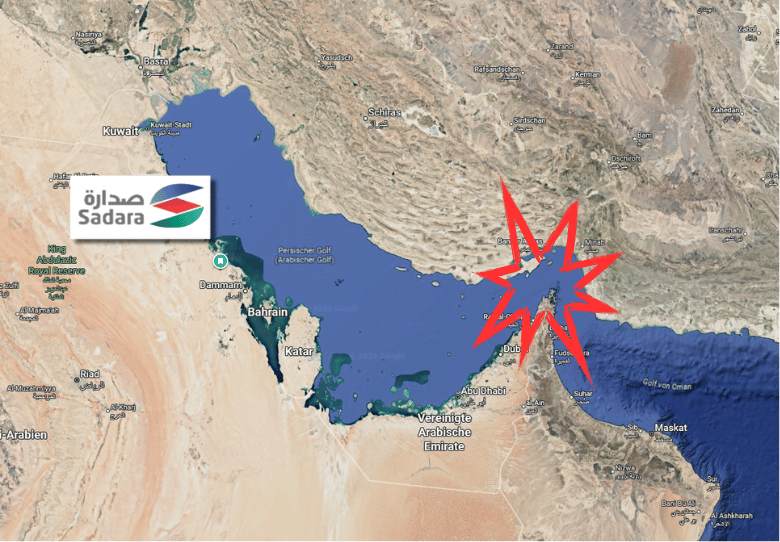
Since the US/Israel war with Iran the spotlight is on the impact of the closure of the Strait of Hormuz (SoH) on the crude production and supply of the Gulf countries. Riyadh and Abu Dhabi are developing plans for the extension of new infrastructure i.e. pipelines to bypass the SoH. Where Saudi and UAE have at least in the longterm geographical options. Other countries like Qatar, Kuwait and Iraq are facing much higher challenges to develop alternative supply lines of their crude oil and products to the global markets.
The gulf countries have been developing sizeable crude value chain industries in the last decades. Particularly Jubail in Saudi Arabia has become a hub for the production of refined and petrochemical products, which also heavily depend on free access to their global customers and reliable supplies.
In this article we want to highlight the consequences of the conflict on the performance of Sadara Chemical company, a joint venture between Saudi Aramco and Dow Chemicals.
Sadara financial performance - History and Q2 2026
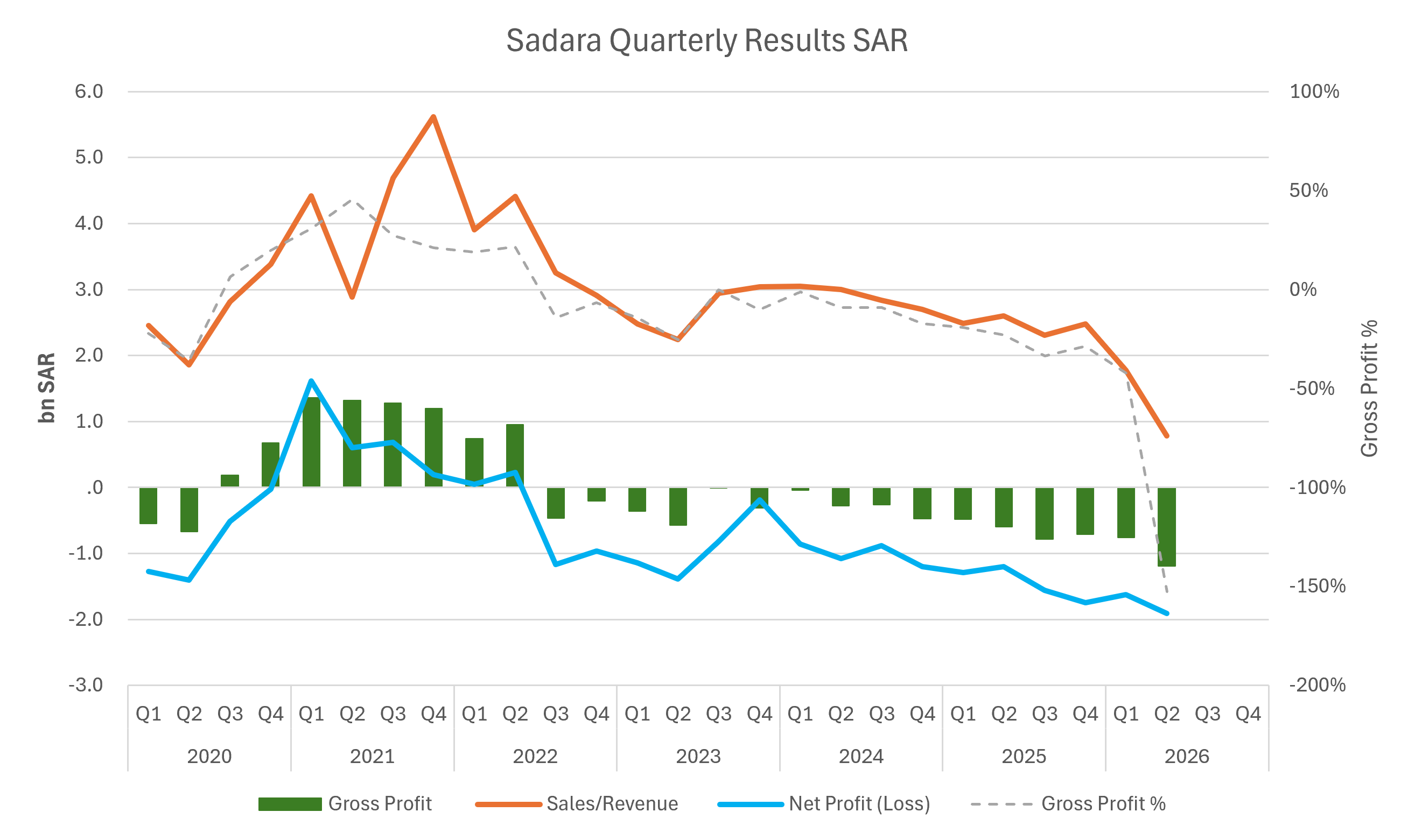
Sadara has been facing significant problems since its startup. The site has been operating reliably and a favourable margin environment generated positive results from the end of 2020 and the beginning of 2022. Since then the company has incurred losses.
All data and Explanation from Saudi Excange (Tadawul) website
| Period | Explanation |
|---|---|
| FY 2022 | The decrease in net profit in the current year compared to last year is mainly attributable to lower product pricing and higher feedstock cost despite higher sales volume, resulting in compressed margins. Additionally, due to the debt reprofiling which occurred last year, there was a favorable impact resulted in recognizing a gain of SAR 1.05 billion, in comparison of the current year. |
| FY 2023 | The key contributing factors to the decrease in Net Profit include compressed margins due to lower sales volumes and reduced average sales prices, along with the mentioned planned manufacturing maintenance activities. However, there were mitigating factors, including a mild reduction in production costs and a favorable impact from the accounting modification of shareholders loan in 2023. |
| FY 2024 | 2024 EBITDA was better than previous year due to higher sales volume but offset with lower prices. The net loss for 2024 increased compared to 2023, primarily due to an accounting adjustment related to debt modification in Q3 2023, which had a favorable impact on the previous year’s financials. |
| FY 2025 | Net profit for 2025 decreased compared to the previous year primarily due to lower sales volumes, margin compression, and higher fixed costs associated with unplanned operational events and extended maintenance activities. In addition, the net loss for 2025 increased compared to 2024, mainly due to an accounting adjustment related to a debt modification that had a favorable impact on the prior year’s results. |
| Q2 2026 | Net loss for Q2 2026 increased compared to the same quarter of last year, primarily due to lower sales volumes and an unfavorable impact on other gain/(loss) from asset write-off provisions. Additionally, a favorable impact on other gain/(loss) arising from the feedstock contractual reconciliation that was recognized in the same quarter of last year is not due for recognition in Q2 2026. |
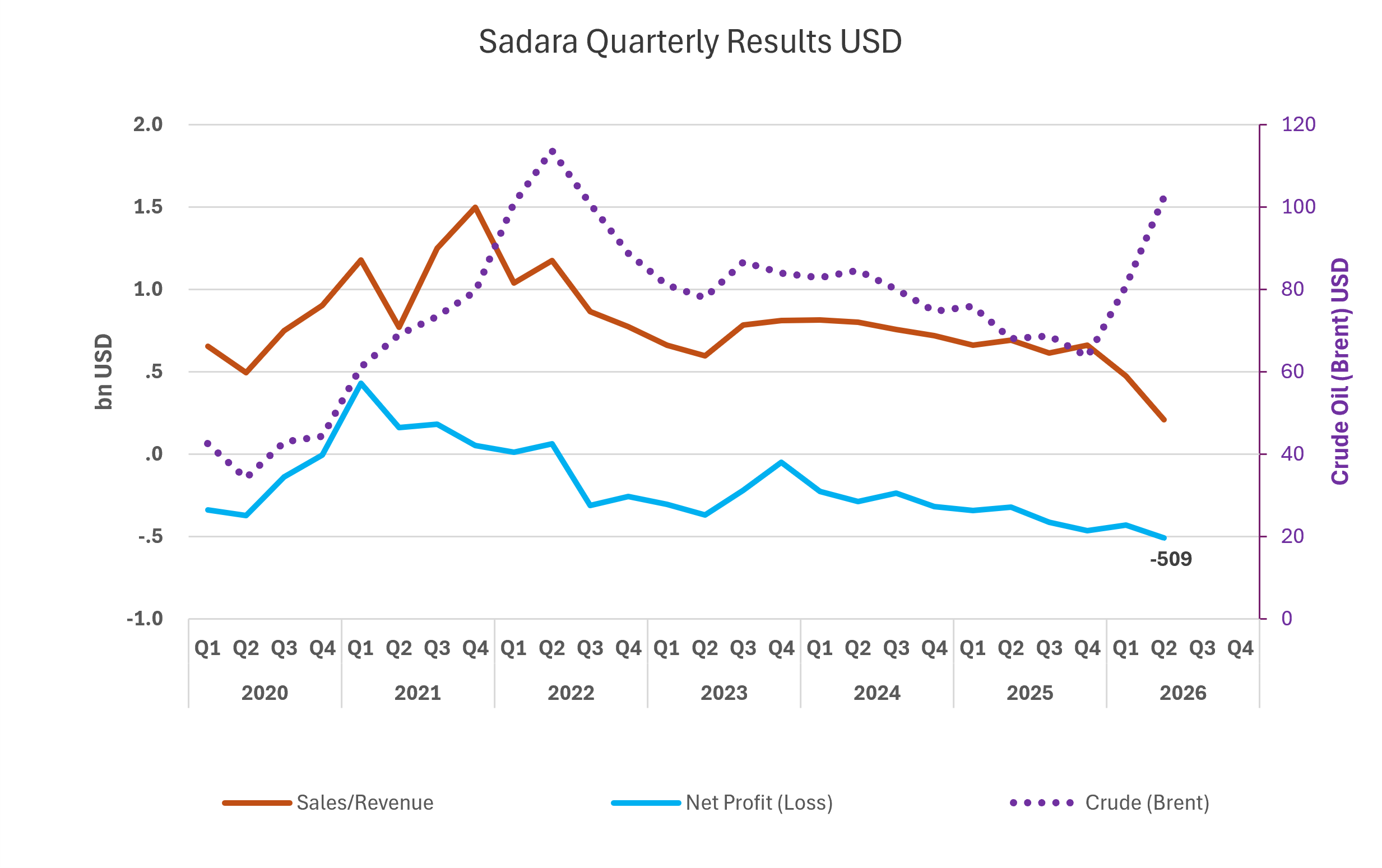
Q2 2026 Performance
In addition to the poor margin environment in previous years, the war between the US and Iran has had a disastrous impact on the Q2 financial results.
The company announced on March 31st, 2026 on the Tadawul a shutdown of its operations:
"Sadara Basic Services Company announces the temporary shutdown of production at the plant operated by its parent company, Sadara Chemical Company (Sadara). The shutdown arises from several factors, including ongoing disruption to Sadara's supply chains. The shutdown was successfully completed in accordance with Sadara’s high safety standards and in a manner that safeguards operations and reduces risk. Sadara cannot provide, at the present time, an estimate for the return to production, as this is contingent on domestic and international factors. The shutdown is expected to have an impact on the financial results for 2026."
The operation did not meet the expectations when the project was designed. Market economics during the startup and in recent years were very unfavourable. A major refinancing program was undertaken in 2020/2021, but current cash flow has led to another amendment of the revolving credit facility in June of this year. (see Shareholder perspective). With the conflict being unresolved, the situation will become even more severe and require further steps to secure the future of this complex operation.
Shareholder perspective
 Saudi Aramco Q2 2026 Report
- On June 9, 2026, the subordinated revolving credit facility agreement between Excellent Performance Chemical Company (“EPCC”), a wholly-owned subsidiary of the Company, and Sadara was amended to increase the facility amount from 1,500 ﷼ to 1,894 ﷼ and extend the maturity date from June 17, 2026 to May 20, 2029. The amount drawn under the facility as of June 30, 2026 was 1,399 ﷼. Further, on June 9, 2026, EPCC and Sadara entered into a 3,000 ﷼ subordinated term loan facility agreement, with a maturity date of June 17, 2038, to provide Sadara funding for general corporate purposes. The amount drawn under this facility as of June 30, 2026 was 1,219 ﷼.
 Dow Chemicals Q2 2026 Presentation
- Dow suspended the recognition of Sadara equity losses from 1Q26 forward o
- Sadara continued to make its debt repayments
- Dow will only continue to fund up to the existing Dow guaranteed amount
The future
Sadara was a star-project in the Saudi Aramco portfolio. The first mixed-feed cracker in the region, a highly diversified product-chain based on new technologies in a joint venture with a major chemicals company. It will be interesting to follow what steps the oil-major is going to undertake to (again) secure the future of this operation.
Dow seems to reach the end of the line and has taken already steps to remove Sadara from the exclusion of Sadara in the consolidation of their investments. How long it can maintain the shareholding in the JV when a cash bail out is required beyond the existing credit facilities.
Sadara is only one example for a whole industry in the Arab Gulf
The situation and the result outcome of Sadara with losses occuring when the market slightly turns downwards may be unique, but all companies depending on an open SoH will have seen similar negative trends in 2026. For some of the companies alternative logistic solutions may be available, but the closure of the strait has an impact on both, the import of feedstocks and export of products.
An outcome with a toll-fee for Iran and Oman will impact the cost of sales of companies with already low margins. Even if there are transport alternatives, like trucking to the west-coast of Saudi Arabia it will reduce their gross margins further. On top of that, customers will ask for a risk-reduction in the sales-prices, as an open and free transport-route may be a thing of the past.
In these days commentaries and analysis in the media has heavily concentrated on the majors in the Gulf region, there are however many chemicals companies (and others) which are equally impacted by the political situation. Their problems will create additional negative impacts on the economies of the region, which have not yet been fully understood.
#straitofhormuz #petrochemicals #sadara #hormuzblockade #gulfcountries #financialresults