Liquid Storage Solutions at Industrial Sites
Liquid storage is a critical aspect of industrial operations, encompassing a wide range of solutions designed to safely contain, handle, and protect liquid products — from bulk chemicals and foodstuffs to fuels, solvents, and cryogenic fluids. Selecting the appropriate storage method depends on the nature of the liquid (volatility, hazard class, temperature, pressure), required capacity, regulatory compliance, and site constraints.
Portable and Small-Scale Storage
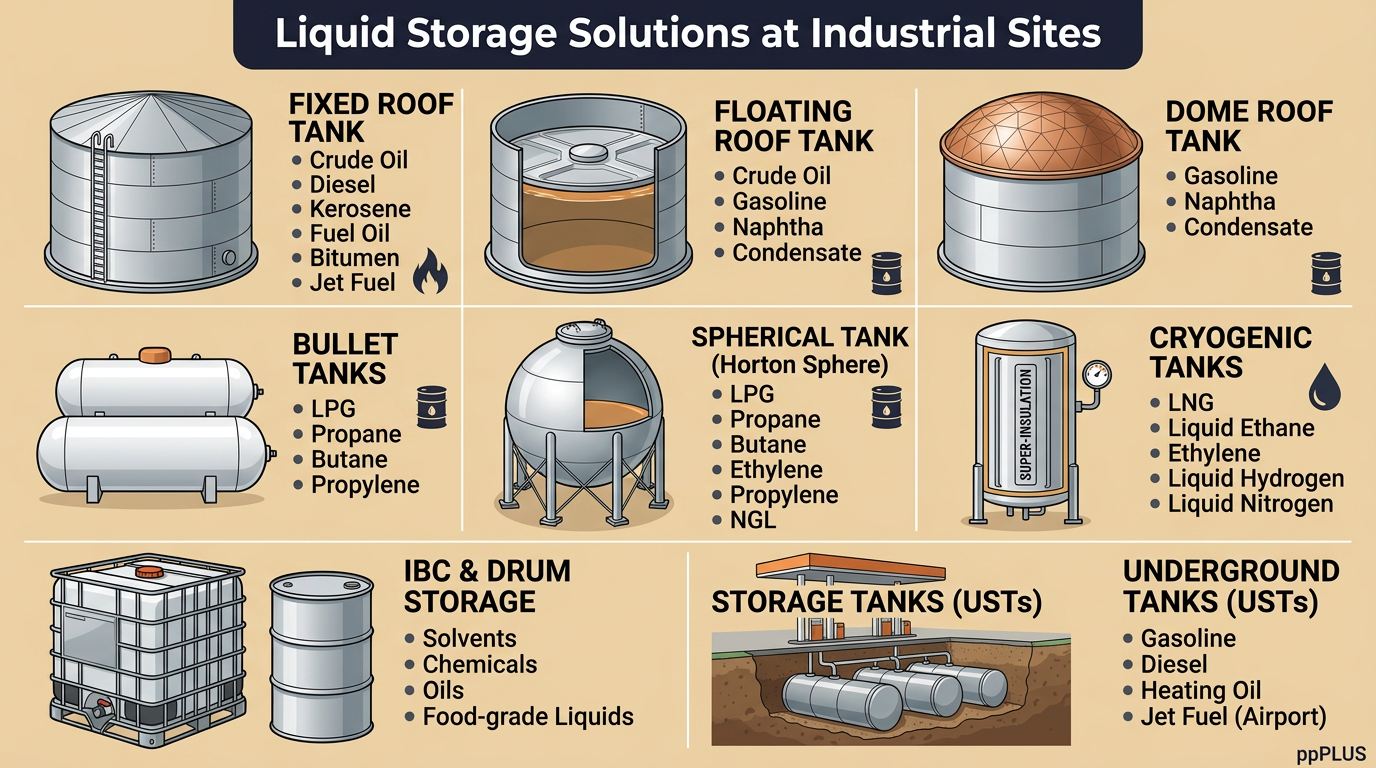
Intermediate Bulk Containers (IBCs) have become the standard for storing moderate volumes of liquids at industrial sites. Typically holding 500–1,000 litres, IBCs are suited for solvents, chemicals, and food-grade liquids. Their steel mesh outer frame provides mechanical protection, and their stackable design optimizes storage space.
Drums remain a classic solution for smaller volumes. Steel drums (standard size: 205 litres) are widely used for hazardous liquids, oils, and foodstuffs. Heavy-duty polyethylene drums (30–220 litres) offer a lighter, corrosion-resistant alternative with removable, lockable lids, and are commonly used for both storage and transportation.
Fixed Industrial Storage Tanks
Bunded (Double-Skin) Tanks are large-capacity tanks featuring an inner and outer wall. If the inner tank fails, the liquid is captured in the outer bund, preventing environmental contamination. These are the preferred solution for fuel oil storage on industrial sites and are subject to oil storage regulations in most jurisdictions.
Fixed Roof Tanks are economical, atmospheric-pressure tanks with a permanently attached roof, suitable for low-volatility liquids such as diesel, water, and heavy fuel oil.
Floating Roof Tanks feature a roof that rests directly on the liquid surface and rises or falls with the liquid level. This design dramatically reduces vapor losses and hydrocarbon emissions, making them the standard choice for volatile products such as crude oil, gasoline, and naphtha. In modern facilities, a geodesic dome roof is often added over a floating roof tank to protect the mechanism from rain, wind, and debris while further reducing emissions and improving regulatory compliance.
Dome Roof Tanks combine a fixed dome-shaped roof with enhanced structural integrity and moderate vapor containment, suitable for a range of petroleum products and chemicals.
Pressure Vessels
Gases that are liquefied under pressure — including LPG (propane, butane), ethylene, propylene, ammonia, and vinyl chloride monomer (VCM) — are stored in dedicated pressure vessels. The choice between vessel types depends on the required storage pressure, volume, and whether refrigeration is applied.
Bullet Tanks are horizontal cylindrical pressure vessels used for smaller to medium volumes of liquefied gases under moderate pressure. They are common for LPG, propylene, and ammonia storage at petrochemical plants, terminals, and distribution facilities.
Spherical Tanks (Horton Spheres) are large-capacity pressure vessels optimized for high-pressure storage of light hydrocarbons and petrochemical gases such as LPG, propylene, ethylene, and butadiene. Their spherical geometry distributes stress uniformly across the vessel wall, making them structurally efficient at the large scales typical of refinery and petrochemical complex storage.
For gases with very low boiling points — such as ethylene (−104 °C) and propylene (−47 °C) — storage is often achieved at reduced pressure by combining partial pressurization with refrigeration (semi-refrigerated storage), or at near-atmospheric pressure using fully refrigerated tanks. This approach significantly reduces vessel wall thickness requirements and capital cost at large scale.
Cryogenic and Underground Storage
Cryogenic Tanks are engineered for liquids stored at extremely low temperatures, including ethylene (−104 °C), LNG (−162 °C), liquid nitrogen (−196 °C), and liquid oxygen (−183 °C). They feature double-wall, vacuum-insulated construction to minimize heat ingress and boil-off losses. Large above-ground cryogenic tanks for LNG and ethylene are typically of flat-bottom, full-containment design with a pre-stressed concrete outer wall.
Underground Storage Tanks (USTs) are installed below grade and commonly used at fuel retail stations and facilities where surface space is limited. They require specialized corrosion protection, leak detection systems, and regulatory oversight to prevent soil and groundwater contamination.