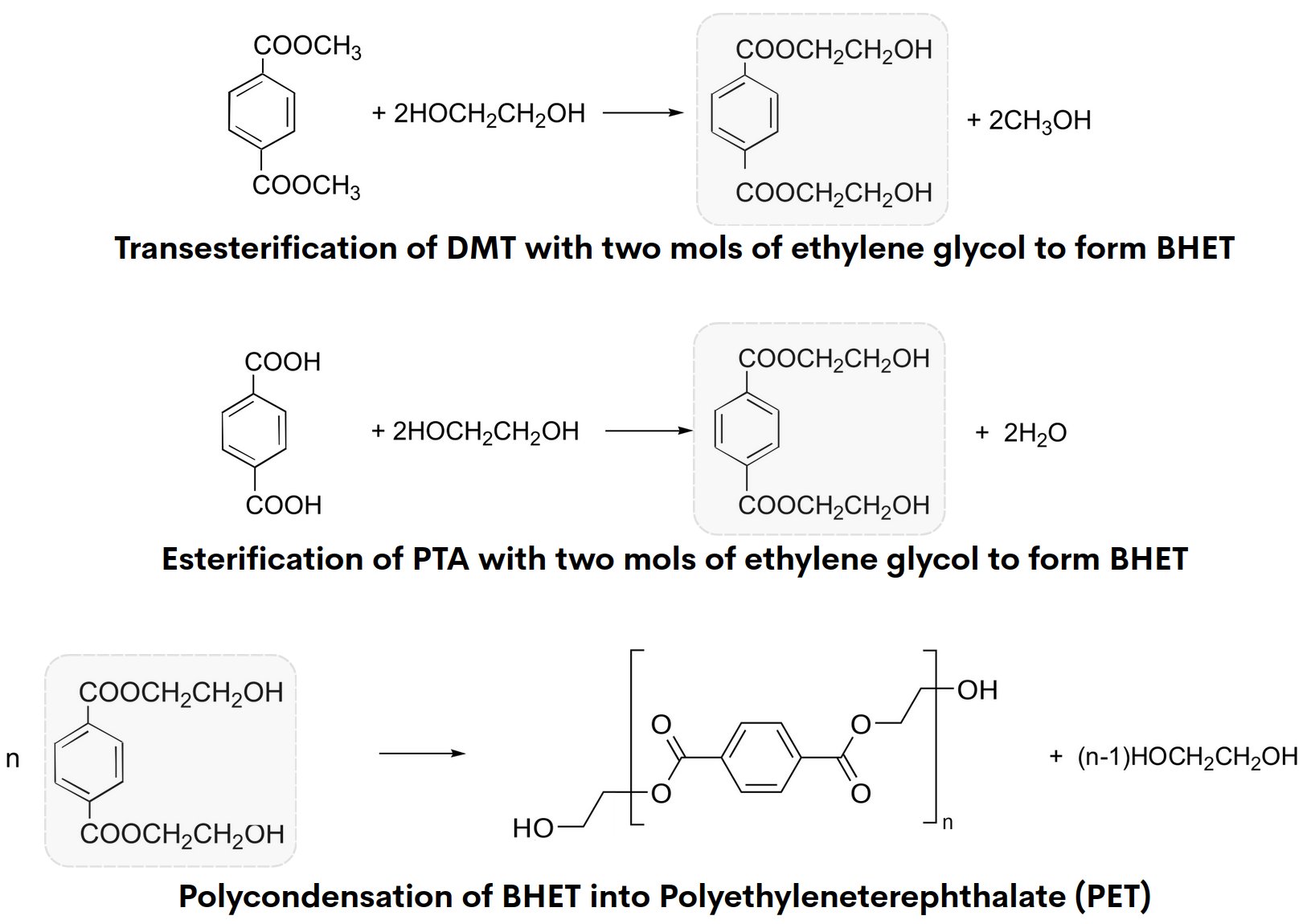
Polyesters are a broad family of polymers formed by step-growth polycondensation between dicarboxylic acids (or their esters) and diols, with PET representing the largest-volume commercial example but not the only one. This review synthesizes chemistry fundamentals, historical development, industrial process engineering, and the current commercial licensing landscape across the polyester family — PET, PBT, PTT, PEN, and related copolyesters — with licensor and technology details vetted against the most recent available industry announcements.
Feedstocks and Monomer Combinations
Polyesters are step-growth polymers formed by condensing a bifunctional acid component (a dicarboxylic acid or its diester) with a bifunctional diol, releasing water or an alcohol as byproduct. The diversity of the polyester family arises almost entirely from which diacid and diol are paired:
| Diacid/Ester Compone(nt |
Diol Component |
Resulting Polymer |
Character |
Terephthalic acid
(or DMT) |
Ethylene glycol (EG) |
PET |
Rigid, high-clarity, high melting point; bottles, fiber, film |
Terephthalic acid
(or DMT) |
1,4-Butanediol |
PBT |
Faster-crystallizing; injection molding, connectors, automotive |
| Terephthalic acid |
1,3-Propanediol |
PTT |
Elastic recovery, stain resistance; specialty fibers/carpets |
| 2,6-Naphthalenedicarboxylate |
Ethylene glycol |
PEN |
Superior barrier/thermal performance; film, tire cord |
Adipic acid/succinic acid
+ terephthalic acid |
Butanediol |
PBAT/semi-aromatic copolyesters |
Biodegradable packaging films |
General polycondensation equation:
(n+1) HO—R—OH + n HOOC—R′—COOH
→ HO—[R—OOC—R′—COO]n—R—OH + 2n H2O
Two monomer routes converge on the same oligomeric intermediate chemistry:
Direct esterification (acid + diol → ester + water)
Transesterification (dialkyl ester + diol → ester + alcohol, used historically with DMT, releasing methanol).
Historical Development
1928–1932 — Foundational chemistry. Wallace Carothers established polycondensation principles applicable to both polyesters and polyamides, polycondensing ethylene glycol with sebacic acid to draw filaments from the melt, though this aliphatic polyester lacked adequate thermal properties for commercial textiles.
Early 1940s — The terephthalic acid breakthrough. Schlack in Germany paired terephthalic acid with 1,4-butanediol, while Whinfield and Dickson in England (Calico Printers' Association) paired terephthalic acid with ethylene glycol. The ethylene glycol combination proved more economical and better suited to textiles, ultimately prevailing commercially.
1947 — Commercialization. ICI (Terylene) and DuPont (Dacron) began mass production, both licensing patent rights from Calico Printers' Association.
1950s — The DMT detour. Early dilute nitric acid oxidation of p-xylene produced terephthalic acid contaminated with colored impurities that resisted purification. Manufacturers instead esterified the crude acid to DMT, purifiable by distillation — making DMT/transesterification the dominant industrial route for roughly two decades.
1952–1963 — Batch to continuous transition. DuPont began developing continuous PET polymerization as early as 1952, but batch processing remained the industry standard until 1963.
1960s — The PTA purification breakthrough. Standard Oil/Amoco's catalytic hydrogenation purification technology (by 1963) finally enabled direct production of sufficiently pure terephthalic acid, triggering the multi-decade industry shift away from DMT toward PTA-based direct esterification — a route still dominant today, though DMT remained in limited commercial use into the mid-2000s.
1970s–present — Continued refinement. High-speed spinning matured in the early 1970s (partially oriented yarn up to 4,000 m/min); catalyst systems, continuous process engineering, and SSP technology have undergone sustained incremental improvement, with commercialization extending to PEN, PBT, PTT, and more recent bio-based variants using bio-derived glycols and terephthalic acid.
Two-Stage Process: Common Across the Polyester Family
Industrial polyester production universally proceeds through two macro-stages, with absolute conditions varying by polymer and by licensor configuration:
Stage 1 — Esterification/transesterification (prepolymerization):
-
EG-to-acid (or DMT) molar ratio typically 1.1–1.3 for direct PTA esterification per validated PET plant data, though older continuous-process modeling literature cites a broader 1.6–2.4 range depending on configuration
-
Temperature: initially ~140°C, ramped to 220–263°C; pressure near-atmospheric to 25 psig, dropping progressively
-
Catalyzed by antimony trioxide (200–300 ppm Sb), titanium alkoxides (50–150 ppm Ti), zinc/manganese/cobalt acetates, or aluminum compounds (30–80 ppm Al)
-
Vapor byproduct (water or methanol) removed via distillation/reflux column, with excess EG recycled
-
Produces oligomer with degree of polymerization 2–10
Stage 2 — Melt-phase polycondensation:
-
Conducted via prepolymerization CSTR followed by one or two horizontal finishing reactors (single- or double-shafted, disc-ring or squirrel-cage agitated) as viscosity rises
-
Temperature 270–290°C under progressively deepening vacuum (down to 0.5–2 mmHg in the final finisher)
-
For PET specifically: 2.0–2.5 hours total residence, yielding melt-phase IV of 0.60–0.65
-
Catalyst concentration optimized (e.g., 250 ppm Sb or ~20–80 ppm Ti) to balance final IV against gel/particulate formation and color
-
Reactor geometry evolves toward large surface-area-to-volume designs and horizontal disc-ring/squirrel-cage configurations as melt viscosity increases, to maintain adequate surface renewal for diol removal
Solid-state polymerization (SSP), required when melt-phase degradation limits achievable molecular weight, is mechanistically shared across the family, governed by a common modified second-order kinetic model. PTT exhibits more than twice the SSP rate of PET with much lower sticking tendency, permitting simpler SSP processing. For PET, SSP at 200–220°C over 10–15 hours raises IV from ~0.60 to 0.72–0.85, reducing acetaldehyde to under 2 ppm and lowering carboxyl end-group content.
Catalysis: A Shared Environmental and Performance Challenge
Antimony trioxide/triacetate remains the dominant catalyst across nearly all commercial polyester polycondensation — cost-effective, but a heavy-metal compound with recognized toxicity and environmental concerns. The catalytic mechanism is well characterized: the metal center of antimony, germanium, or titanium alkoxide catalysts coordinates to the carbonyl oxygen of the ester, and the alkoxy oxygen then attacks the carbonyl carbon via a four-centered transition state, with titanium alkoxide activation energy calculated at 15.47 kcal/mol, close to the experimental 11.2 kcal/mol reported for PBT/Ti(OBu)4 systems.
Titanium-based catalysts are increasingly positioned as antimony replacements for their environmental profile and strong activity, dosed at much lower levels (~20–80 ppm Ti versus ~250–300 ppm Sb) while leaving less residual catalyst in the finished polymer. Germanium dioxide combined with tetraalkylammonium hydroxide is used in premium, low-color applications. This trend recently reached full commercial scale: Clariant launched titanium-based AddWorks catalyst solutions in 2025, explicitly engineered to function across the entire polyester family — PET, PETG, PCT, PBT, PTT, PBAT, TPEE, and emerging PEF — targeting improved sustainability and simplified PET recycling. This confirms titanium catalyst technology as a cross-polyester development rather than a PET-specific niche.
Licensor and Technology Landscape
The technology landscape has undergone material ownership changes since the technologies were first developed and newer technologies were developed, in particular by Chinese companies.
| Licensor (current legal entity) |
Technology |
Status/Current Ownership |
Key Feature |
| Uhde Inventa-Fischer (subsidiary of thyssenkrupp Uhde) |
Melt-To-Resin (MTR®), using patented Espree® and Discage® reactors |
Actively licensing; signed a new contract with Turkish producer KÖKSAN in April 2026 for a 324,000 t/y plant (start-up 2028), and with SASA Polyester (Turkey) in 2022 for a 330,000 t/y MTR line |
Two-reactor continuous polycondensation that eliminates SSP entirely, cutting energy use, capital cost, and CO2 footprint by up to 30 percent |
| Zimmer® Polymer Technologies |
DHI four-reactor process, Direct-to-Preform, Ecocat non-heavy-metal catalyst |
No longer independently owned: Air Liquide sold the Zimmer polymer business to Technip in 2014; Technip merged into TechnipFMC (2017); Zimmer is now a wholly-owned subsidiary of Technip Energies following its 2021 spin-off from TechnipFMC — celebrated its 75th anniversary in October 2025 |
Non-heavy-metal catalyst on porous carrier; direct-to-preform route bypassing SSP |
|
Eastman Chemical (IntegRex,
Pipe Reactor)
|
IntegRex integrated PTA-to-PET, pipe-geometry polycondensation |
Eastman exited the PET business entirely; its PET operations and IntegRex/PTA technology IP were sold to DAK Americas (Alpek subsidiary) — DAK also separately faced (and lost) an Eastman patent infringement suit over unauthorized IntegRex use in 2010, prior to the technology later passing to DAK via acquisition |
Now controlled by Alpek/DAK Americas, not Eastman |
|
INVISTA (Koch, Inc.)
Koch's PET polymerization technology, formerly DuPont NG3
|
NG3 rotoformer/pastille technology |
Owned by Koch Industries via the 2004 Invista spin-off from DuPont; DuPont's separate DuPont-SA European PET/intermediates business was excluded from that transaction |
Low-IV melt pastilles finished via SSP; >1,150 TPD demonstrated single-line capacity |
| Mossi & Ghisolfi (MG) — EasyUp SSP |
Larger single-line SSP (480 KTA demonstrated) |
MG itself went bankrupt; its global PET assets were redistributed to Alpek, Far Eastern New Century (FENC), and the Corpus Christi Polymers joint venture; MG survives only as a residual legal entity in Mexico |
Lower capital intensity per tonne of SSP capacity |
| Hengli Group |
Self-developed polymerization/fiber technology (National Science and Technology Progress Award) |
Privately held Chinese conglomerate; fully vertically integrated from crude oil to BOPET film, with 6 million tons/year polymerization capacity |
First large-scale, domestically originated (non-licensed) polymerization technology outside the traditional US/European/Japanese lineage |
| Sinopec Yizheng Chemical Fibre |
Hybrid model: licensed INVISTA P8++ (PTA) combined with proprietary polymerization/PBT technology |
State-controlled (Sinopec subsidiary); licensed P8++ PTA technology from INVISTA in 2021 while operating in-house polymerization lines |
Illustrates the common Chinese pattern of licensing upstream PTA oxidation technology while relying on in-house downstream polymerization |
Industry Structure: Consolidation Across the Polyester Value Chain
Ownership consolidation, not just technology licensing, increasingly defines competitive position across polyester production. Following Mossi & Ghisolfi's bankruptcy, virtually all Americas PET/polyester capacity consolidated among four groups — Alpek, Far Eastern New Century, Indorama, and Nan Ya — with the Corpus Christi Polymers joint venture (Alpek/Indorama/Far Eastern) targeting 1.1 million tonnes/year of integrated PET capacity to close the cost gap with back-integrated Asian producers.
Southeast Asian capacity is similarly concentrated among Indorama Ventures, Far Eastern Group, Billion Holdings, Shinkong Group, Reliance Industries, and Formosa Plastics Group. Global polyester consumption was estimated at 44 million tonnes in 2007, growing at roughly 7 percent annually at that time, with the North American PET market alone projected to reach 6.77 million tonnes by 2031.
China now dominates global polyester supply, holding roughly 60–65 percent of global capacity (approximately 85–90 million tonnes/year of a ~135–140 million tonne global total in 2026), up from 59 million tonnes/year in 2019, and accounting for nearly half of global polyester exports. This scale rests on a hybrid technology model — selective licensing of upstream PTA processes (e.g., Sinopec Yizheng's 2021 INVISTA P8++ license) combined with increasingly self-developed downstream polymerization technology, exemplified by Hengli Group's nationally awarded, fully vertically integrated PX-to-BOPET technology stack. Full vertical integration has entrenched a structural cost advantage that sustains output even amid weak margins, and most 2025–2026 market analyses consider capacity rationalization unlikely before 2027, reinforcing the same consolidation dynamic already observed globally among Alpek, Indorama, Far Eastern New Century, and Reliance.
Sustainability regulation is reshaping demand for the polyester family broadly, since PET recycling infrastructure (mechanical, and emerging chemical/depolymerization routes) is the most mature. The EU's Packaging and Packaging Waste Regulation (PPWR), formally adopted as Regulation (EU) 2025/40 and entering into application from 12 August 2026, supersedes the earlier packaging waste directive and replaces general recycling-rate targets with binding, packaging-specific recycled-content mandates. From 1 January 2030 (or three years after the relevant implementing act, whichever is later), plastic packaging must contain minimum post-consumer recycled content of 30 percent for single-use PET beverage bottles, 30 percent for contact-sensitive PET packaging, 10 percent for contact-sensitive packaging in other plastics, and 35 percent for all other plastic packaging, calculated as a plant-level annual average.This shift from an EU-wide packaging recycling-rate target toward legally binding, per-format and material recycled-content quotas represents a materially stronger and more PET-specific demand driver for recycled PET (rPET).
References
- Synthesis of Polyester: Important Polymerization Reaction
- Polyester: Comprehensive Analysis Of Molecular Structure, Synthesis Routes, And Advanced Applications In Industrial Sectors — Eureka, April 2026
- Reaction Kinetics of Polybutylene Terephthalate Polycondensation
- Solid-State Polymerization of Poly(trimethylene terephthalate)
- The Mechanism of Catalysis in the Polycondensation Reaction
- Clariant Unveils Titanium-Based Catalyst Solutions for More Sustainable Polyester Production
- Uhde Inventa-Fischer: Neue PET-Anlage für türkischen Verpackungshersteller KÖKSAN — MTR technology contract, April 2026
- thyssenkrupp Uhde Builds Low-Emission PET Plant for KÖKSAN in Turkey
- thyssenkrupp Wins Contract to Build Three Major Polymer Plants for SASA Polyester — 2022 MTR contract
- Zimmer Polymer Technologies — Company History — Technip Energies ownership timeline
- Technip Announces Plans to Acquire Zimmer Polymer Technologies — 2014 acquisition from Air Liquide
- Eastman Sues DAK Americas Over IntegRex Technology — 2010 patent litigation
- Eastman Exits PET Business, Finalizes Sale of U.S. Operations to DAK — IntegRex IP transfer to DAK Americas
- Status Quo and Future Development of China's Polyester Industry
- Global Polyester Market Report
- China's Sinopec Yizheng Plans PTA, PET Resin Expansion
- A Comprehensive Look at Hengli's Expertise in Oil Refining and Petrochemicals
- Sinopec Yizheng PBT Resin — Full Series Engineering Plastic