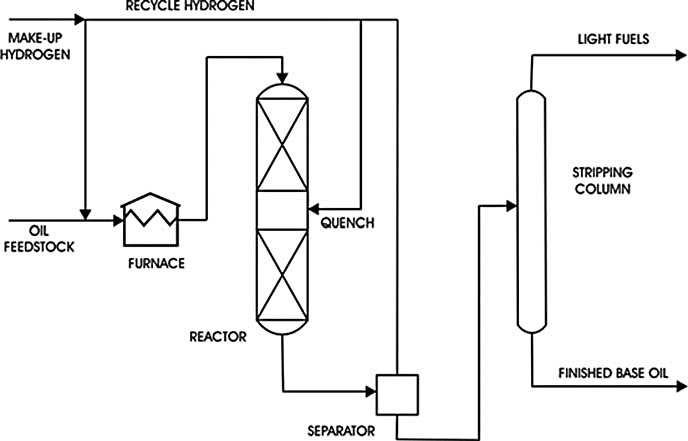
Hydrofinishing, also known as Hydrofining, is a mild catalytic hydrotreating process used in refineries as a final polishing step to improve the quality of petroleum products, particularly lubricating oil base stocks and middle distillates. The process treats pre-refined oils with hydrogen under moderate conditions to remove trace impurities without significantly altering the molecular structure of the hydrocarbons.
Process Conditions and Operation
Hydrofinishing typically operates at temperatures of 200-340°C and pressures around 5.5 MPa (approximately 800 psi), which are milder conditions compared to hydrocracking. The feedstock is passed through a fixed-bed reactor containing a hydrofinishing catalyst in the presence of hydrogen, which can be used in once-through or recycle mode. The catalyst may be either base-metal (typically cobalt-molybdenum) or noble-metal catalysts, with noble-metal catalysts offering higher activity at lower temperatures.
Key Reactions and Objectives
The primary reactions occurring during hydrofinishing include:
- Removal of organically bound sulfur compounds
- Elimination of nitrogen-containing compounds
- Removal of oxygen compounds and polar molecules
- Saturation of unstable aromatic molecules and color bodies
- Saturation of multiring aromatics
Unlike hydrocracking, which breaks down molecular structures, hydrofinishing preserves the basic hydrocarbon skeleton while significantly improving chemical stability.
Product Quality Improvements
Hydrofinishing enhances several critical quality parameters:
- Color stability: Removes color carriers to produce clear, light-colored products
- Oxidation resistance: Improves long-term stability and storage life
- Viscosity index: Can contribute to higher VI in lubricant base stocks
- Contaminant reduction: Lowers sulfur, nitrogen, and oxygen content
Applications in Refinery
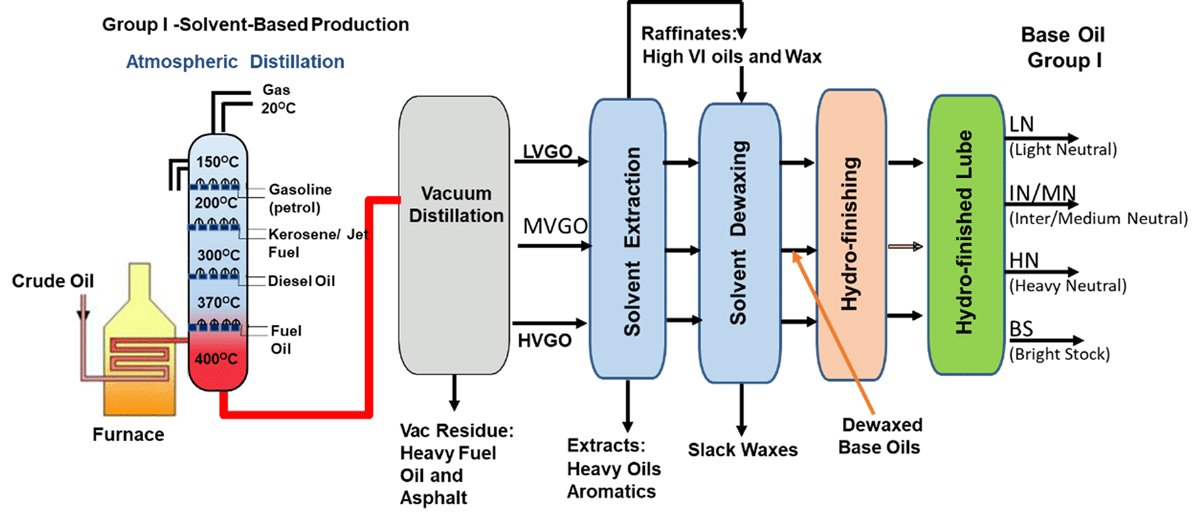
While hydrofinishing is particularly valuable in lubricant base oil production as a finishing step after solvent extraction and dewaxing, it is also applied to other refinery streams. The process can treat heating oil, diesel fuel, and wax products to improve their specifications. In lube oil processing, hydrofinishing may be integrated with solvent extraction configuration or used as a standalone finishing treatment on dewaxed oil products.
Figure 1 - Base Oil Group I solvent-based production [8]
After the reactor, the effluent undergoes separation stages to recover unreacted hydrogen, remove hydrogen sulfide and ammonia byproducts, and strip light hydrocarbons through steam stripping and vacuum drying before the finished product goes to storage.
References
- Basinol. Hydrofinishing
- ScienceDirect. Engineering Topic — Hydrofining
- Sabry A., DeveLub. Mineral Base Oil Manufacturing
- Magiera, J., Markiewicz, M., & Gluszek, A. (2003). Hydrofinishing of distillates obtained from waste oils. Environment Protection Engineering, 29(3-4), 83-96
- Chevron Lummus Global. ISOFINISHING
- Esmaili Z., Infinity Galaxy (July 13, 2024). Base Oil Production Process
- Wright J., Noria Corporation (June 27, 2012). The Fundamentals of Mineral Base Oil Refining. Machinery Lubrication
- Kathait A.S., Machinery Lubrication India. Base Oil: Building Blocks for Lubricants. March-April 2019.