Process Background
ISOFINISHING® is CLG's proprietary noble-metal catalytic hydrofinishing technology, constituting the terminal hydroprocessing step in the all-hydroprocessing lube route. Chevron introduced the first all-hydroprocessing lube plant in 1984, with ISOFINISHING commercialized as part of that integrated scheme, and later licensed by Chevron Lummus Global (CLG). ISOFINISHING uses noble-metal catalysts to almost completely remove aromatics, obtain excellent oxidation stability, and produce a practically water-white product.
Process Objective
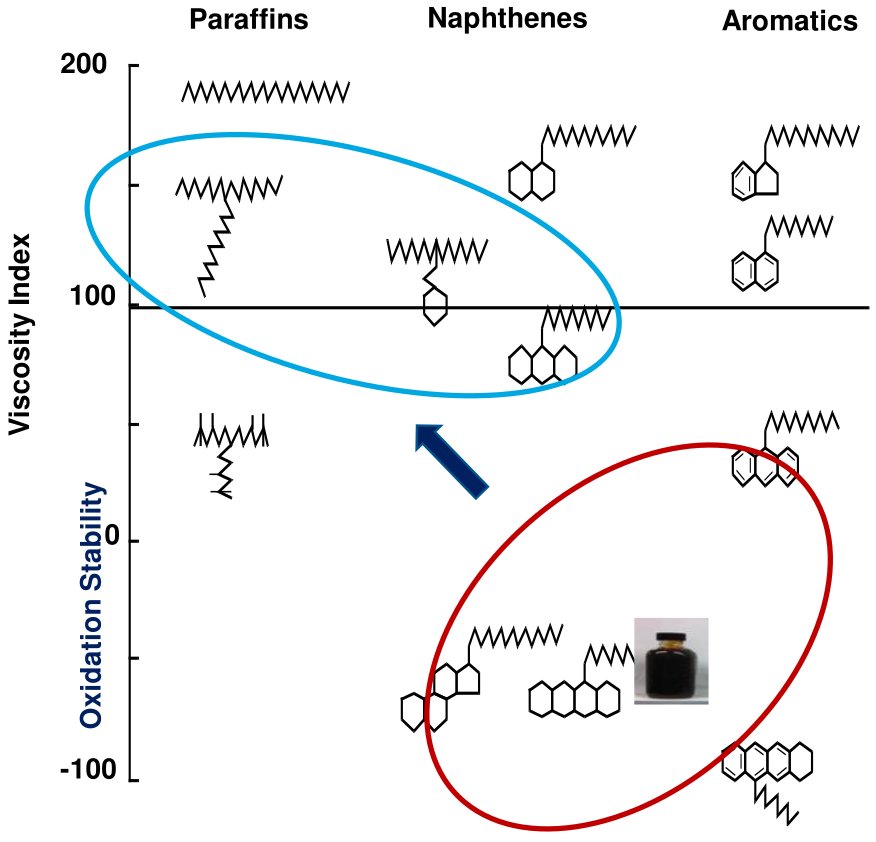
The ISOFINISHING reactor performs deep aromatics saturation of the dewaxed effluent from the ISODEWAXING reactor under hydrogen pressure over the noble-metal catalyst surface, converting residual aromatic rings and unsaturated species to stable saturated structures in a reaction that is highly selective with minimal cracking or side reactions. ISODEWAXING converts paraffins to isoparaffins, while ISOFINISHING converts aromatics to naphthenes — together yielding a base oil composed almost entirely of stable, highly saturated species. ISOFINISHING can also be deployed as a stand-alone unit for the production of white oils and de-aromatized solvents.
Figure 1 - Molecular Transformation during ISODEWAXING and ISOFINISHING [1]
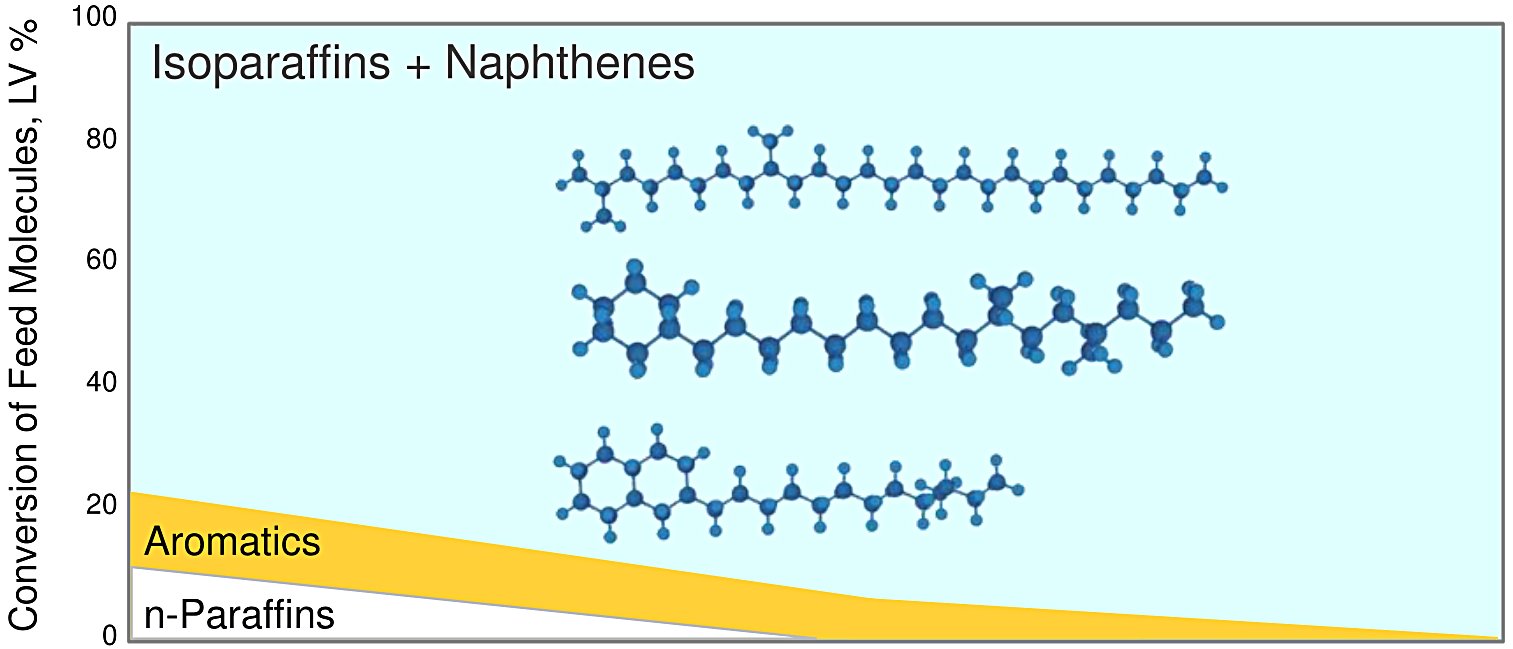
ISODEWAXING converts paraffins to iso-paraffins
ISOFINISHING converts aromatics to naphthenes
Catalyst
ISOFINISHING uses CLG's proprietary noble-metal catalysts, which provide substantially higher hydrogenation activity per unit volume than conventional base-metal finishing catalysts. Noble-metal catalysts require lower operating temperatures than base-metal catalysts for the equivalent product oxidation stability, which in turn results in superior color; these results are achieved at lower pressures and in smaller reactor volumes. The ISOFINISHING catalysts are most effective in low-sulfur, low-nitrogen environments, such as those produced by upstream ISOCRACKING and ISODEWAXING steps.
Operating Conditions
By virtue of the intrinsically higher activity of the noble-metal catalyst system, ISOFINISHING operates at lower reactor temperatures, lower pressures, and higher weight hourly space velocities (WHSV up to 3 h⁻¹) than conventional base-metal hydrofinishing, resulting in a smaller reactor volume for a given throughput. Operating temperature is in the range of 250–350 °C. The ISODEWAXING/ISOFINISHING unit utilizes a dedicated high-pressure recycle gas loop, separate from that of the upstream hydrocracker/hydrotreater when the processes are combined in an integrated unit.
Process Flow Integration
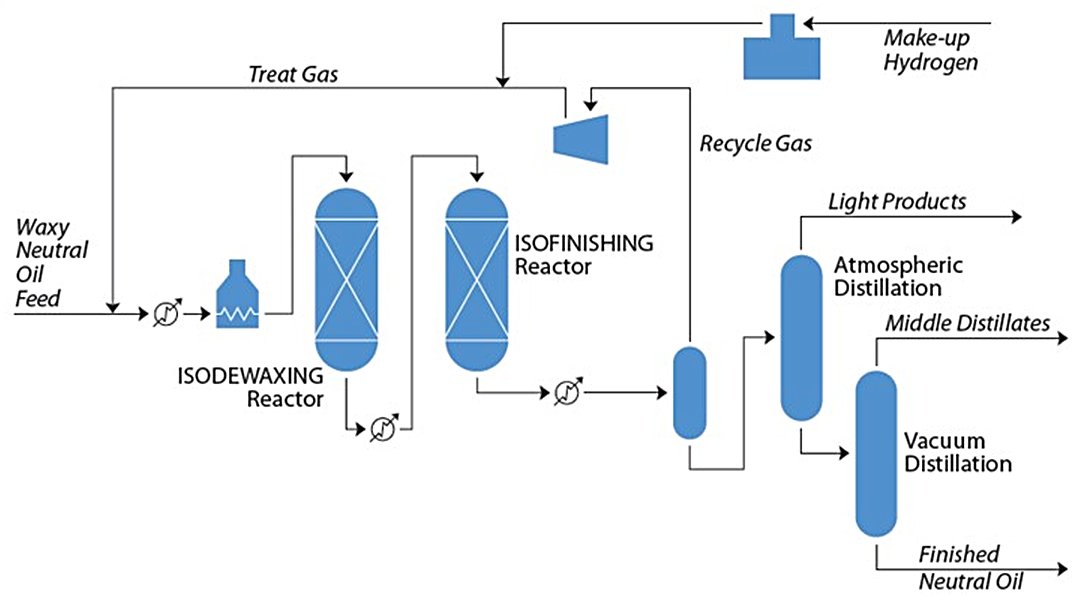
The waxy neutral oil feed from a hydrocracker or hydrotreater, together with treat gas, is preheated and fed to the ISODEWAXING reactor, which isomerizes normal paraffins (waxes) to high-VI isoparaffins and lowers pour point, while cracking other paraffins to highly saturated light products such as high-smoke-point jet fuel and high-cetane-index diesel. The full effluent from the ISODEWAXING reactor is then sent directly to the ISOFINISHING reactor, where the product undergoes deep aromatics saturation to provide a highly stable finished neutral oil product. After the ISOFINISHING reactor, the combined effluent passes through a separation system and is fractionated via atmospheric distillation — yielding light products and middle distillates — followed by vacuum distillation to produce the finished neutral oil in the target viscosity grades.
Feedstock Flexibility and Process Configurations
The following ISODEWAXING/ISOFINISHING configurations are applied in commercial practice:
- ISODEWAXING/ISOFINISHING stand-alone – waxy VGO or hydrocrackate feed directly to dewaxing/finishing
- ISOCRACKING + ISODEWAXING/ISOFINISHING – integrated all-hydroprocessing lube route
- Block operation SSOT (single-stage once-through)
- Integrated with two-stage fuels hydrocracker
- Integrated with single-stage recycle hydrocracker
- ISOTREATING → ISODEWAXING/ISOFINISHING – for raffinate or hydrotreated feeds
Commercial and pilot plant experience covers vacuum gas oils of the complete boiling range, blends of VGO/HCGO/DAO, raffinate streams, FT wax/slack wax, renewables, and recycled lubricant oils. For renewable paraffinic feedstocks, ISOFINISHING aromatics removal is listed as optional, since such feeds are already highly paraffinic.
Product Qualities
ISOFINISHING produces Group II (≥90% saturates, ≤0.03 wt% S, VI 80–119) and Group III (≥90% saturates, ≤0.03 wt% S, VI ≥120) base oils with the following characteristics:
- Near water-white color with high color stability
- Ultra-low aromatic content
- High oxidation and thermal stability
- Group II and Group III base oil specifications achievable
Figure 2- Viscosity Index by Chemical Category [1]
Commercial Application
ISOFINISHING has been commercialized at numerous base oil units worldwide, with reference plant partners including Bharat Petroleum (BPCL), BAPCO, IndianOil, ADNOC, SK Lubricants, KNPC, Sinopec, Luberef, NESTE, LOTOS, Suncor Energy, PEMEX, and GS Caltex as of 2023. In March 2023, CLG announced an ISOFINISHING award from BPCL for a 200,000 t/a stand-alone unit at the Mumbai refinery, configured to produce de-aromatized solvents and white oils. CLG's ISOFINISHING technology was also employed in the startup of Novvi's 100% renewable base oil unit at Deer Park, Houston, Texas in 2021.
References
- Bhattacharya, S., Chevron Lummus Global (May 5, 2023). The Evolution of Base Oil Hydroprocessing. Paper presented at the 27th ICIS World Base Oils and Lubricants Conference
- CB&I (2012). ISODEWAXING & ISOFINISHING brochure. Retrieved via Yumpu
- Abbas A.S., University of Bagdad (2009 estimated). Isodewaxing & Isofining Technologies. SCRIBD
- Chevron Lummus Global. ISOFINISHING
- Outhwaite A. & Rosenbaum, J. (2011). Base oils – An evolving landscape. Lubrisense White Paper, 11-11. Axel Christiernsson AB
- PR Newswire (March 22, 2023). Chevron Lummus Global Announces ISOFINISHING Award from BPCL