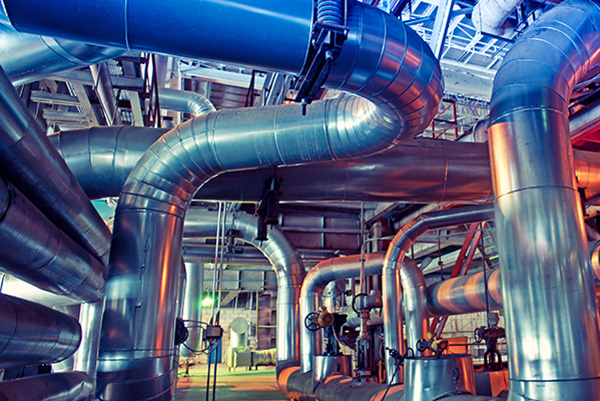
A distillation column is a continuous-operation separation vessel used in petroleum refineries to separate liquid hydrocarbon mixtures into individual components or product fractions based on differences in their volatility (boiling points). The column functions by establishing a continuous countercurrent contact between ascending vapor and descending liquid streams, enabling high-purity separation through repeated cycles of vaporization and condensation.
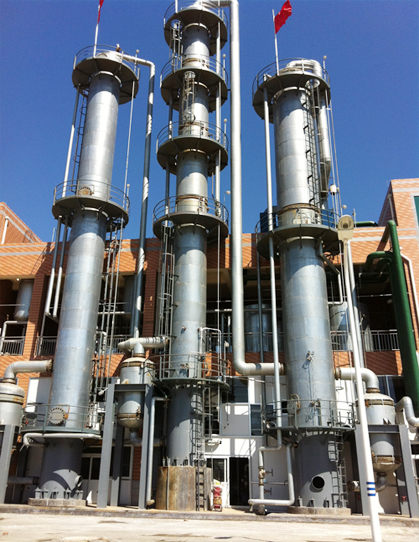
Distillation Installation | Credit: Hubei Sanli Fengxiang Technology Co., Ltd.
Basic Operating Principle
The distillation process relies on the thermodynamic principle that different hydrocarbon components within a mixture exhibit different boiling points. By applying heat to the bottom of the column and removing heat from the top, the column establishes a temperature gradient that drives the separation. Lighter, more volatile components preferentially concentrate in the vapor phase and rise toward the top of the column, while heavier, less volatile components condense and accumulate in the liquid phase flowing downward.
Physical Configuration
The column consists of a vertical cylindrical vessel typically constructed from carbon steel (or corrosion-resistant materials for specific applications) and contains internal contact devices to maximize vapor-liquid interaction. The column diameter and height are determined by the throughput requirements, desired separation difficulty, and product specifications.
Core Components
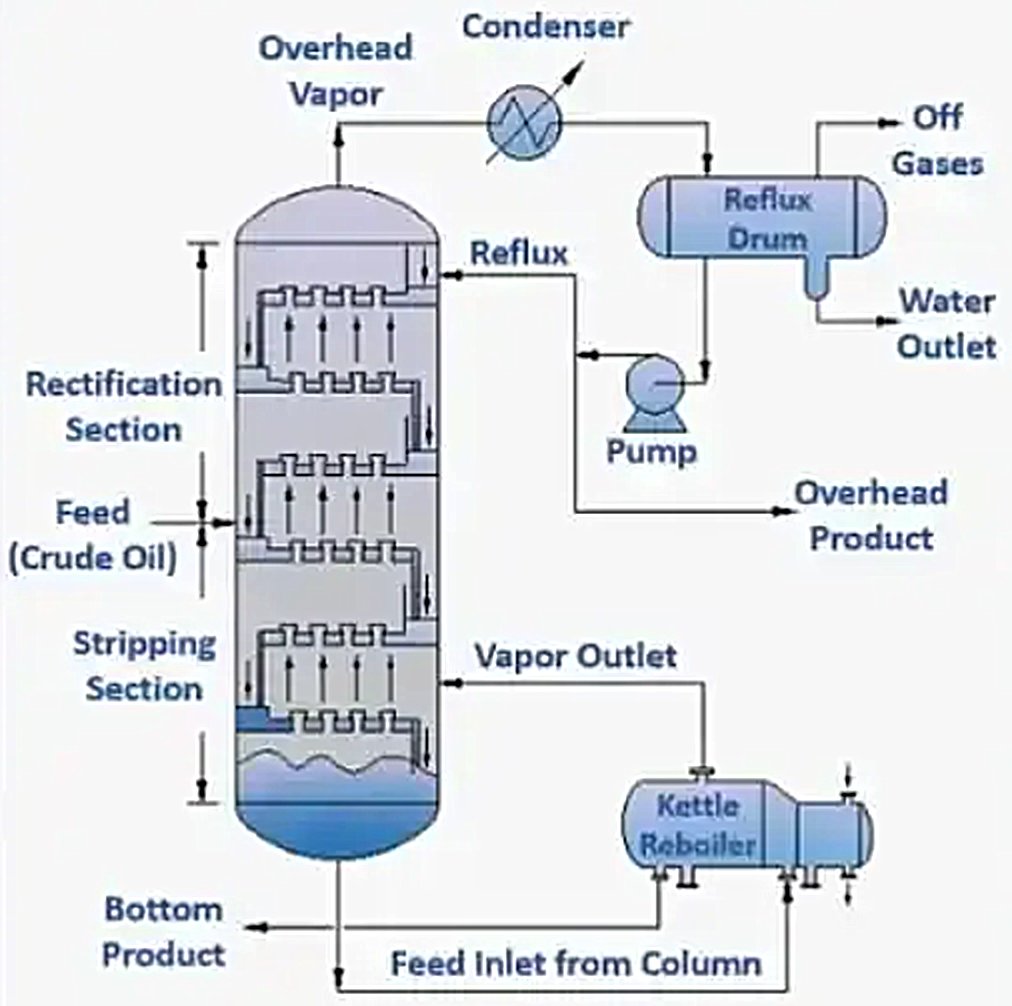
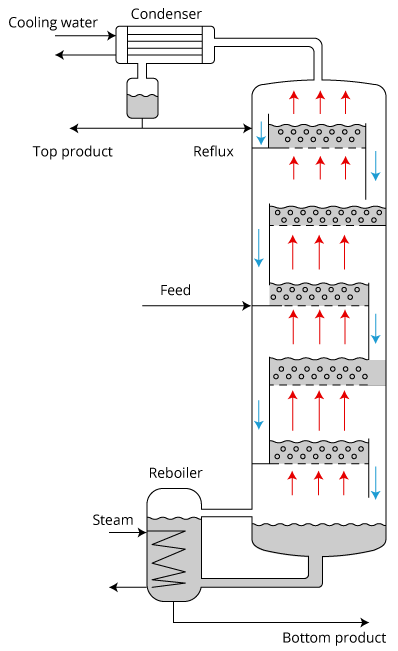
The process of tray distillation columns to purify mixture | Credit: Know Piping Engineering (July 2024)
Internals (Contact Stages): The column contains either trays (horizontal metal plates with designed openings for vapor passage and downcomers for liquid flow) or packing materials (random or structured metal, ceramic, or plastic elements that provide large surface area for vapor-liquid contact). Each stage provides one theoretical separation equilibrium. Typical industrial refinery columns contain 30 to 200+ theoretical stages depending on the separation difficulty. For example, a deethanizer column typically operates with 30-60 trays, while a depropanizer or debutanizer may require 40-90 trays for optimal separation of propane from propylene or butane from heavier components.
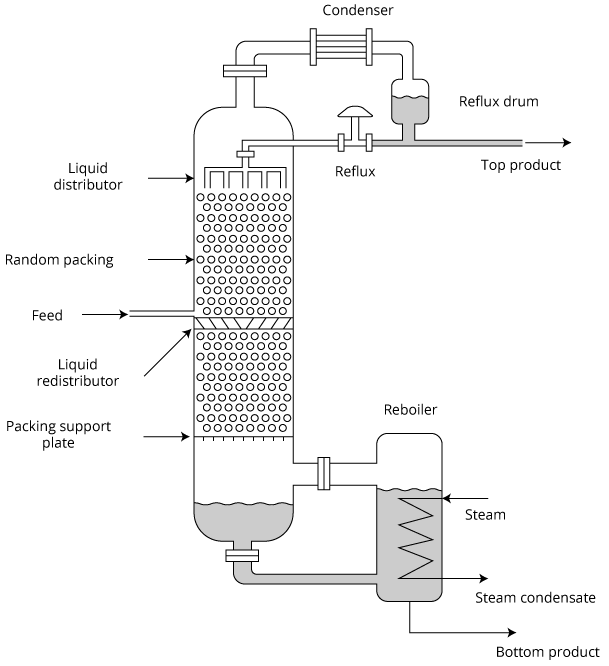
Schematic representations of a packed distillation column with random packings (left) and a tray distillation column with multiple trays in cascade and cross-flow pattern (right) | Credit: Chemical Engineering Virtual Labs, University of Waterloo, Canada
Reboiler: Located at the bottom of the column, the reboiler is a heat exchanger that provides the thermal energy necessary to vaporize the liquid at the column bottom, generating the rising vapor stream. The reboiler can be fired-tube, thermosiphon, or kettle-type. In some applications, particularly for stripper columns, direct steam injection can replace a conventional reboiler.
Condenser: Located at the top of the column, the condenser cools and condenses the rising vapor into liquid form. In petroleum refining, overhead condensers typically operate at atmospheric or slightly elevated pressure. For low-temperature separation processes such as C2 splitters and deethanizers operating at cryogenic conditions, specialized refrigerated condensers using propane or other refrigerants are employed.
Reflux Drum: The reflux drum (or overhead accumulator) collects the condensed overhead vapor. Part of this liquid is recycled back into the top of the column as reflux to enhance separation quality, while the remainder is removed as the overhead or top product (distillate).
Feed Point: The feed inlet, typically located near the middle of the column, divides the column into two functional sections.
Column Structure and Sections
The feed tray divides the distillation column into two distinct sections with different functions:
Stripping Section: The section below the feed tray where the concentration of heavy (less volatile) components in the descending liquid increases toward the reboiler. Vapor rising from the reboiler strips light components from the descending liquid. This section functions to strip light components from the bottom product.
Rectification (Enriching) Section: The section above the feed tray where the concentration of light (volatile) components in the ascending vapor increases as it rises. Reflux from the top provides the downward-flowing liquid stream (coutercurrent) that contacts the rising vapor. This section functions to enrich the overhead product in light components.
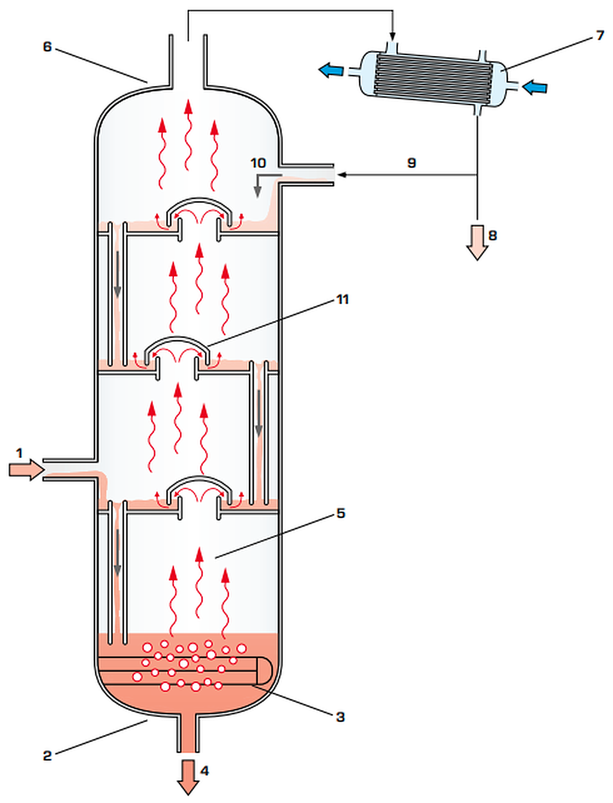
Principle of Rectification | Credit: Hubei Sanli Fengxiang Technology Co., Ltd.
1 Feed, 2 Bottom of column, 3 Bottom heating, 4 Bottom product, 5 Upward-moving vapor phases, 6 Top of column, 7 Condenser, 8 Top product, 9 Reflux, 10 Downward-moving liquid phase, 11 Tray (bubble cap tray in illustration)
Variations Based on Separation Requirements
While all distillation columns operate on the same fundamental principles, they are designated by specific device types based on their application:
Fractionators – Multi-Component Separation
Fractionators are multi-component distillation columns designed to separate feeds into multiple product streams (three or more) through the use of multiple side draws. These represent the most common type in crude oil refining, atmospheric and vacuum distillation units. They typically operate with 40-80+ trays and employ pump-around loops and side-stripper columns to economically extract intermediate products.
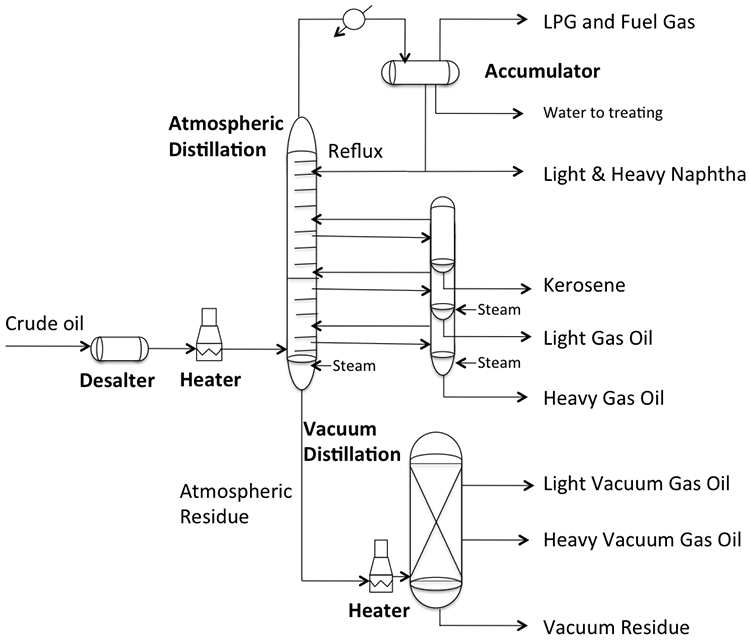
Multi-component separation in a crude oil fractionation process | Credit: PennState
Light Ends Fractionation Units
Light Ends Fractionation Units are a specialized sequence of distillation columns used to separate volatile hydrocarbon streams into defined product cuts based on carbon number. The light ends unit typically consists of a series of columns including:
- Deethanizer: Separates ethane (C2) and lighter components from propane and heavier (C3+) components. The deethanizer overhead product (ethane and methane) proceeds to a C2 splitter, while bottoms feed downstream separation stages. The deethanizer typically operates at elevated pressure (20-30 bar) with 30-60 trays.
- C2 Splitter: A high-purity binary splitter column that makes a sharp separation between ethylene and ethane in the C2 stream. The C2 splitter operates at low pressure and temperature (cryogenic), receiving both a vapor stream and a liquid stream. It produces high-purity ethylene as overhead and ethane (recycled to furnaces) as bottoms. This is a demanding separation due to the close boiling point of ethylene and ethane.
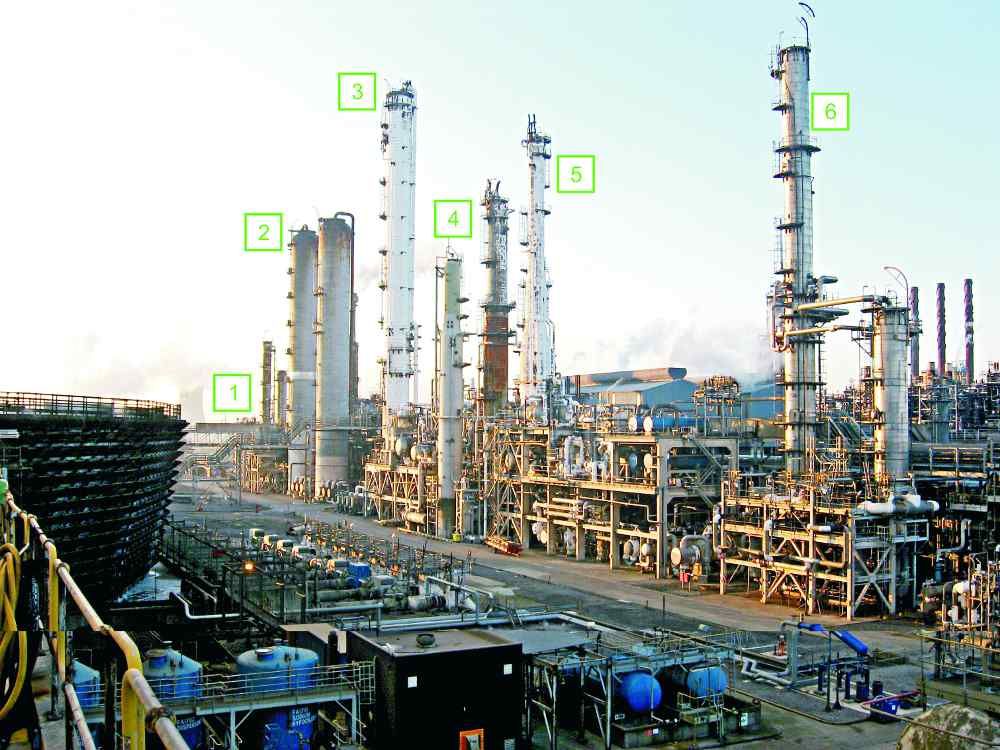
Separation Columns in a Steam Cracking Plant: 1 - A debutaniser which separates the C4 hydrocarbons from the C1-C3 hydrocarbons, 2 - A depropaniser which separates out the C3 hydrocarbons, 3 - A deethaniser which separates out the C2 hydrocarbons, 4 - A demethaniser which separates out the methane, 5 - A C3 splitter which separates propene from propane, 6 - A C2 splitter which separates ethene from ethane.
- Depropanizer: Separates propane (C3) and lighter components (C2) from butane and heavier (C4+) components. The depropanizer overhead product contains propane and propylene. The depropanizer typically operates at intermediate pressure (10-17 bar) with 40-70 trays.
- C3 Splitter: A high-purity binary splitter column designed to separate propylene from propane in the C3 stream. Due to the very close boiling points (propylene/propane relative volatility is less than 1.2), the C3 splitter requires significant reflux and many theoretical stages, making it one of the most energy-intensive separations in a gas processing plant. Some designs utilize two integrated towers (a stripper and rectifier) to optimize thermodynamic efficiency.
- Debutanizer: Separates butane (C4) and lighter components from pentane and heavier (C5+) components. The debutanizer receives liquid feed from the depropanizer bottoms and produces C4-rich overhead (sent to gasoline blending or further alkylation processing) and C5+ bottom product (heavy gasoline or cracked stock). The debutanizer typically operates at atmospheric or slightly elevated pressure (3-10 bar) with 40-90 trays.
- Deisobutanizer: In some configurations, further separation of isobutane (iC4) from normal butane (nC4) is performed, particularly when isobutane is needed for alkylation unit feedstock. This represents another high-purity binary separation.
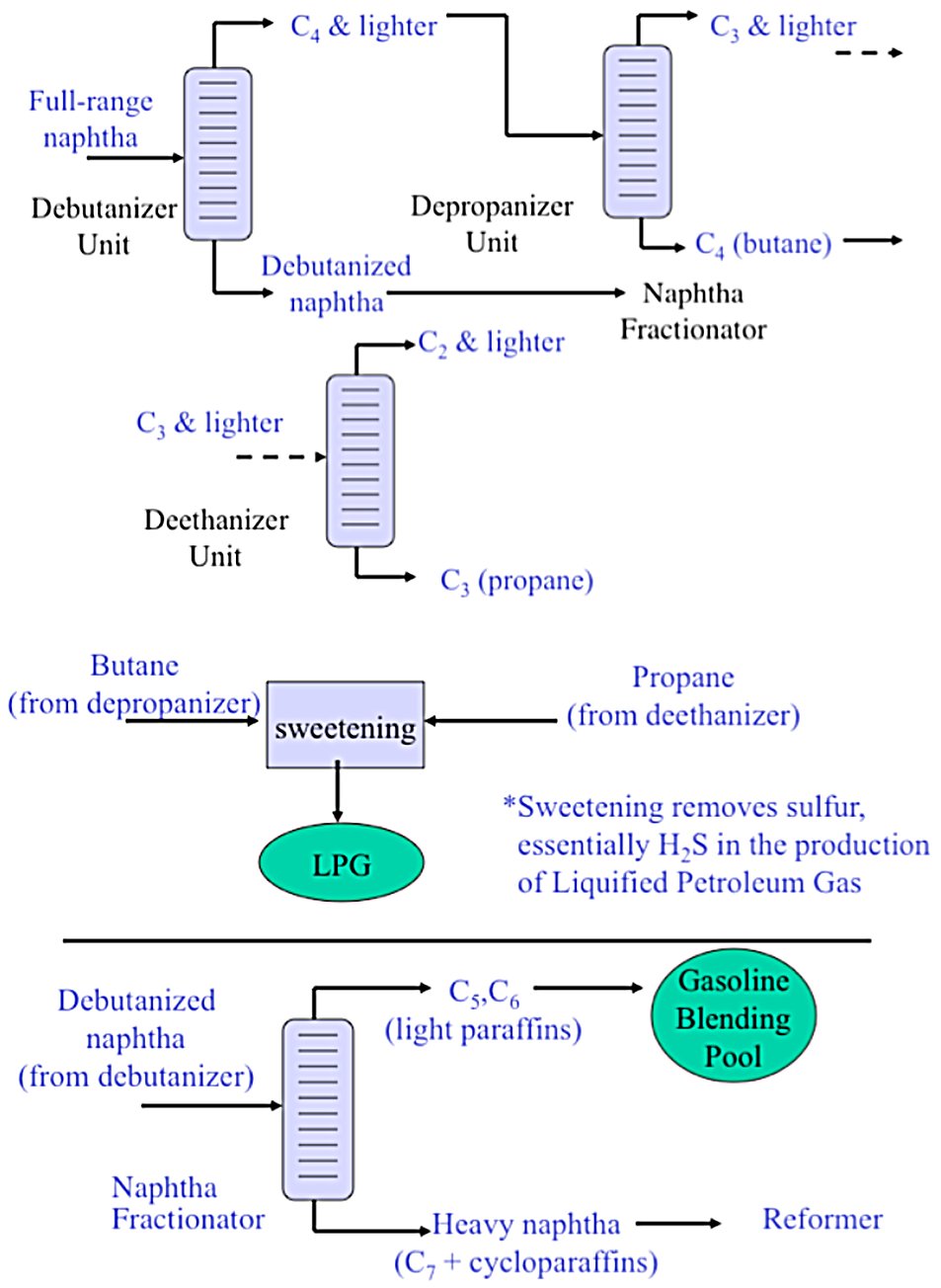
Separation in light ends unit | Credit: PennState
The light ends unit therefore converts a single overhead stream from an atmospheric distillation unit into five separate products: C2 and lighter (fuel gas), C3 (propane/LPG), C4 (butane/LPG), light naphtha (C5-C6), and heavy naphtha (C7+).
Binary Splitters (Product Splitters)
Product splitters are specialized high-purity distillation columns designed to separate feeds into primarily two product streams with high product purity specifications. These columns typically require higher reflux ratios, more theoretical stages, and tighter temperature/pressure control than fractionators. Examples include C3/C4 splitters, C2 splitters, and C3 splitters for separating close-boiling components. Binary splitters are inherently more energy-intensive than fractionators due to the proximity of product boiling points and the high purity requirements.
Rerun Columns (Redistillation Columns)
Rerun Columns are secondary distillation columns used to purify or upgrade an intermediate product stream through a second distillation pass. These columns operate similarly to binary splitters but process intermediate product fractions rather than primary feeds. In a light ends unit context, side-stripper columns (auxiliary distillation units integrated with side draws from main columns) function as rerun devices to recover entrained light components from intermediate product streams.
Stripper Columns
Stripper columns represent a specialized distillation configuration where the primary objective is to remove light volatile components from a liquid stream through contact with an upward-flowing vapor or steam stream. Unlike conventional distillation columns that have both rectification and stripping sections, stripper columns are designed with minimal or no rectification section above the feed point.
The feed enters near the top of the stripper column and flows downward through trays or packing material. Steam or stripping gas is injected at the bottom of the column, creating a countercurrent flow that strips light components from the descending liquid. The vapor phase, enriched with volatile components, exits from the top as overhead vapor, while the stripped liquid product is withdrawn from the bottom.
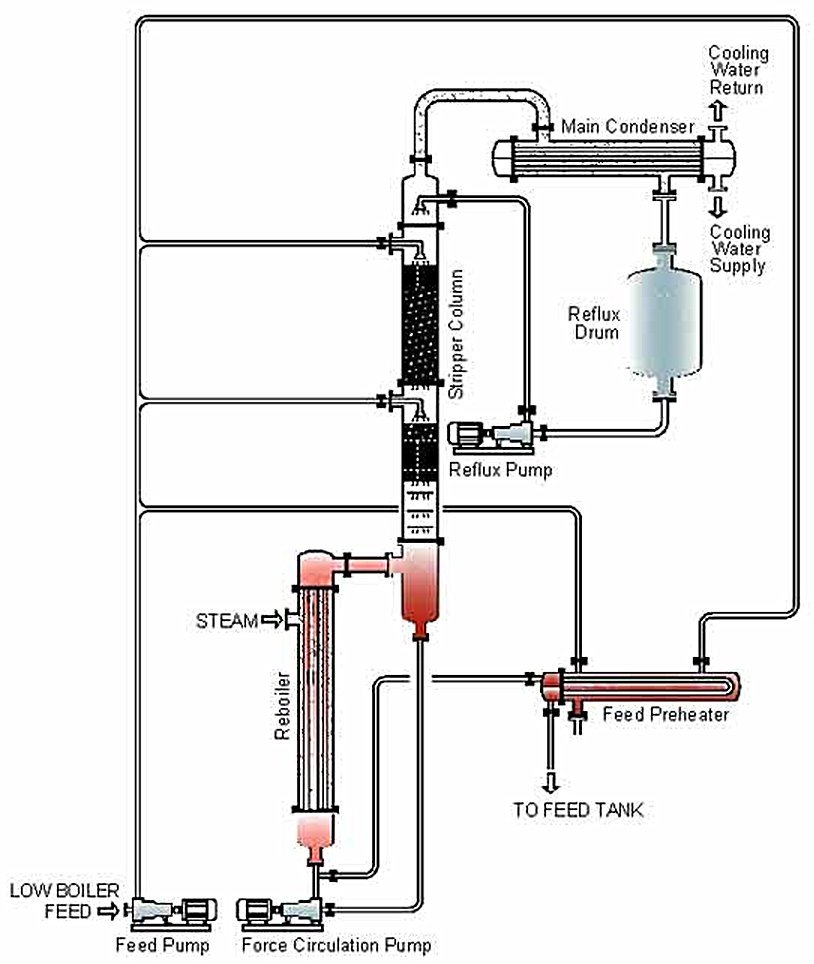
Stripping column for removing low boiling solvents | Credit: unitop aquacare
Stripper columns are widely used in refineries for several critical applications:
- Sour Water Strippers: Remove hydrogen sulfide (H2S) and ammonia (NH3) from contaminated water streams produced in atmospheric distillation units (ADU), fluid catalytic cracking units (FCCU), hydrotreaters, and coker operations. The sour water stripper uses steam to drive both H2S and NH3 into the gas phase, typically operating at pH around 8 to enable removal of both contaminants. Some refineries employ a two-stage configuration with separate H2S and NH3 stripping columns operating at different pH levels and pressures to produce segregated gas streams.
- Product Stabilizers: Remove dissolved light gases (typically C4 and lighter components) from liquid hydrocarbon products to reduce their vapor pressure for safe storage and transportation. Stabilizer columns receive hydrocarbon liquid feeds near the top and use steam stripping or reboiler-generated vapor to remove light ends. The stabilized liquid withdrawn from the bottom meets specified Reid Vapor Pressure (RVP) requirements for gasoline blending or product shipping.
- Hydrotreater Product Strippers: Strip light ends, hydrogen, and hydrogen sulfide from hydrotreated products in naphtha hydrotreater (NHT), kerosene hydrotreater (KHT), and diesel hydrotreater (DHT) units. These strippers typically use direct steam injection to lower the partial pressure of light components, inducing vaporization at lower temperatures and preventing thermal degradation of the product.
- Side Strippers: Small auxiliary stripper columns used in conjunction with crude distillation units and fractionators to remove entrained light components from side-draw product streams. Side strippers improve product specification control by stripping residual volatiles from kerosene, diesel, and gas oil side draws before they leave the main column.
The choice between using direct steam injection versus a conventional reboiler in stripper columns depends on several factors:
- Steam injection increases vapor flow rate, reduces liquid holdup, enhances mass transfer, and lowers the partial pressure of hydrocarbons, allowing vaporization at lower temperatures. This approach is preferred for heat-sensitive products, low-boiling-point components, and low-energy-cost scenarios. However, steam injection consumes more energy, introduces water into the overhead system, and may cause flooding or entrainment at high rates.
- Reboiler heating provides better energy integration opportunities, avoids water contamination of overhead vapors, and offers more precise temperature control. Reboilers are preferred for high-boiling-point components, moderate-purity products, and situations where steam is expensive or unavailable. However, reboilers require higher capital costs and may cause fouling or corrosion in the heat exchanger.
Stripper columns typically operate with 10-40 trays (significantly fewer than fractionators), use simple sieve trays or structured packing, and do not require overhead reflux systems since product purity in the overhead is not typically critical.
Operating Parameters
Distillation column performance is controlled through:
- Temperature Management: Maintaining appropriate temperature gradients by controlling reboiler duty, condenser duty, and reflux temperature. For example, a deethanizer may operate at higher temperatures (40-60°C overhead), while a C2 splitter operates at cryogenic conditions (-30 to -60°C overhead).
- Pressure Control: Operating at design pressure; light ends columns typically operate at declining pressures across the sequence (deethanizer at 25-30 bar, depropanizer at 15-20 bar, debutanizer at 5-10 bar) to enable integration of heat recovery between columns. Sour water strippers typically operate at 1-7 bar depending on whether a single-column or double-column configuration is employed.
- Reflux Ratio: The ratio of liquid returned to the column versus overhead product removed; higher reflux improves purity but increases energy consumption. Binary splitters such as C3 splitters require particularly high reflux ratios (often 3-5 or higher) for high-purity product separation. Stripper columns typically operate with zero reflux since the overhead product is not the primary product.
- Feed Rate and Feed Temperature: Controlled inlet flow and thermal condition (subcooled, saturated vapor, or superheated). In light ends units, feed temperatures are optimized through heat integration with downstream column condensers or side-draw cooling loops.
- Steam Rate (for strippers): In stripper columns using direct steam injection, the steam rate is a critical control parameter. Increasing steam rate improves stripping efficiency but increases energy consumption and overhead vapor handling requirements.
- Product Withdrawal Rates: Individual control of overhead, bottom, and side draw flows. In multi-component fractionators, precise control of multiple side draws is critical for simultaneous production of multiple products with specification purity.
- Tray Location Optimization: Feed tray location significantly affects column efficiency. For example, optimization of feed tray location in debutanizer or deethanizer columns can reduce heat duty by 1-29% while improving product composition.
Applications in Petroleum Refining
Distillation columns are used for:
- Crude Oil Fractionation: Separating crude oil into light naphtha, heavy naphtha, kerosene, diesel, light gas oil, heavy gas oil, and atmospheric residue in the atmospheric distillation unit
- Vacuum Distillation: Further separating heavy atmospheric residue fractions under vacuum to prevent thermal cracking in the vacuum distillation unit.
- Light Ends Recovery: Separating light hydrocarbon streams into individual components through the integrated deethanizer, depropanizer, debutanizer sequence for LPG and gasoline production
- Product Separation: Fractionation of intermediate streams (reformate, alkylate, cracked stocks) into component products through naphtha splitters and other fractionators
- Binary Separations: High-purity separation of close-boiling components such as propylene from propane, or ethylene from ethane through binary splitter columns
- Stabilization: Removing light gases from liquid products using stabilizer stripper columns to meet vapor pressure specifications
- Wastewater Treatment: Removing hydrogen sulfide and ammonia from sour water streams using sour water stripper columns
- Product Purification: Stripping light ends, hydrogen, and contaminants from hydrotreated products
- Side-Draw Product Finishing: Recovering entrained light components from intermediate product streams using side stripper columns
Energy Efficiency Considerations
Distillation is an inherently energy-intensive separation process. Energy optimization strategies in modern columns include side-draw recovery systems, thermal integration of heat exchangers between columns at different pressure levels (particularly in light ends units), heat pump integration between rectifying and stripping sections, and thermodynamic targeting to identify minimum energy requirements. For particularly difficult separations such as C3 splitters and propylene/propane separations, advanced technologies such as divided-wall columns have been developed to reduce energy consumption by 20-30% compared to conventional column sequences.
In stripper columns, energy efficiency is improved by optimizing steam injection rates, recovering heat from hot stripped bottoms to preheat incoming feed streams, and integrating overhead vapor condensation with feed preheating or steam generation.
References
A list of references is provide in this appendix.