Crude-to-Chemicals: From Refining to Molecular Manufacturing
For most of the twentieth century, crude oil was primarily refined into transportation fuels—gasoline, diesel, and jet fuel—with petrochemicals representing a secondary, opportunistic yield. The crude-to-chemicals (COTC, C2C, CTC, TC2C) concept inverts this hierarchy entirely: the refinery is redesigned from the ground up to maximize the conversion of crude into petrochemical feedstocks, with fuels becoming the byproduct rather than the objective. Conventional refineries yield only 10–20% chemicals from a barrel of crude; integrated COTC complexes now achieve 40–50% commercially, with advanced configurations targeting 70% and above.
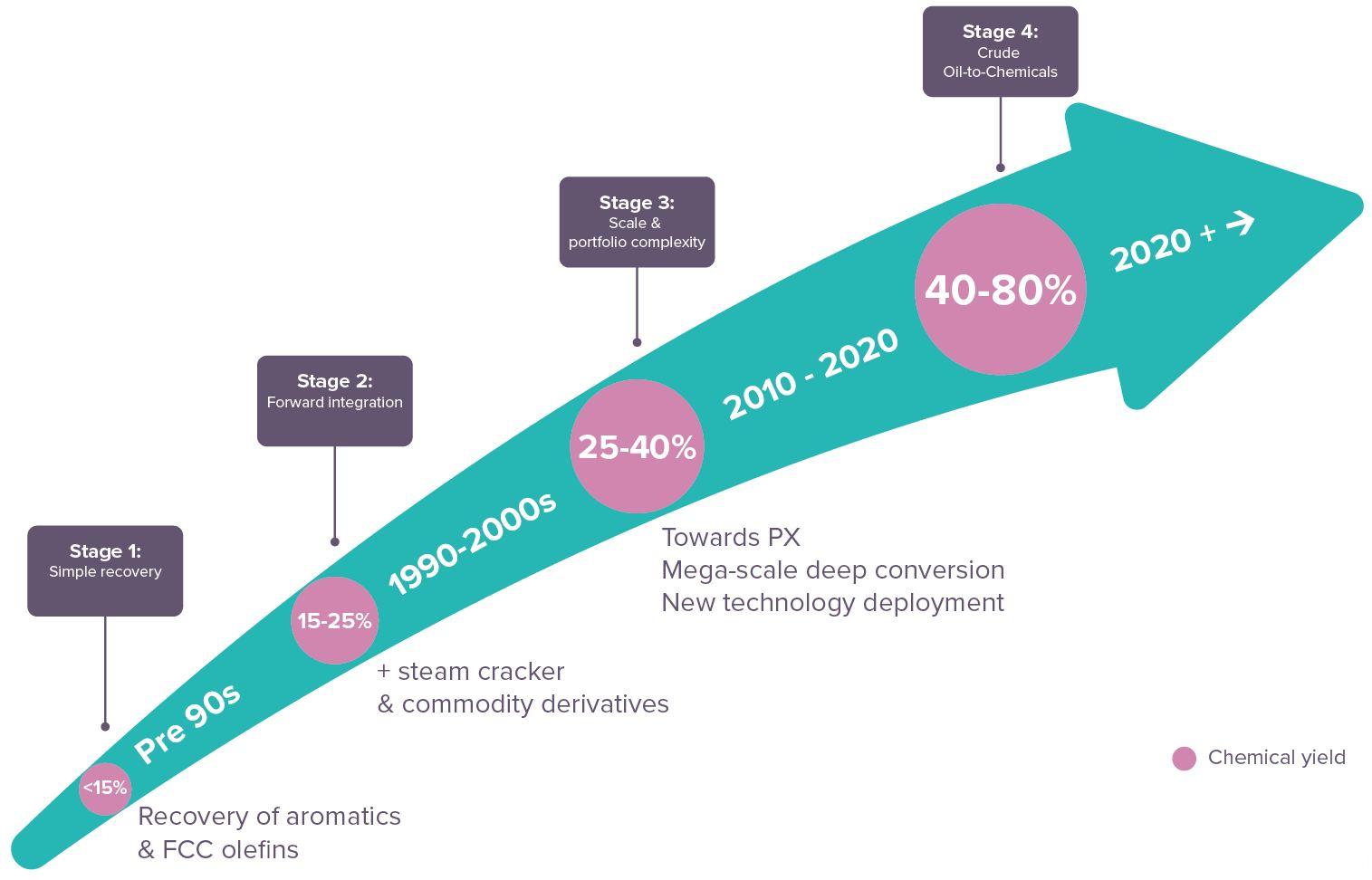
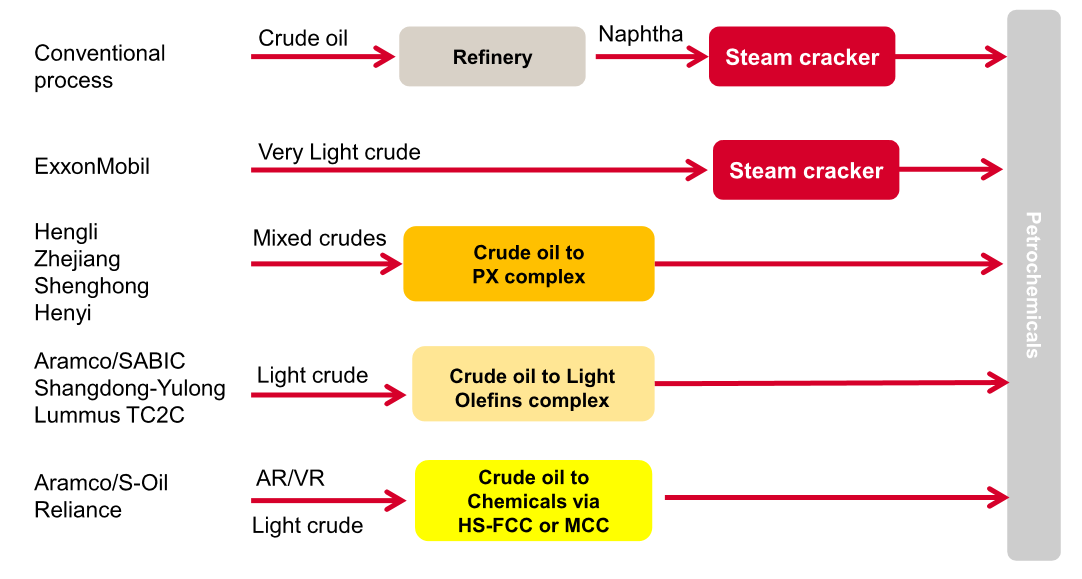
The constant evolution of refining over time towards chemical yield was achieved in four main stages up to the ultimate integration degree between refining and petrochemicals materialized by the Crude-To-Chemicals (CTC) complexes corresponding to a chemical yield greater than 40% | Source: Axens Crude-to-Chemicals (CTC) page
The concept gained industrial momentum in the 2010s as petrochemical demand growth began to outpace fuel demand growth globally. Saudi Aramco's Thermal Crude-to-Chemicals (TC2C) program, ExxonMobil's Singapore integrated complex — the longest-running commercial proof of concept for direct crude steam cracking — and large-scale integrated complexes in China (Zhejiang Petrochemical, Hengli Petrochemical) established COTC as a commercially proven paradigm rather than a speculative vision. Technology licensors including Shell, Axens, Honeywell UOP, and Lummus Technology have since developed dedicated COTC licensing packages.
An Integration Concept, Not a Single Technology
A common misconception is that crude-to-chemicals refers to a specific process unit or reactor. It does not. COTC is an integration architecture—a deliberate configuration of multiple established and emerging process technologies, interconnected so that the output of each unit becomes the optimal feedstock for the next.
No single catalyst, reactor, or licensed unit converts crude oil directly into polyethylene or terephthalic acid in one step. Instead, COTC complexes chain together distillation, hydroprocessing, catalytic cracking, steam cracking, catalytic reforming, and aromatics separation into a tightly coupled system governed by molecular management logic—routing every hydrocarbon fraction to the conversion pathway that extracts maximum chemical value. As Axens describes it, the integration is the innovation. The degree of chemical yield achieved depends not on any one unit but on the depth and precision of inter-unit integration. This is why COTC projects are capital-intensive and site-specific: the value lies in the system design, not a single licensed process.
The Three Interlocking Blocks
A well-designed COTC complex is typically organized around three functionally distinct but tightly coupled processing blocks, each handling a specific crude fraction and targeting a specific family of chemical products.
Conversion Block — Residue Upgrading
The conversion block processes the heavy end of crude: vacuum gas oil, atmospheric residue, and vacuum residue—fractions that in a conventional refinery would become heavy fuel oil or require expensive coking. In a COTC configuration, these streams are instead fed to hydrocrackers, slurry-phase reactors, or high-severity FCC units to crack them into lighter, chemically useful fractions. The objective is to eliminate the heavy fuel oil pool entirely, routing all carbon upward into the olefins or aromatics blocks. Hengli Petrochemical's Dalian complex—one of the world's largest integrated COTC facilities—exemplifies this approach, processing ultra-low-sulfur crude directly through a deeply integrated hydrocracker-to-cracker chain with virtually no fuel oil yield.
Olefins Block — Light Ends Processing
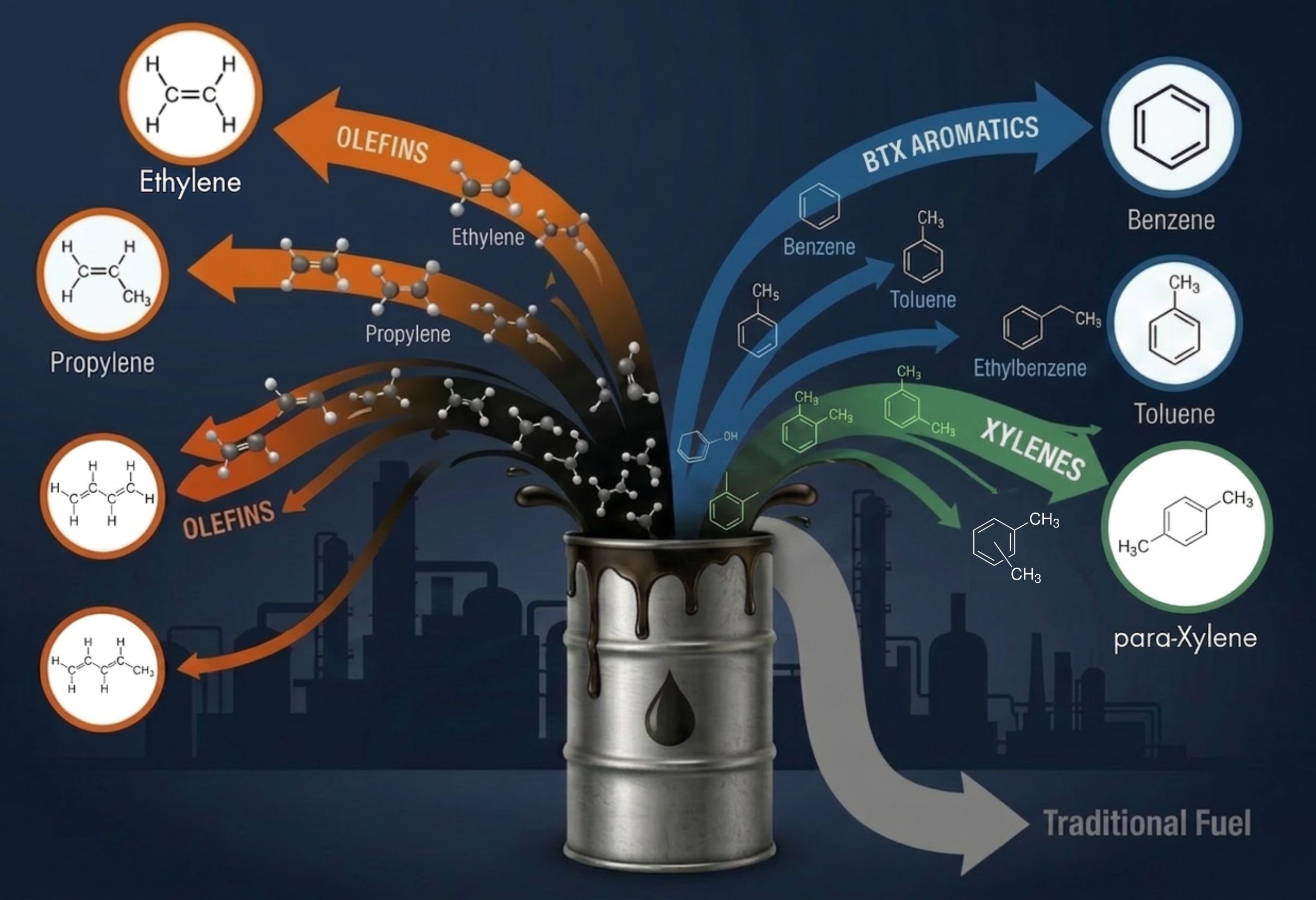
The olefins block centers on the steam cracker, which processes light naphtha, LPG, ethane, and other light fractions produced upstream. Operating at temperatures above 800°C, steam crackers pyrolytically break C–C bonds to yield ethylene, propylene, 1,3-butadiene, and mixed C4 streams—the primary building blocks for polyolefins, synthetic rubbers, and a wide range of chemical intermediates. In COTC complexes, the steam cracker is fed not just by light ends from the atmospheric distillation unit but also by hydrocracker effluents and FCC light products, maximizing olefin throughput. ExxonMobil Singapore—the oldest operating COTC configuration—processes very light Malaysian crude oil directly in a steam cracker using a flash pot between the convection and radiant sections of the furnace, bypassing conventional distillation entirely. It has been operating for over a decade and is the proof-of-concept reference for direct crude steam cracking. The S-OIL Shaheen project (Onsan refinery, South Korea)—the first commercial deployment of Saudi Aramco/Lummus/CLG's TC2C™ technology, currently under construction—integrates a 46 kbpd TC2C unit with a 1,800 ktpa mixed-feed steam cracker, targeting over 65% chemical yield.
Aromatics Block — Heavy Naphtha Processing
The aromatics block processes heavy naphtha through catalytic reforming and aromatics extraction to produce the BTX family: benzene, toluene and xylenes. Para-xylene is the most commercially significant output, feeding purified terephthalic acid (PTA) units for PET resin and polyester fiber production. Reformate and pyrolysis gasoline from the steam cracker are additional aromatics sources, extracted and fractionated in integrated aromatics recovery units. Zhejiang Petrochemical's Zhoushan complex in China—with para-xylene capacity exceeding 9 million tonnes per year—represents the most scaled-up deployment of this block in a COTC context.
Technology Components
Feedstock Conditioning and Process Integration
Effective crude-to-chemicals conversion begins before the first reactor. Desalting, stabilization, and pre-fractionation remove contaminants and sharply segregate crude into chemically relevant fractions—light naphtha, heavy gas oil, and residues—each routed to the most appropriate downstream unit. The quality and precision of this initial fractionation directly determines the efficiency of all downstream conversion.
A critical step in COTC feedstock preparation is crude hydroprocessing pretreatment. In the approach demonstrated with Arab Light, the crude is first passed through a hydroprocessing unit to remove sulfur, nitrogen, and metals and to improve the hydrogen-to-carbon ratio of the feed. The vacuum residue fraction is then separated and removed — routed to dedicated residue upgrading. Critically, all remaining material up to the vacuum gas oil range is fed directly to the steam cracker, where it is pyrolysed to produce ethylene, propylene, and pyrolysis gasoline (pygas) as the major products. Only the vacuum residue is excluded from the cracker feed.
Coupling vacuum distillation with hydrocrackers or pyrolysis reactors ensures that residues are upgraded into chemical feedstocks rather than fuel blendstocks, systematically minimizing diesel and gasoline yields by design. Feed routing logic—which fraction goes to which unit under which operating conditions—is the key differentiator between a reconfigured fuel refinery and a purpose-built COTC complex.
Thermal Conversion
High-severity thermal cracking is the workhorse for processing heavy fractions that are too refractory for catalytic routes alone. Steam cracking at temperatures above 800°C breaks long-chain hydrocarbons into light olefins with high selectivity. For heavier feeds including atmospheric and vacuum residues, supplying active hydrogen — either via elevated hydrogen partial pressure or through hydrogen-donor diluents such as tetralin — stabilizes free radical intermediates formed during pyrolysis, suppressing coke precursor condensation and improving liquid product yields.
Advanced reactor designs with liquid circulation and recycle systems manage polynuclear aromatic (PNA) buildup to prevent equipment fouling, enabling continuous operation at high conversion rates. In a COTC context, thermal processes such as visbreaking and delayed coking serve as residue destruction steps within the conversion block — thermally cracking vacuum residue into lighter gas oils, naphtha, and LPG streams that feed the olefins and aromatics blocks downstream, while solid coke is removed as a byproduct.
Catalytic Conversion
Catalytic routes provide the greatest flexibility for steering product slates toward high-value chemical intermediates. Three configurations are particularly central to COTC complexes:
-
High-severity FCC using modified zeolite catalysts shifts selectivity toward propylene and BTX aromatics by increasing cracking temperature and catalyst-to-oil ratio, with propylene yields reaching 20–25 wt% in deep-cracking configurations
-
Multifunctional direct-conversion catalysts simultaneously crack hydrocarbons, remove sulfur, and isomerize intermediates in a single pass—reducing unit count, capital cost, and inter-unit handling losses
-
Hydrocracker–steam cracker integration upgrades heavy vacuum gas oil into naphtha and light olefins, with unconverted oil recycled for maximum carbon efficiency, as practiced in the Shell COTC configuration
Hydroprocessing Integration
Deep hydroprocessing is the enabling backbone for COTC when processing high-sulfur or extra-heavy feeds. Slurry-phase hydrocracking reactors with in-situ catalyst activation handle the most refractory crudes under elevated hydrogen pressure, producing lighter fractions suitable for downstream steam crackers and aromatics units. Without adequate hydroprocessing, sulfur and metals contamination would poison the downstream catalysts on which the entire COTC value chain depends.
Hydrocracker effluents are increasingly routed directly to steam crackers, while integrated aromatics recovery units extract benzene and xylenes from reformate and pyrolysis gasoline streams. Mild hydrocracking also serves as FCC pretreatment, protecting catalysts from metals and nitrogen poisoning while boosting naphtha yields,.
Key Challenges
Despite rapid commercial progress, COTC complexes face structural challenges that limit adoption beyond greenfield projects in capital-rich environments:
-
Hydrogen supply and cost: Deep hydrocracking consumes hydrogen at scale; building or sourcing sufficient H2 infrastructure adds significant capital and operating cost, and ties the complex's economics to natural gas prices
-
Catalyst durability: High-severity FCC, slurry-phase hydrocracking, and direct crude conversion all impose severe conditions on catalysts; achieving commercial lifetimes while maintaining selectivity remains an active area of R&D
-
Capital intensity: Grassroots COTC complexes are among the most capital-intensive industrial projects ever built—Zhejiang Petrochemical's Phase 1 and 2 exceeded $20 billion USD—limiting deployment to sovereign wealth-backed or major integrated players
-
Retrofit economics: Reconfiguring an existing fuel refinery toward COTC yields rarely pencils out; the inter-unit integration required is difficult to graft onto infrastructure optimized for fuel production, making brownfield conversion economically complex
-
Feedstock flexibility vs. optimization: COTC complexes are typically optimized for a narrow crude slate; processing off-spec or highly variable crudes degrades yields and risks catalyst poisoning across multiple downstream units