1. Summary
The SABIC Proprietary Emulsion ABS Technology is the emulsion (hybrid) ABS production route offered for license by Technip Energies, which acts as exclusive worldwide licensor of the proprietary SABIC technology and markets the package as "Cycolac™ ABS emulsion technology"[1][2]. The technology descends from the longest-lived commercial ABS lineage: Cycolac was introduced by Marbon Chemical, a division of Borg-Warner, in 1954; the USPTO assignment records of the Borg-Warner process patents (US 4,141,932 and US 4,182,820) document the transfer to GE Chemicals, Inc. (1989–1990) and General Electric Company (1995), and SABIC acquired the business with GE Plastics in 2007[4]. The process follows the dominant global ABS manufacturing family — emulsion grafting of styrene and acrylonitrile onto polybutadiene latex, followed by blending of the recovered high-rubber graft powder with separately polymerized styrene–acrylonitrile (SAN) resin[1][2] — but is organized into a four-unit configuration with distinctive design choices: semi-batch polybutadiene latex (PBL) polymerization with dedicated mechanical particle-size control, a high-rubber graft (HRG) train with continuous coagulation and drying, SAN produced in a single agitated bulk reactor, and final compounding on an extruder package. Reference plants include two 200,000 MTA lines at Tianjin Dagu, China (start-up Q4 2010 and Q4 2011) and a 140,000 MTA line at Petrokemya, Saudi Arabia (start-up Q1 2016)[1].
2. Ownership, licensing and lineage
- Technology lineage. Cycolac, one of the first commercial ABS resins, was introduced by Marbon Chemical, a division of Borg-Warner, in 1954. Borg-Warner's process patents of the era — the combined emulsion-graft/suspension finishing process (US 4,141,932, filed Oct 3, 1977) and the low-emulsifier, fatty-alcohol-assisted dispersion SAN polymerization (US 4,182,820, filed Jun 8, 1978) — carry USPTO assignment records documenting the corporate chain: Borg-Warner Corporation → Borg-Warner Chemicals Inc. (1981) → BW-ABS Corporation (1988) → GE Chemicals, Inc. (1989–1990) → General Electric Company (1995). SABIC acquired the business with GE Plastics in 2007[4].
- Technology owner: SABIC — the handbook classifies the process explicitly as "Proprietary SABIC technology"[1].
- Licensor: Technip Energies, stated to be the exclusive worldwide licensor; the ABS package sits within the Badger Process Technology portfolio in Technip Energies' Technology & Product Handbook, and the licensor's Styrenics brochure markets the package under the Cycolac™ name[1][2].
3. Process overview
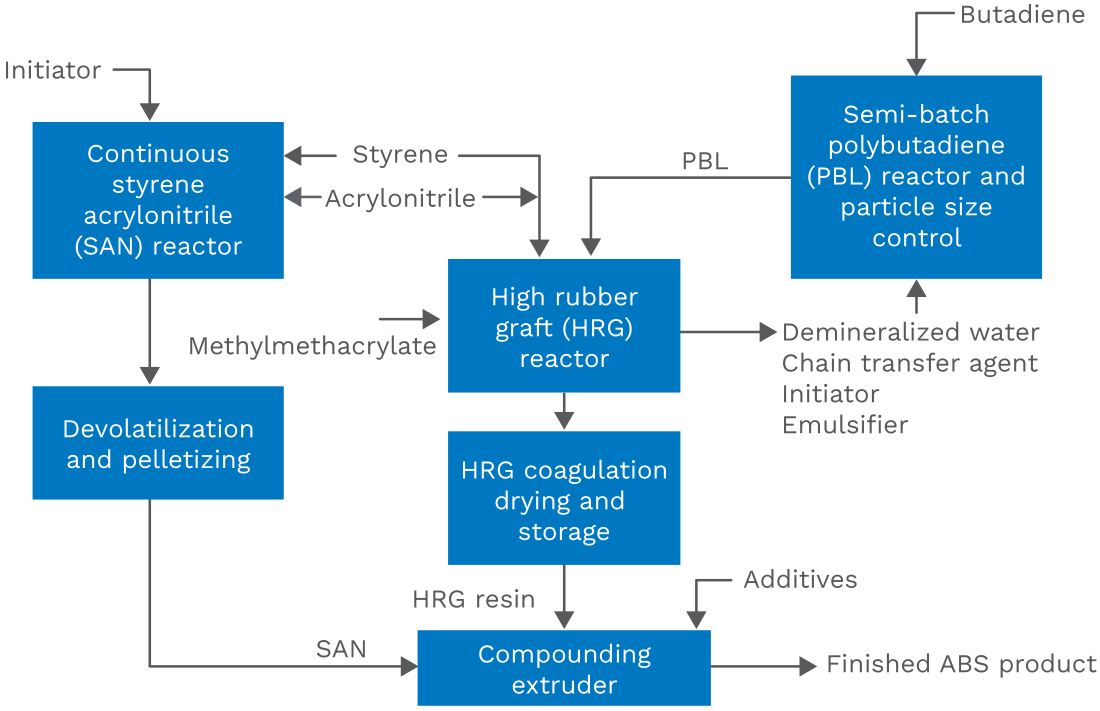
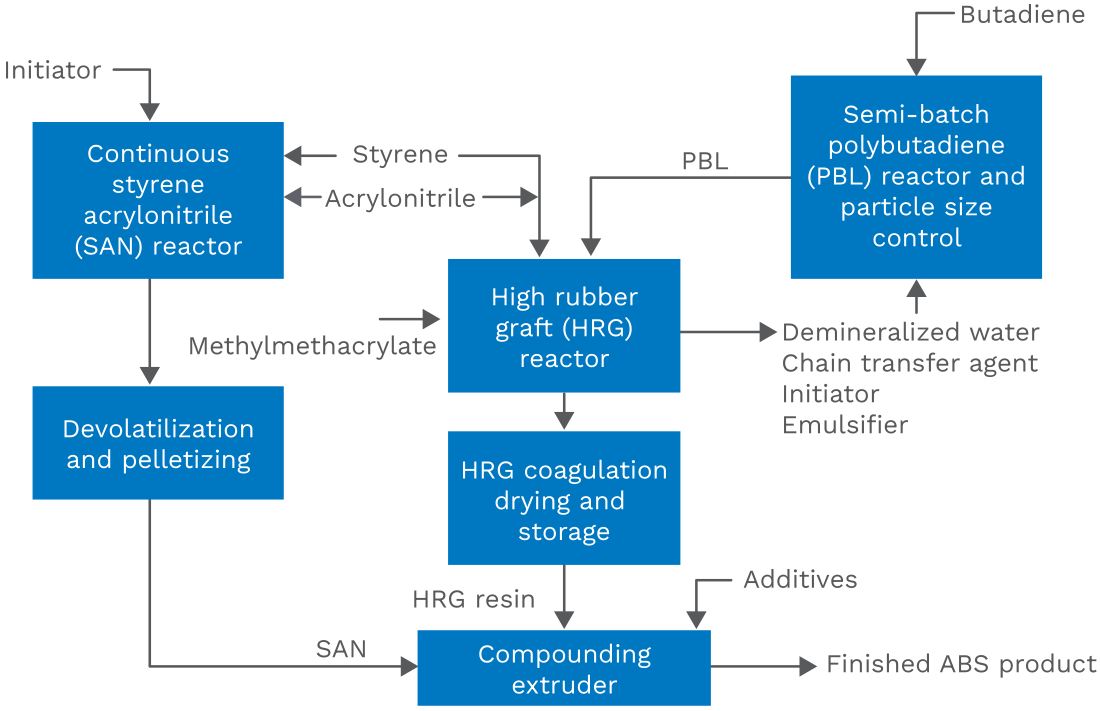
The technology requires four main process units[1]:
Figure 1 — Cycolac™ ABS emulsion technology block flow diagram
| Unit |
Function |
| Polybutadiene Latex (PBL) unit |
Emulsion polymerization of butadiene to polybutadiene latex, with feed preparation, reaction, flash removal of unreacted butadiene and particle-size control[1] |
| High Rubber Graft (HRG) unit |
Graft copolymerization of styrene and acrylonitrile (methyl methacrylate appears as a feed in the published flow diagram[1]) onto the PBL, followed by continuous coagulation, drying and storage of the HRG resin[1] |
| Styrene–Acrylonitrile (SAN) unit |
Bulk SAN copolymerization in a single agitated reactor, with feed filtration, devolatilization, unreacted-monomer recovery and SAN pelletizing[1] |
| Compounding unit |
Automated feed of HRG resin, SAN pellets and additives to an extruder package (screen changer, strand die, water slide, pelletizer, pellet dryer, water recirculation and screener) with pellet transfer to product surge hoppers and packaging[1] |
4. Step-by-step process description
4.1 Polybutadiene latex synthesis
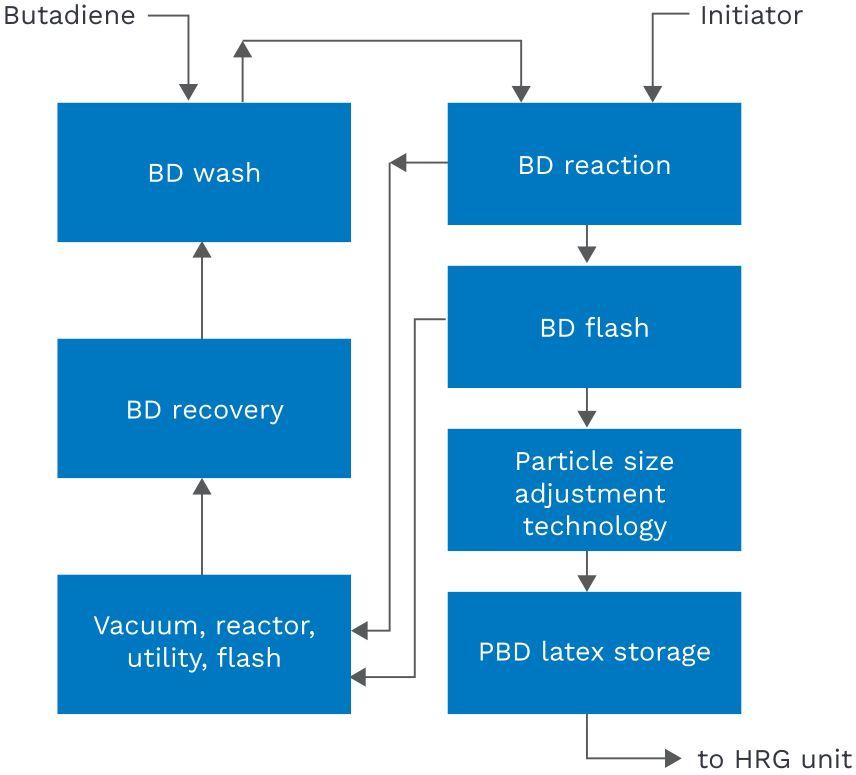
The PBL unit uses a semi-batch reaction process: butadiene, water, emulsifier and additives are initially charged at a relatively low percentage of the total reaction volume and then continuously added throughout the reaction cycle. According to the licensor this yields a faster batch time and an inherently safer reaction, since stopping the feed stops the reaction process without risk of runaway reactions[1]. After reaction and removal of unreacted butadiene, the latex passes a mechanical particle-size control operation that produces a PBL with a desirable particle-size distribution[1]. The licensor's Styrenics brochure describes the semi-batch PBL process as a unique patented technology that differentiates SABIC's process and products from the competition, with more than ten years of service at two production sites representing more than 100 reactor-years of operation[2].
Figure 2 — Semi-batch polybutadiene process (PBL) block flow diagram
4.2 High-rubber graft polymerization
The final PBL intermediate is combined with styrene, acrylonitrile and additives in the HRG unit, which uses the same semi-batch technique as the PBL reactor[1]. The graft reaction step is followed by a continuous coagulation and drying process that forms resin particles and delivers the dry HRG product[1]. A single polybutadiene latex and a single high-rubber graft product serve the whole plant, which the licensor credits with simplified operation[1]. The Styrenics brochure adds that the HRG process has been in service for more than 15 years at three production sites, representing more than 150 reactor-years of operation without a major safety incident[2].
4.3 SAN synthesis
SAN is produced in parallel with the HRG train in a single agitated bulk reactor; the SAN unit comprises feed filtration, bulk reaction, devolatilization, unreacted monomer recovery and SAN pelletizing[1]. The licensor reports that the SAN process has been in service for more than 30 years without a major process safety incident[2].
4.4 Compounding and finishing
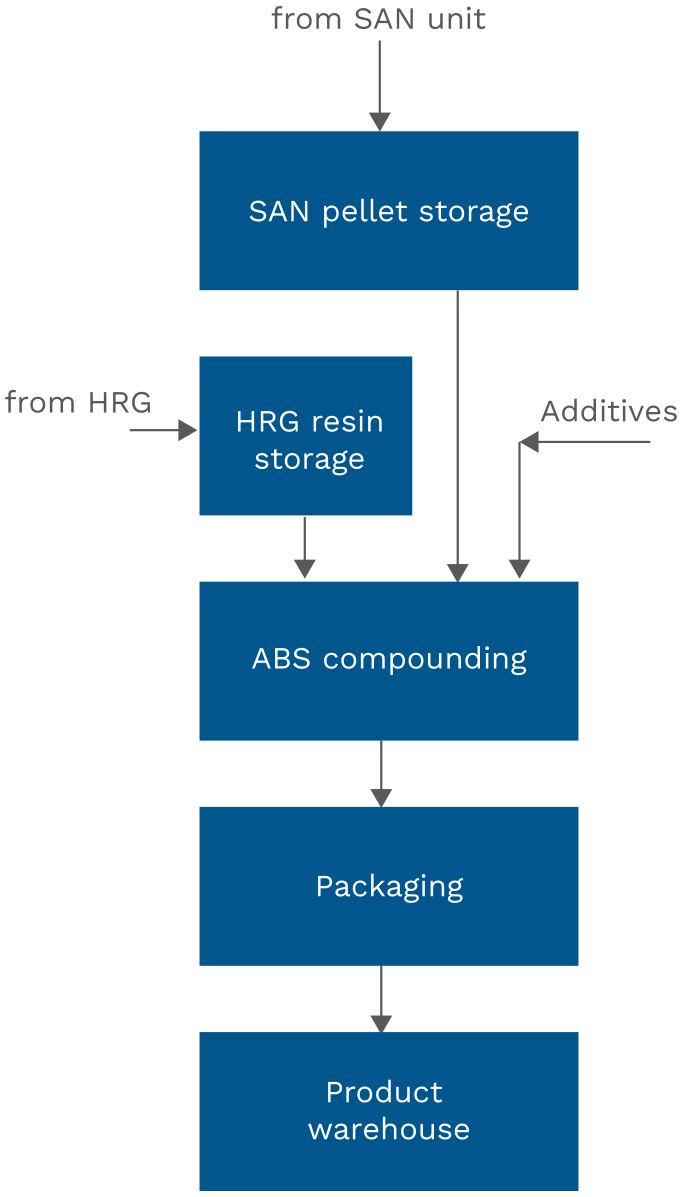
Finished ABS is formulated in the compounding unit. An automated feed system delivers HRG resin, SAN pellets and preblended additives to the extruder; the extruder system includes a screen changer, strand die, water slide, pelletizer, pellet dryer, water recirculation system and screener, and the screened pellet material is transferred to product surge hoppers and packaging[1].
Figure 3 — ABS compounding extrusion process block flow diagram
5. Product characteristics and grade slate
ABS properties can be widely varied by using different concentrations of butadiene rubber particles and acrylonitrile in the copolymer[1]. The licensor states that the technology delivers a broad product family meeting demanding application requirements, that custom high-heat grades with polycarbonate blends are available for license, and that additive flexibility enables specialty products in natural, black, white and custom colors[1]. The compounding unit's product portfolio comprises more than 24 grades covering general-purpose moulding and extrusion, high-heat ABS, building and construction grades, appliances, fire-retardant ABS and specialty grades for antistatic and low/high-gloss applications[2]. Application fields named for the technology are electronics, appliances, building, construction and transportation[1].
6. Performance claims
- Inherently safe reaction processes with low reaction viscosities[1]
- High process yields[1]
- Competitive capital and operating costs[1]
- Single polybutadiene latex and high-rubber graft product, simplifying operation[1]
- Exceptional product quality across a broad family of products[1]
- Optimized impact–flow performance with low organic volatiles and non-polymer impurities[1]
- Additive flexibility enabling specialty product colors[1]
Quantified figures declared by the licensor across the technology generations[2]:
- Capital and investment: recent technology generations brought a 25–35% reduction in total investment cost compared with previous generations.
- PBL: improved mechanical agglomeration raised throughput per unit by 100% versus the previous generation; reactor volume use of 85–90% versus 70–75% for a typical batch process; reaction cycle of 8 hours versus 18–48 hours for standard batch and direct-growth technologies; only one reactor cleaning shutdown per quarter; monomer recovery yield greater than 99.5%.
- HRG: reaction-process improvements raised capacity per reactor by 25%; graft reaction cycle of 4.25 hours versus 8–16 hours for standard technologies; patented monomer conversion greater than 99.8%; a newly developed water-recycle system reuses 90% of water inside the HRG battery limits and reduces waste-water effluent by 90%; a redesigned dryer dust collector reduces air pollution from dust in vent vapors.
- SAN: debottlenecking achieved a 90% increase in production rates with better resin quality; monomer recovery yields greater than 99%; acrylonitrile content up to 34% possible; no solvents in manufacturing or cleaning.
- Compounding: improved extrusion process raised throughput per line by 120%; extruder sizes from 70 mm to 133 mm.
No independent third-party performance comparison with other licensed ABS technologies was located in the reviewed public sources; the statements above are licensor-declared.
7. Commercial experience
| Plant |
Capacity |
Milestone |
| Tianjin Dagu Chemical, Tianjin, China — Phase I |
200,000 MTA |
Start-up Q4 2010[1] |
| Tianjin Dagu Chemical, Tianjin, China — Phase II |
200,000 MTA |
Start-up Q4 2011[1] |
| Petrokemya (front-end engineering 2011; plant at Al-Jubail, Saudi Arabia) |
140,000 MTA |
Start-up Q1 2016[1] |
| Undisclosed client |
200,000 MTA |
PDP engineering started January 2020[1] |
The Tianjin Dagu reference plants are consistent with Daguchem's commercial ABS resin slate (injection-moulding and extrusion grades), although the producer's own product pages do not name the licensor[3].
8. Notes
- Polymerization conditions such as reactor sizes, temperatures and per-unit consumptions are not disclosed in the reviewed licensor material; no values are inferred here. The cycle times, conversion figures and generation-over-generation improvements quoted in section 6 are licensor-declared comparisons, not absolute design guarantees.
- The term "hybrid/emulsion" family used in the companion profile covers emulsion grafting blended with separately produced SAN; the SABIC package belongs to this family, with the SAN produced in bulk in a single agitated reactor[1].
- Technip Energies also offers a second ABS process for license — a continuous mass route with lower capital cost — alongside the emulsion package described here[2].
9. References
- Technip Energies B.V. — Technology & Product Handbook (Oct, 2023), Acrylonitrile butadiene styrene (ABS) p. 13
- Technip Energies N.V. — Styrenics: Ethylbenzene, Styrene Monomer, Acrylonitrile Butadiene Styrene and Polystyrene Technologies brochure, Badger Process Technology portfolio (© 2021 Technip Energies N.V.), ABS technology section pp. 11–17
- Tianjin Dagu Chemical Co., Ltd. — Daguchem Product Portfolio: ABS (accessed: Nov 18, 2026)
- Borg-Warner Corporation — Butler J.M., Combined Emulsion and Suspension Process for Producing Graft ABS Bead-Like Particles, US 4,141,932 A (filed Oct 3, 1977; granted Feb 27, 1979); Curfman D.C. & Rea G.D., Process for Polymerization of Styrene and Acrylonitrile, US 4,182,820 A (filed Jun 8, 1978; granted Jan 8, 1980). USPTO assignment records (Google Patents legal events) document the transfer chain Borg-Warner Corporation → Borg-Warner Chemicals Inc. (1981) → BW-ABS Corporation (1988) → GE Chemicals, Inc. (1989–1990) → General Electric Company (1995)