The INEOS continuous mass polystyrene technology is a bulk (solvent-free) free-radical polymerization process for general-purpose polystyrene (GPPS, "crystal" PS) and high-impact polystyrene (HIPS), developed and historically offered for licensing by INEOS Technologies[2]. The reaction train combines two CSTR-type prepolymerization reactors with proprietary agitator designs and a final plug-flow reactor of proprietary design, followed by two-stage vacuum devolatilization with foaming-agent stripping (residual styrene down to 200 ppm), distillative recovery of styrene and ethylbenzene, and melt finishing to pellet[2]. Swing-line operation produces both GPPS and HIPS grades in single lines of 60,000–200,000 tpy with a 60% turndown capability[2].
The technology's lineage traces to BP Chemicals: BP's petrochemicals business (Innovene) was acquired by INEOS in 2005 in a "transformational acquisition", and INEOS Technologies was formed from the restructuring of Innovene in the same year[1]. By 2010, nearly 1.3 million tpy of world-scale capacity had been awarded through seven projects using the INEOS proprietary technology[2]. Since September 2025, INEOS Styrolution's Antwerp operations also process chemically recycled styrene monomer supplied by Indaver's depolymerisation plant, 10 km from the Zandvliet site, demonstrating integration of recycled feedstock with the company's mass polymerization operations[3][4].
1. Process history and ownership
The continuous mass polystyrene process was developed and licensed by BP Chemicals. BP established its styrenics operations over several decades, and the process was offered for licensing under the BP banner before the corporate succession to INEOS. In 2005, INEOS acquired BP's petrochemicals subsidiary Innovene and, upon restructuring Innovene, formed INEOS Technologies — the licensor of record for the polystyrene process[2] — alongside INEOS Nitriles, INEOS Olefins & Polymers, INEOS Refining and other business units[1]. INEOS also acquired BASF's US and Canadian polystyrene business in 2005, forming INEOS Styrenics, and launched the expanded INEOS Nova Styrenics joint venture in 2007[1]; these transactions consolidated INEOS's position across both PS production and styrenics licensing.
The licensor of record for the continuous mass PS process is INEOS Technologies[2]. INEOS Styrolution, the group's styrenics producer, operates polystyrene plants and confirmed in September 2025 the first commercial-scale delivery of recycled styrene monomer at its Antwerp site[3][4]; the corporate history does not, however, publish the legal assignment of the process technology title between INEOS entities beyond the INEOS Technologies licensor identification in the licensor handbook[2].
INEOS Technologies is no longer an active technology licensor: INEOS wound down its technology-licensing activities across the portfolio in the mid-2010s. The group's annual report for 2015 still describes INEOS Technologies as "a leading developer and licensor of polyolefin, expandable polystyrene, nitriles, maleic anhydride, and vinyls technologies" and states "we license our polyethylene, polypropylene, polystyrene... technologies to third parties"[5]; from the 2016 annual report onward the wording changes to the past-tense "we have licensed" and the licensor profile statement disappears[6] — marking the end of active licensing between the 2015 and 2016 reporting years. The last polystyrene technology licence publicly announced was the expandable-polystyrene licence to EPS Qatar announced in June 2014[7]; no further GPPS/HIPS licensing announcements followed. The process remains in commercial operation at INEOS Styrolution and licensee plants, but the technology is no longer offered for new licences.
2. Process summary and chemistry
The process polymerizes styrene by free-radical chain polymerization in bulk, without an aqueous suspension or emulsion medium:
n CH2=CH–C6H5 → [–CH2–CH(C6H5)–]n
For GPPS, styrene monomer is combined with minor additives and, where used, initiators. For HIPS, polybutadiene rubber bales are chopped into crumbs and dissolved directly in the styrene feed in a proprietary grinding-and-dissolving unit using a high-shear in-line mixer, which permits high-capacity production of dissolved rubber at high rubber concentration[2]. Polymerization may be initiated thermally or chemically depending on the product; the licensor describes a "catalyzed polymerization" feature said to enhance polymer/rubber grafting and reduce oligomer byproducts[2]. Ethylbenzene is used as a viscosity modifier (diluent), and a foaming agent is injected into the second devolatilization stage as stripping agent[2].
The reaction is strongly exothermic, and heat removal with temperature control of the viscous reaction mass is the central reactor-design requirement. In the INEOS design, the prepolymerization reactors provide temperature and morphology control, and the final plug-flow reactor provides high-efficiency heat removal[2].
3. Step-by-step process description
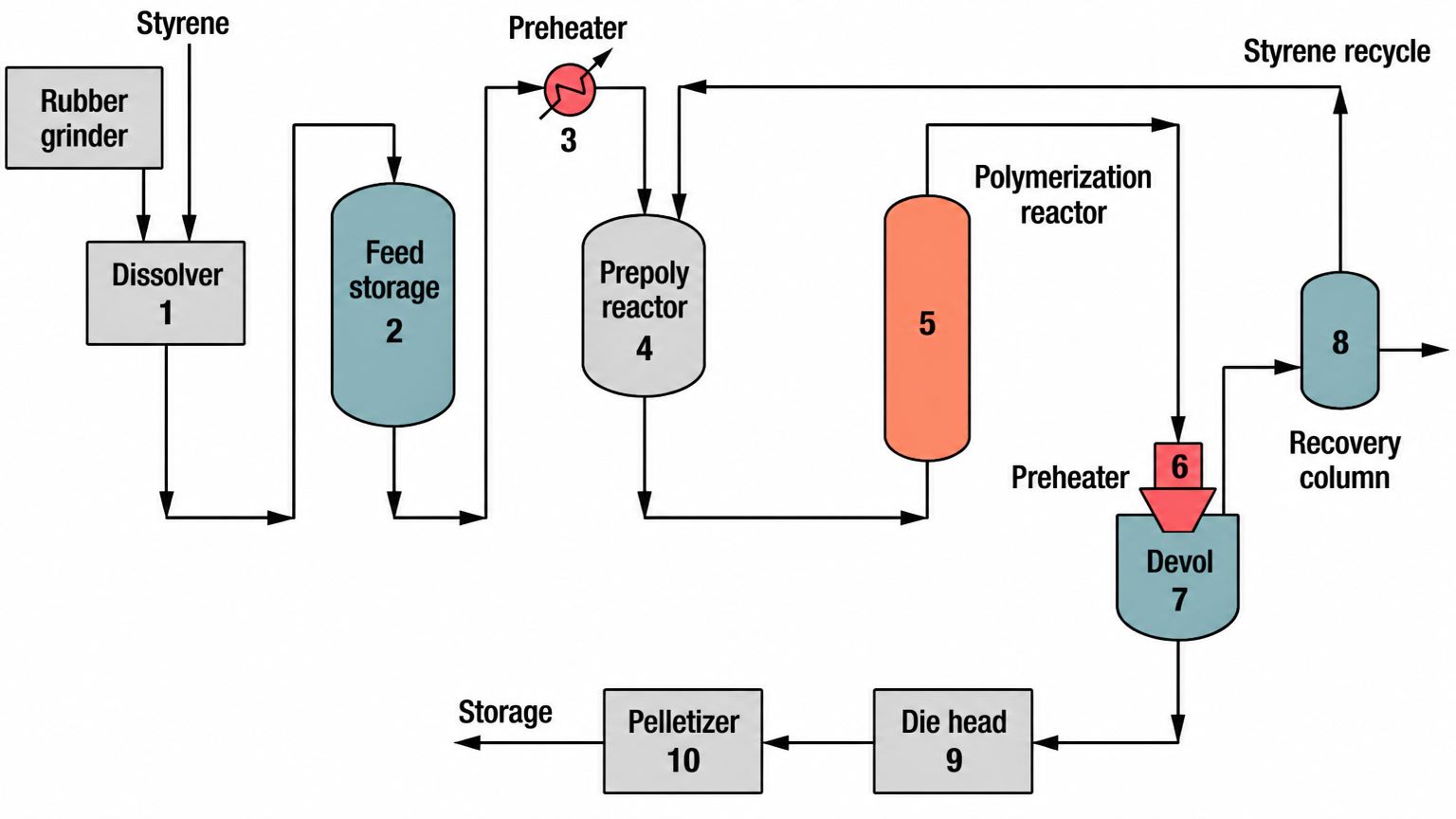
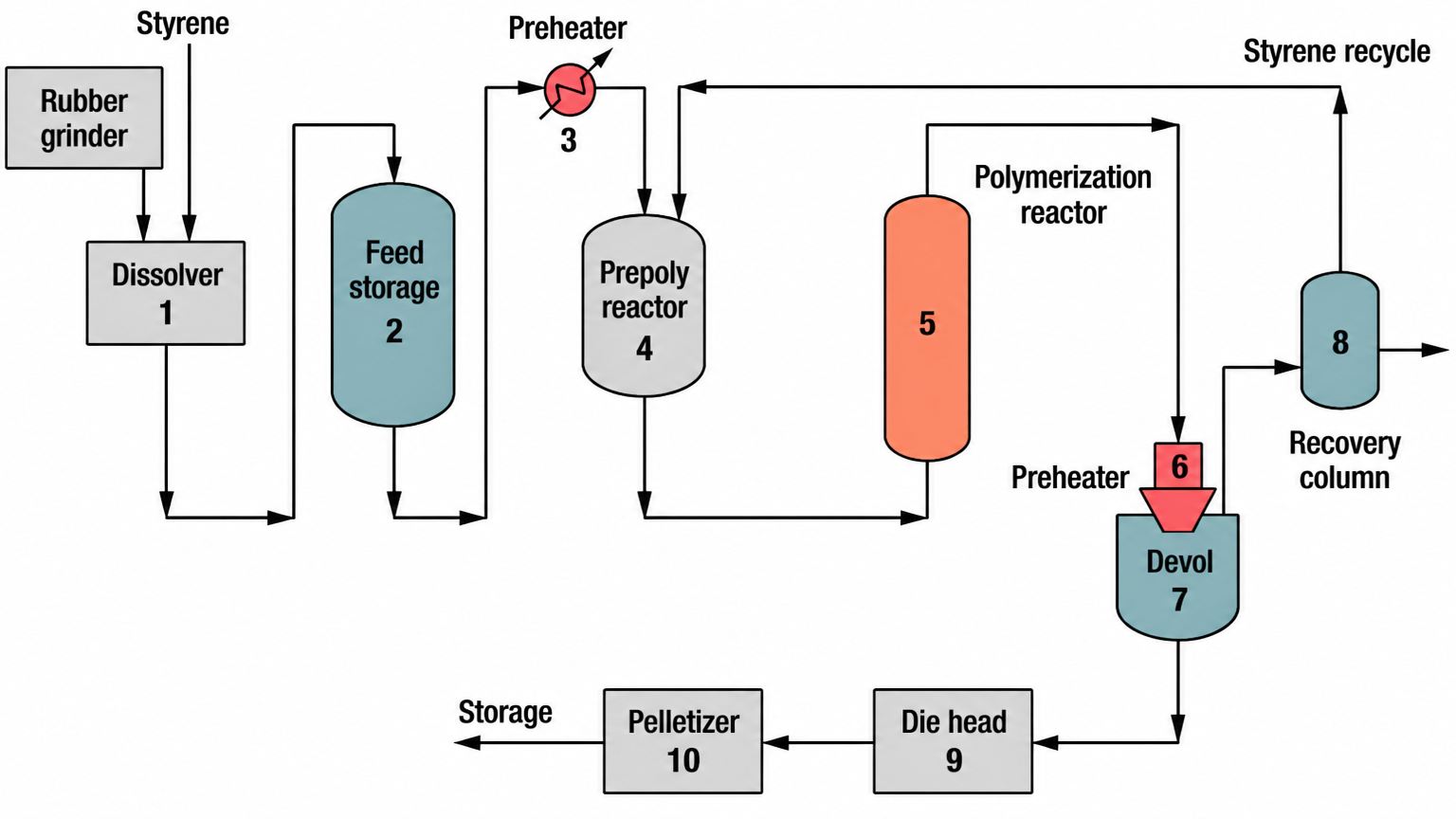
The flow scheme below follows the licensor handbook flow diagram (Fig. 1: rubber grinder → dissolver (1) → feed storage (2) → preheater (3) → prepoly reactors (4) → polymerization reactor (5) → preheater (6) → devolatilizer (7) → recovery column (8) → die head (9) → pelletizer (10) → storage)[2].
Figure 1 — Simplified process flow diagram of the INEOS styrene mass polymerization technology[2]
Step 1 — Rubber dissolving (HIPS)
Polybutadiene rubber in bale form is chopped into crumbs and dissolved in preheated styrene in a high-shear in-line mixer — the proprietary rubber grinding and dissolving unit. This operation allows high-capacity production of dissolved rubber at a high rubber concentration[2]. For GPPS, this step is bypassed and pure styrene with minor additives and initiators (where used) is fed forward.
Step 2 — Prepolymerization
Prepolymerization is conducted in the first two reactors, which are CSTR-type with proprietary agitator designs[2]. Prepolymerization may be thermally or chemically initiated depending on the desired product. For HIPS, this phase is critical: it is where the rubber morphology and the physical properties of the resultant product are controlled — polystyrene grafts onto the rubber chains and, with agitation and temperature control, the two-phase morphology with the desired rubber-particle structure develops[2].
Step 3 — Final polymerization
Polymerization is completed in the last reactor, a plug-flow type of proprietary design allowing high-efficiency heat removal and temperature control on viscous media[2]. The plug-flow arrangement preserves the rubber morphology developed upstream and brings the reaction mass to the conversion required for devolatilization[2].
Step 4 — Devolatilization
Devolatilization is a two-step operation under high vacuum to remove light components — unreacted styrene and diluent — enhanced by the addition of a foaming agent in the second stage; the stripping effect of the foaming agent reduces the residual monomer content to as low as 200 ppm[2].
Step 5 — Recycle recovery
Unreacted styrene and diluents from devolatilization are distilled in a recovery column and recycled to the front end of the process. The distillation ensures that only styrene and ethylbenzene are recycled back to the first prepolymerization reactor, minimizing the styrene purge and keeping the oligomer concentration in the reactor system low. Two purges control the accumulation of light and heavy components: a lights purge (styrene and ethylbenzene) and a heavy purge (oligomers and other heavy organics); both are used as fuel for the hot-oil heater[2].
Step 6 — Finishing and pelletizing
The polymer melt is filtered, extruded through a die head into strands, cooled, and cut into cylindrical pellets of prescribed size. The pellets are sorted from fines and oversize and conveyed to quality-control and product silos[2]. A low-pressure (LP) steam generation system is part of the process features[2].
4. Technology performance and features
Licensor-stated process features[2]:
- Proprietary rubber grinding and dissolving unit
- Catalyzed polymerization — enhanced polymer/rubber grafting; reduced oligomer byproducts
- Proprietary prepoly reactor design allowing temperature and morphology control
- Proprietary plug-flow reactor design — temperature control, high conversion rates, rubber morphology preservation
- High-efficiency devolatilization system
- LP steam generation system
- Ongoing development of new and improved formulations
Licensor-stated client benefits[2]:
- High rubber efficiency; excellent rubber yields
- Low investment cost and inventory on the rubber section
- High consistency and product quality through rubber morphology control
- Best-in-class residual styrene monomer (SM) on final product (down to 200 ppm)
- Fast transitions and high prime-quality yields (swing-line GPPS/HIPS)
- Lowest utility consumption among licensed technologies
| Parameter |
Value[2] |
| Product slate |
GPPS and HIPS, swing-line operation |
| Single-line capacity |
60,000–200,000 tpy |
| Turndown capability |
60% |
| Prepolymerization reactors |
Two CSTR-type, proprietary agitators;
thermal or chemical initiation |
| Final reactor |
Plug-flow, proprietary design,
internal heat-transfer duty |
| Devolatilization |
Two-stage, high vacuum,
foaming agent in second stage |
| Residual styrene monomer |
As low as 200 ppm |
| Recycle |
Styrene + ethylbenzene distilled and
recycled to first prepolymerization reactor;
lights and heavy purges to hot-oil heater fuel |
| Heat recovery |
LP steam generation |
The licensor's quantitative claims (capacity window, turndown, residual monomer) are stated in the licensor handbook; no independent plant operating data, conversion levels, or utility-consumption figures are published in the sources reviewed. Numerical conditions not disclosed publicly include reactor temperatures and pressures, residence times, conversion by reactor, rubber concentration and dissolution conditions, and devolatilization vacuum levels.
5. Commercial experience
By 2010, nearly 1.3 million tpy of world-scale capacity had been awarded through seven different projects using the INEOS proprietary technology[2]. The licensor describes the technology as commercially proven with worldwide product acceptance[2]. Individual licensee names, plant locations and start-up dates are not published in the sources reviewed; the licensed-plant list therefore remains incomplete pending an INEOS Technologies licence catalogue or licensee announcements.
No new PS technology licences have been announced since the mid-2010s (see section 1); INEOS Technologies' licensing activity across all product lines wound down in that period[5][6].
In September 2025, INEOS Styrolution confirmed the first commercial-scale delivery of chemically recycled styrene monomer in Europe: the first truckloads arrived at the Antwerp site, supplied by Indaver from its new depolymerisation plant — the first facility in Europe dedicated to polystyrene recycling — inaugurated on 25 September 2025, located about 10 km from INEOS Styrolution's Zandvliet location (Indaver's Plastics2Chemicals plant)[3][4]. INEOS states that the recycled feedstock enables production of high-quality polystyrene and other styrenics, including food-grade, transparent and medical applications[3]. The announcements do not disclose which polymerization line processes the recycled monomer, the blending ratio, or the grades produced.
Appendix — Key equipment list (per licensor handbook flow diagram)
| No. |
Item |
Function |
| — |
Rubber grinder |
Chops polybutadiene bales into crumbs (HIPS) |
| 1 |
Dissolver |
High-shear in-line dissolution of rubber crumb in preheated styrene |
| 2 |
Feed storage |
Buffer of prepared GPPS/HIPS feed |
| 3 |
Preheater |
Feed temperature control ahead of prepolymerization |
| 4 |
Prepoly reactors (×2) |
CSTR-type, proprietary agitators; grafting and phase inversion (HIPS) |
| 5 |
Polymerization reactor |
Plug-flow, proprietary design; final conversion with high-efficiency heat removal |
| 6 |
Preheater |
Melt heating ahead of devolatilization |
| 7 |
Devol (×2 stages) |
High-vacuum devolatilization with foaming-agent stripping |
| 8 |
Recovery column |
Distillation of styrene/ethylbenzene recycle; lights and heavy purges |
| 9 |
Die head |
Strand extrusion of devolatilized melt |
| 10 |
Pelletizer |
Strand cutting to cylindrical pellets; fines/oversize screening |
| — |
Storage / QC silos |
Product silos downstream of pelletizing |
References
- INEOS — Our History (accessed: Nov 14, 2026) — 2005 acquisition of Innovene from BP; formation of INEOS Technologies; INEOS Styrenics (2005) and expanded INEOS Nova Styrenics JV (2007)
- Gulf Publishing Company — Hydrocarbon Processing, Petrochemical Processes 2010, "Polystyrene — INEOS Technologies" (2010; pp. 239–240) — process description, flow diagram, capacity window, turndown, residual SM, commercial plants, licensor; reprinted at Oil & Gas Process Engineering, "Polystyrene Process by INEOS Technologies" (Jun 18, 2018)
- INEOS Styrolution — INEOS Styrolution marks milestone with first commercial delivery of recycled styrene monomer from Indaver (Sep 25, 2025)
- INEOS Belgium — First delivery of recycled styrene monomer from Indaver to INEOS Styrolution (Sep 25, 2025) — Zandvliet site; Indaver Plastics2Chemicals plant 10 km away
- INEOS Group Holdings S.A. — Annual Report 2015 (2016; INEOS Technologies described as "a leading developer and licensor"; "we license our ... technologies to third parties"; 386 licenses in 56 countries agreed to date, 67 since beginning of 2008)
- INEOS Group Holdings S.A. — Annual Report 2016 (2017; licensing referenced in the past tense: "we have licensed our ... technologies")
- CHEManager — Ineos Technology for New EPS Plant in Qatar (Jun 06, 2014) — INEOS Technologies licenses expandable-PS process to EPS Qatar (50,000 t/y, Doha region); last publicly announced PS-family licence