
Name
Generic Refrigerated Lean Oil Absorber
Owner
/ Undefined Technology Provider
Brand

Description

The Refrigerated Lean Oil Absorber combines deep chilling via a C₂ refrigerant loop with counter-current oil scrubbing and a de-methanizer, boosting ethane recovery from ~30% (ambient absorption) to ~70–90%, at the price of significant refrigeration and regeneration energy.


Technology Description

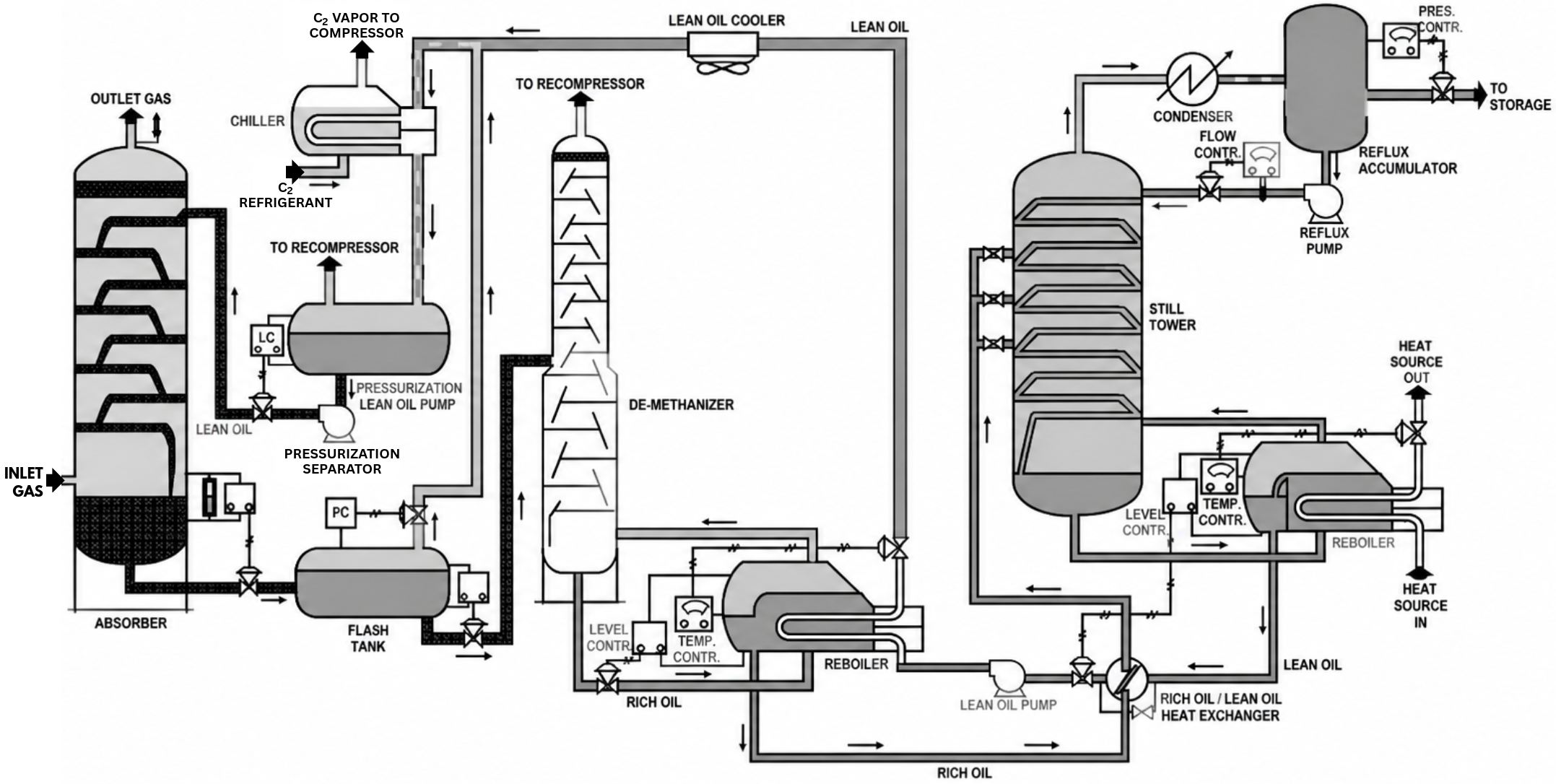
The Low-Temperature Lean Oil Absorption unit is designed specifically for ethane (C₂) recovery from a rich feed gas. Unlike conventional ambient-temperature absorbers, deep chilling dramatically improves ethane solubility in the absorption oil.


Flow Path (per diagram, left to right)

1. Inlet Gas Chilling (C₂ Refrigeration)

  • Rich inlet gas is first cooled in a chiller using a closed-loop ethylene/ethane (C₂) refrigerant system

  • The refrigerant is vaporized in the chiller; the vapor (“C₂ VAPOR TO COMP”) returns to a refrigerant compressor, is condensed, and recirculated

  • Feed gas is chilled to roughly −50 to −100 °C — cold enough to condense much of the C₂⁺ content

2. Absorber Column

  • The chilled gas enters the bottom of the Absorber

  • Chilled lean oil (fed at the top, pre-cooled by the Lean Oil Cooler) flows down counter-currently, dissolving C₂⁺ hydrocarbons

  • Outlet gas (methane-rich residue) leaves the top

3. Rich Oil Flash & Presaturation Section

  • Rich oil leaving the absorber bottom passes to a Flash Tank, releasing absorbed light ends (CH₄, H₂)

  • Flash vapors are routed to the Presaturator Separator, contacted with lean oil to recapture entrained heavies; off-gas goes “TO RECOMPRESSOR” for recycling or fuel

  • Liquid from the presaturator is pumped (Presaturated Lean Oil Pump) back into the system

4. De-methanizer Column

  • Rich oil is fed to the De-methanizer — a distillation column that strips residual methane overhead (“TO RECOMPRESSOR”), producing a methane-free C₂⁺ liquid

  • A reboiler supplies stripping heat at the column bottom

5. Still Tower (Lean Oil Regeneration)

  • The de-methanizer bottoms (still rich in absorbed C₂⁺ product) go to the Still Tower

  • Heat (via reboiler, “HEAT SOURCE IN”) distills the absorbed product overhead

  • Overhead vapors are condensed (Condenser), collected in the Reflux Accumulator, partly refluxed (Reflux Pump), and the net liquid product sent “TO STORAGE” (C₂/C₃⁺ NGL product)

  • Regenerated lean oil leaves the still tower bottom, is pumped (Lean Oil Pump) through the Rich Oil/Lean Oil Heat Exchanger (recovering heat), then through the Lean Oil Cooler, and back to the absorber top — completing the closed oil loop


Ethane Recovery Efficiency

Metric Value
Ethane recovery ~70–90% achievable —
far above ambient absorption (~20–50%)
Propane⁺ recovery ~95–99%
Methane rejection High — de-methanizer keeps CH₄
content in product low

Why Chilling Works

  • Ethane’s vapor–liquid equilibrium constant (K-value) falls sharply with decreasing temperature

  • Absorption factor A = L/(K·V) increases correspondingly → much higher C₂ recovery at practical lean-oil circulation rates

  • Chilling also pre-condenses a portion of the C₂⁺ before the absorber, reducing the load on the oil circulation system


Trade-off vs. Turboexpander (Cryogenic) Plants

  • Refrigerated absorption achieves comparable or slightly lower ethane recovery than modern turboexpander plants (~90–95%), but at higher energy cost (large oil circulation + refrigeration + reboiler duty)

  • This is why it was largely superseded by turboexpander technology for grassroots high-C₂-recovery plants, while remaining relevant in refinery/petrochemical applications (e.g., ethylene plant front ends) and revamps


Insight Articles
Your insights will be shown here

Refrigerated Lean Oil Absorption PFD | Enhanced from Petroleum Learning Programs https://www.petroleumlearning.com/training-manuals/e11-lean-oil-absorbers
Title Date
Content provided by
Transaction Name Date
Modified by UserPic   Kokel, Nicolas 9/5/2026 7:20 AM
Added by UserPic   Kokel, Nicolas 9/4/2026 12:47 PM