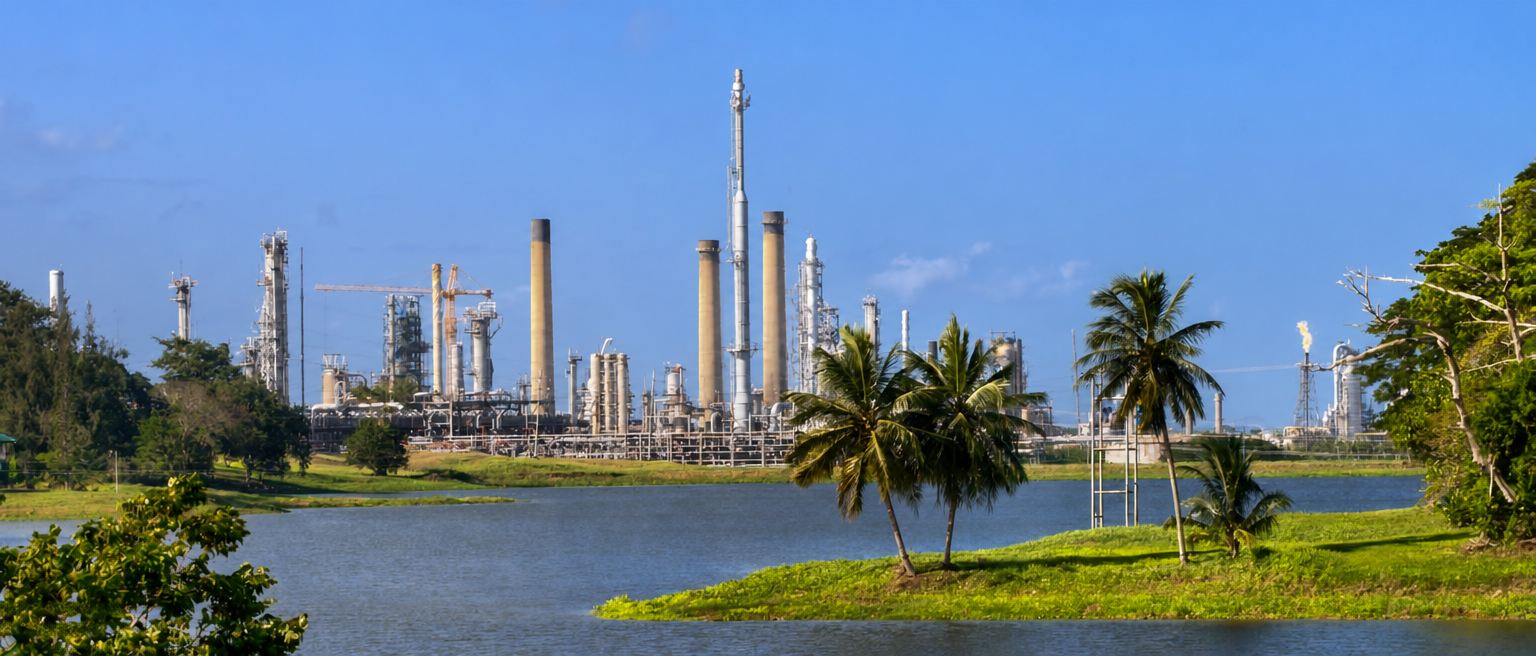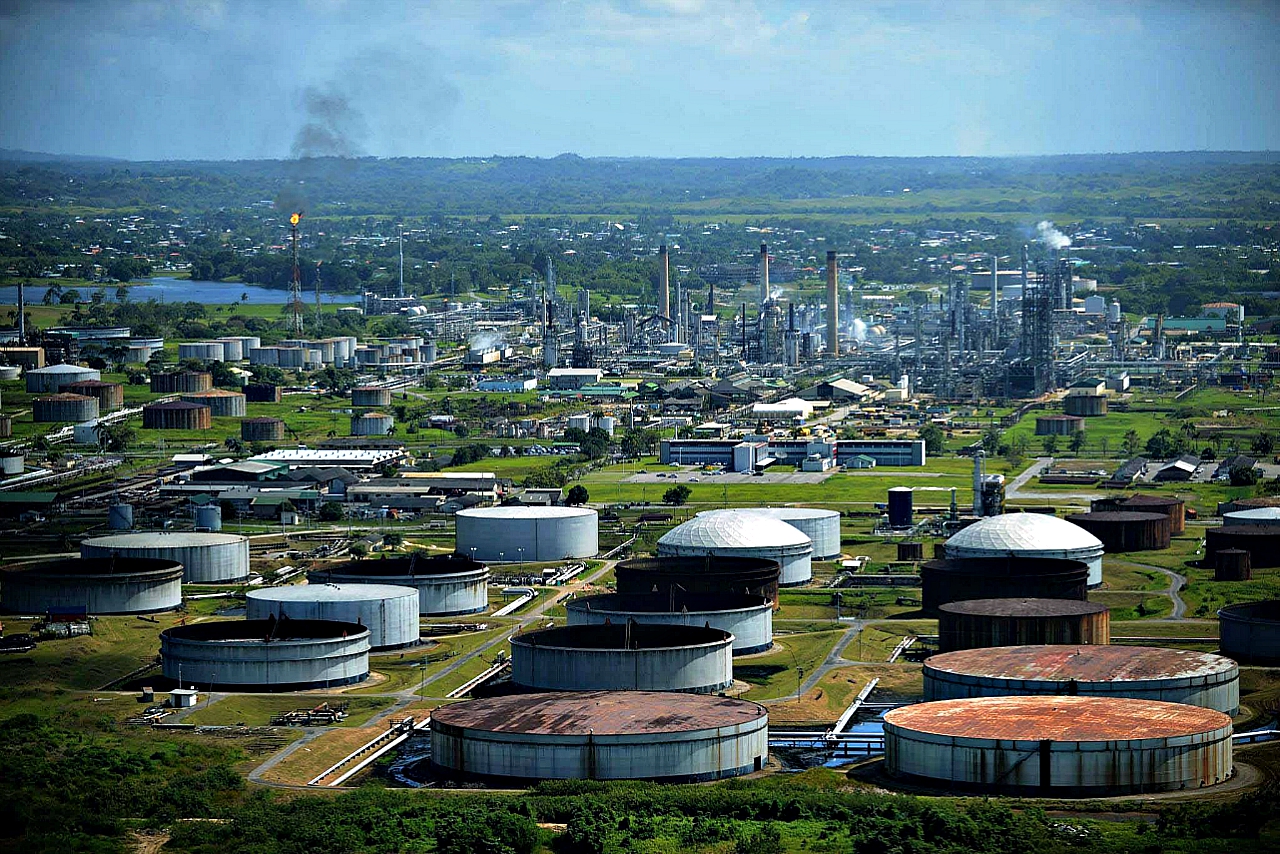
Point-à-Pierre Refinery | Source: The Habari Network (Sep 21, 2018)
Strategic & Historical Highlights
- Built 1917 by Trinidad Leaseholds on former sugar-estate land purchased in 1913.
- World War II: designated an asset to be "protected at all cost" as a major Allied aviation-fuel supplier; expanded under the top-secret "Project 1234" (1940); first Catalytic Cracking Unit on stream May 1942.
- Largest refinery in the British Empire at the end of WWII (per Wikiwand).
- Described as the only refinery in the world that operated alongside a wildlife park.
- Sole refinery in the Caribbean during its operating life, making Trinidad and Tobago the region's refined-product supplier.
- At peak capacity of 360,000 bpd (1970) and 355,000 b/d (1973), belonged world top-20 refineries
- Refinery idle since 2018
Facility Snapshot
| Field |
Detail |
| Asset type |
Petroleum refinery — full conversion configuration |
| Location |
Pointe-à-Pierre, west coast of Trinidad, on the Gulf of Paria; immediately north of San Fernando |
| Site area |
~2,000 acres (9 km of coastal frontage not confirmed in sources) |
| Status |
Ceased refining operations 30 November 2018 after 101 years; idle and held for sale under Guaracara Refining Company Limited |
| Nameplate capacity |
Up to 168,000 bpd full conversion (company-stated); nameplate 160,000 bpd with crude charges up to 175,000 bpd following the 1990s upgrade |
| Average throughput (final years) |
~112,974 bpd |
| Historical peak |
360,000 bpd (1970); 355,000 b/d by 1973 — one of the world's 20 largest refineries at that time |
| Regional role |
Only refinery in the Caribbean during operation; supplier of refined products to the wider region |
Ownership / Operator Timeline (for ppPLUS asset linking)
| Period |
Owner / Operator |
| 1913–1956 |
Trinidad Leaseholds Ltd (British subsidiary of Central Mining Company, UK) — land purchased 1913 from former sugar estates; refinery built 1917 |
| 1956–late 1984 |
Texaco (acquired Trinidad Leaseholds 1956) |
| Late 1984–1993 |
Trintoc (State acquisition of Texaco assets) |
| 1993–30 Nov 2018 |
Petrotrin (merger of Trintoc and Trintopec, Jan 1993) |
| Dec 2018–present |
Guaracara Refining Company Limited (asset holding, under Trinidad Petroleum Holdings) — refinery idle |
Process Units & Technologies
The retrieved sources name the following process units. Unit-level capacities are not stated in any retrieved source. No process licensors (e.g., FCC, reformer, ULSD technology suppliers) are named in the retrieved sources.
| Unit |
Technology / Type |
History |
| Crude distillation ("topping") units |
Atmospheric distillation |
No. 3 & No. 4 Topping Plants built 1928; No. 8 Topping Unit on stream April 1960; two idle crude distillation units restored in the 1991–98 upgrade. 175,000 BPD primary distillation capacity as per Petrorin website archive from May 2016 |
| Fluid catalytic cracking unit (FCCU) |
Catalytic cracking; revamped to **riser cracking** |
First Catalytic Cracking Unit on stream May 1942; FCCU revamped during the 1991–98 upgrade program |
| Mild hydrocracker |
Converted from the gas oil desulfurization unit |
1991–98 upgrade program |
| Catalytic reformers |
Catalytic reforming |
Second catalytic reformer installed 1991–98 |
| MTBE plant |
Oxygenate (etherification) for gasoline blending |
Installed 1991–98 upgrade |
| Gasoline Optimization Programme (GOP) |
Gasoline quality/octane upgrade project |
Construction "almost complete" per company brochure (undated, c. mid-2000s) |
| Ultra Low Sulphur Diesel (ULSD) plant |
Diesel hydrotreating to ULSD spec |
Construction "almost complete" per brochure; further plant upgrades reported as recent as 2011 |
| Sulphur unit |
Recovery and **pelletized** sulphur, bulk loading by conveyor belt |
Operational at closure |
| Bitumen unit |
Bitumen production |
Operational at closure |
| Lubricating oil plant |
Lube oil manufacture |
On stream April 1960 (Texaco era; status at closure unverified) |
| Paraffins (wax) plant |
Wax production |
On stream April 1960 (Texaco era) |
| Canning plant |
Product packaging |
On stream April 1960 (Texaco era) |
Capacity Evolution
Capacity figures are internally inconsistent: the 1917 startup capacity of 75,000 bpd is nearly identical to the post-expansion 1942 figure (~78,000 bpd), which is implausible; and the Wikiwand infobox figure of 190,000 bpd conflicts with the company-stated 168,000 bpd full-conversion / 175,000 bpd maximum crude charge.
| Period |
Reported figure |
Source |
| 1917 (startup) |
75,000 bpd at first production |
Wikiwand |
| 1942 |
28.5 million bbl/yr (~78,000 bpd) with first catalytic cracker on stream |
Wikiwand |
| 1970 / 1973 peak |
360,000 bpd (1970); 355,000 b/d (1973), world top-20 |
Wikiwand / OGJ |
| 1970s decline |
183,000 bpd after 1970 unrest; 200,000 b/d by 1978 before Texaco stopped crude imports |
Wikiwand / OGJ |
| Pre-upgrade (c. 1990) |
90,000 bpd nameplate |
OGJ |
| 1991–98 upgrade (US$350 million) |
Nameplate 160,000 bpd; crude charges up to 175,000 bpd; residual fuel oil cut reduced from 45% to 35% of crude charge |
OGJ |
| Brochure era (c. mid-2000s) |
Throughput ~160,000 bpd |
Petrotrin brochure |
| Final operating years |
Up to 168,000 bpd full-conversion capacity; average throughput ~112,974 bpd; Wikiwand infobox cites 190,000 bpd (30,000 m³/d) |
Petrotrin site / Wikiwand |
Feedstock & Product Slate
Feedstock: ~60,000 bpd of equity and purchased domestic crude, with the balance imported — cited as Russia, West Africa and South America — via outright purchases or processing arrangements for foreign companies. Almost half the crude charge was a 22° API gravity naphthenic crude with 1.4 wt% sulphur (OGJ, 2002). Company-wide crude production near closure was 48,047 bpd (Wikiwand), below the brochure-era domestic supply figure of ~60,000 bpd.
Products: LPG (propane/butane), unleaded motor gasoline (to customer specification), aviation gasoline, aviation jet fuel/kerosene, diesel (incl. ULSD), kerosene, low- and medium-sulphur fuel oil (low pour, low metals, <8% asphaltenes), pelletized sulphur and bitumen.
Markets: Domestic Trinidad and Tobago, the Caribbean, Latin America, and the US eastern seaboard (brochure) / US Gulf Coast (company site) — the two sources differ, likely reflecting different periods.
References
- Wikiwand — Petrotrin
- Oil & Gas Journal — State oil company Petrotrin pushing foreign investment in bid to resuscitate Trinidad & Tobago petroleum sector (25 Mar 2002)
- Petrotrin corporate brochure — Petrotrin: A Valued Partner (Jan 15, 2013)
- Petrotrin corporate website content — refinery description and products (via the Web Archive, May 2016)
- Global Infrastructure Magazine — Petrotrin and therein attached brochure: "Petrotrin, Investing for increased production brochure" (July 2014)