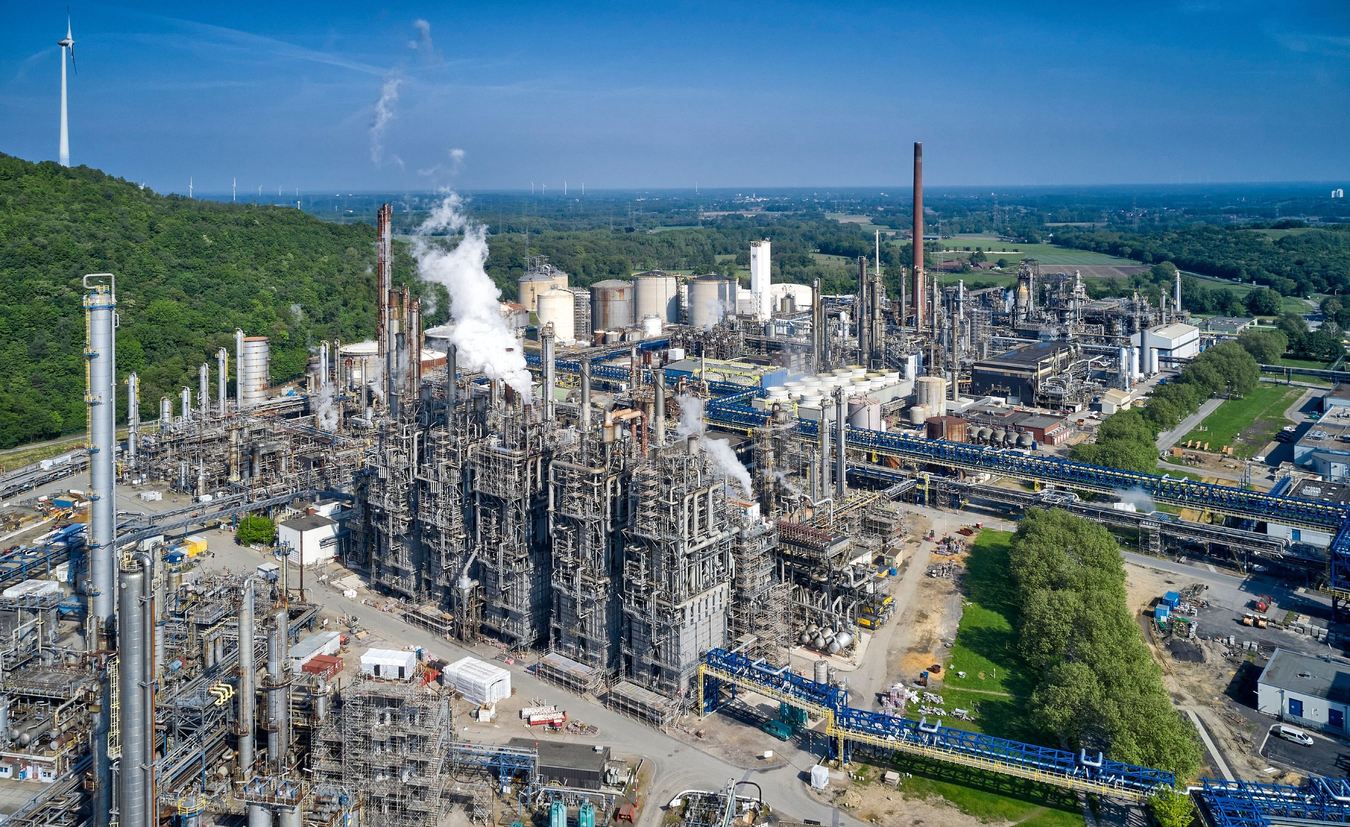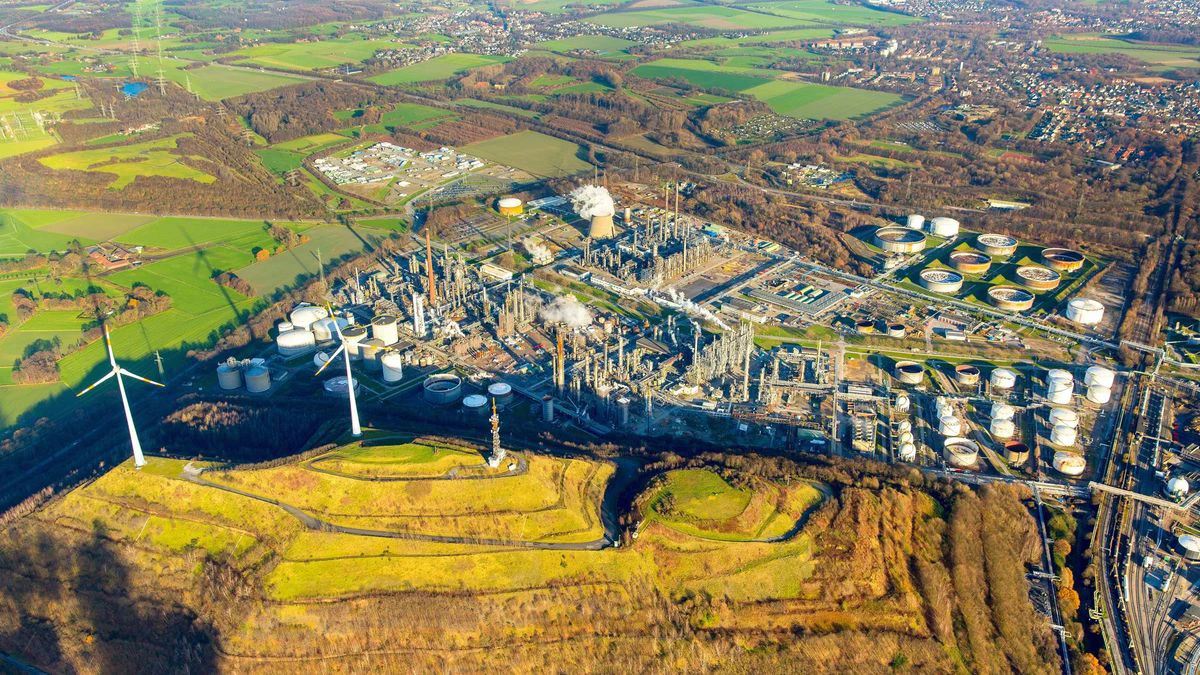
Aerial view of the Scholven refinery | Source: WAZ (Aug 2, 2016)
The Scholven refinery is the larger and more complex of the two Gelsenkirchen sites, covering approximately 250 hectares. With a crude distillation capacity of 7.8 million tonnes per year, it is the primary crude processing hub of the integrated complex and additionally operates the site's petrochemical units — two steam crackers producing ethylene and propylene — making it the conversion and chemical heart of the Ruhr Oel GmbH–BP Gelsenkirchen complex.
Historical Summary
The Scholven site was established in the early 1930s as a coal hydrogenation plant, co-developed by I.G. Farben and Hibernia AG to produce synthetic gasoline, making it a key strategic target during World War II. After the war, the site transitioned to conventional crude oil refining. In 1979, Scholven was fully integrated with the adjacent Horst site into a single operational complex, and in 1983 both sites were incorporated into the Ruhr Oel GmbH joint venture between Veba Oel and Venezuela's PDVSA.
Following BP's acquisition of Veba Oel in 2002 and Rosneft's purchase of the PDVSA stake in 2010, the refinery operated as a BP–Rosneft joint venture until BP became sole owner in 2017. In 2024, BP announced a restructuring towards lower-emission and sustainable fuels, reducing crude capacity from 12 to 8 million tonnes per year. The refinery was sold to Klesch Group in March 2026 and now operates as one of Germany's largest refining and petrochemical complexes, with a crude capacity of approximately 265,000 barrels per day and around 2,200 employees across both sites.
Process Units & Capacities
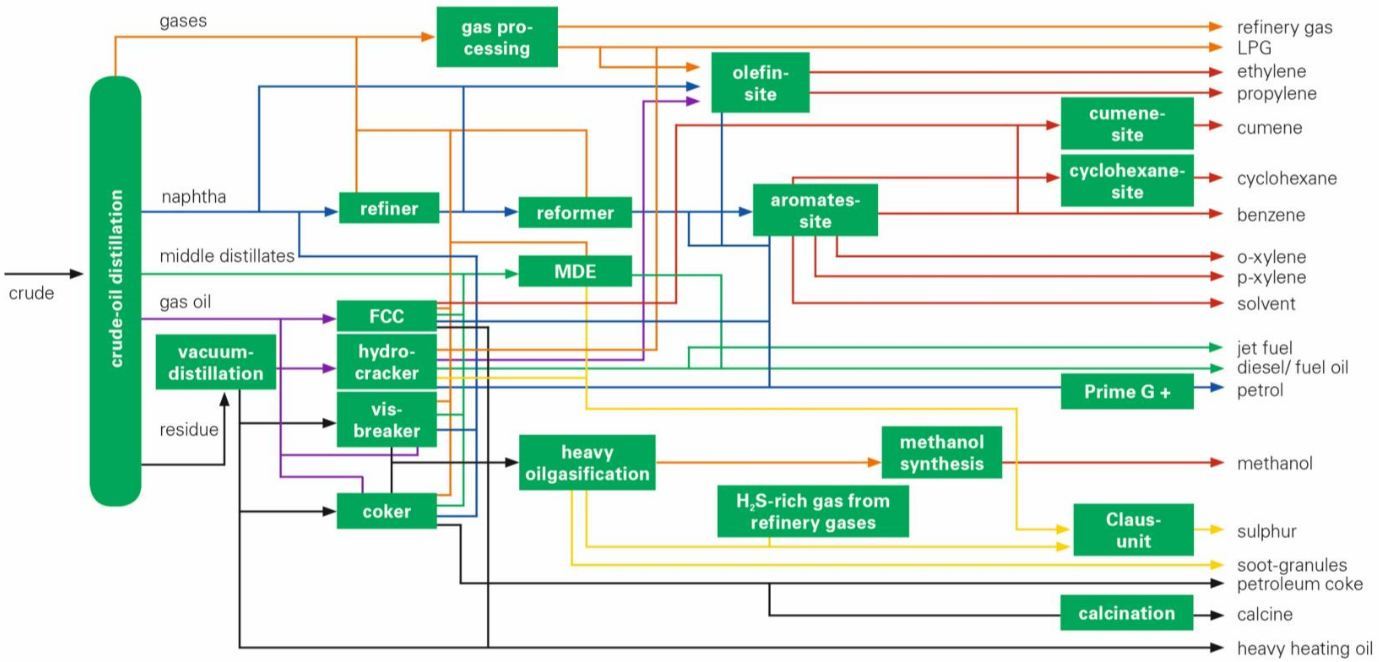
Gelsenkirchen refinery (combined Horst and Scholven refineries) PFD | Source: 2019 Ruhr Oel GmbH – BP Gelsenkirchen presentation
| Process Unit |
Capacity
(bpd) |
Notes |
Atmospheric Distillation
(CDU-1) |
~70,000 |
140,000 bpd capacity at Scholven,
265,000 bpd across Scholven
and Hosrt refineries.
CDU-2 was planned for permanent
closure from 2025; BP reversed this decision in July 2025 citing
improved profitability |
Atmospheric Distillation
(CDU-2) |
~70,000 |
| Vacuum Distillation (VDU) |
~40,000 |
40,000 bpd VDU was planned for
closure; also kept
online following July 2025 reversal |
| Hydrocracker (HCU) |
Part of combined HCU+FCC ~4.5 mt/yr |
Key Scholven conversion unit; also designated for SAF co-processing
once regulatory approval secured |
| Visbreaker |
~2.1 mt/yr (combined with Horst Coker) |
Visbreaker furnace confirmed
at Scholven |
| Catalytic Reformer |
Part of combined
1.3 mt/yr |
Naphtha reforming for octane
upgrading |
| Hydrotreating |
Part of combined
4.9 mt/yr |
Multiple trains across the
integrated complex |
| Steam Cracker (× 2) |
1,060 kt/yr ethylene combined |
Two crackers operated by BP
Refining & Petrochemicals GmbH; produce ethylene and propylene |
References
- Reuters — BP Plans to Reduce German Oil Refinery's Oil Processing Capacity (265,000 bpd confirmed by head of refining) (Mar 20, 2024)
- Bezirksregierung Münster — Genehmigungsbescheide für die Stadt Gelsenkirchen
- Yahoo Finance / Reuters — BP Says Planned Maintenance Underway at Gelsenkirchen-Scholven — 140,000 bpd site reference (Mar 8, 2018)
- Industrial Info Resources — BP Delays Unit Closure at Main Germany Refinery — 70,000 bpd CDU and 40,000 bpd VDU at Scholven (Nov 12, 2025)
- Bloomberg — BP Plans to Keep Crude Unit at German Refinery Running for Now (Jul 8, 2025)
- Offshore Technology — BP Agrees to Sell Gelsenkirchen Refinery — 265,000 bpd confirmed at sale (Mar 20, 2026)
- Ruhr Oel GmbH – BP Gelsenkirchen — 2019 Company Presentation (2019)