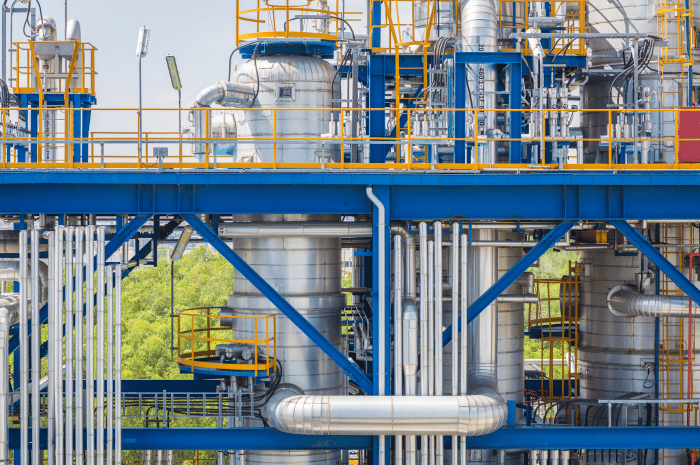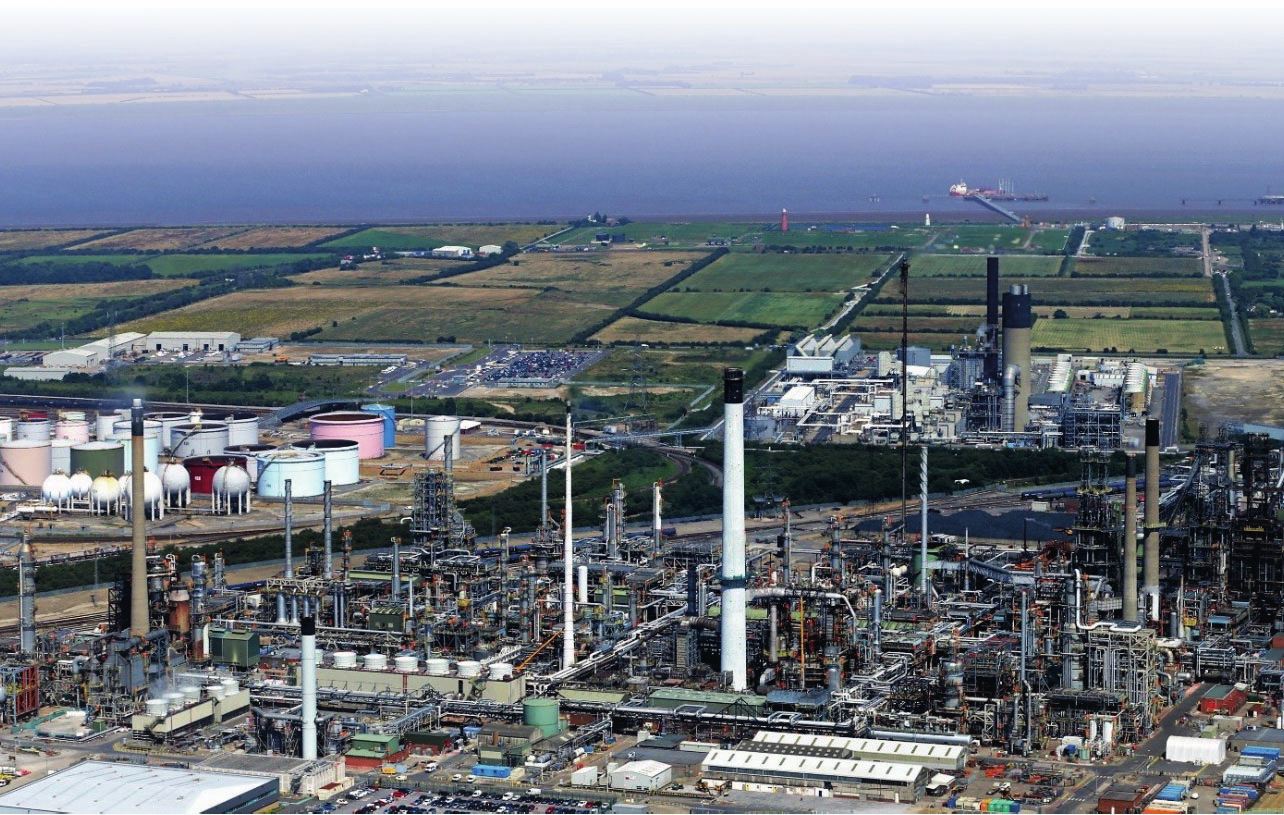
Humber Refinery | Source: Humber Zero Technology Selection Report (Apr 2022)
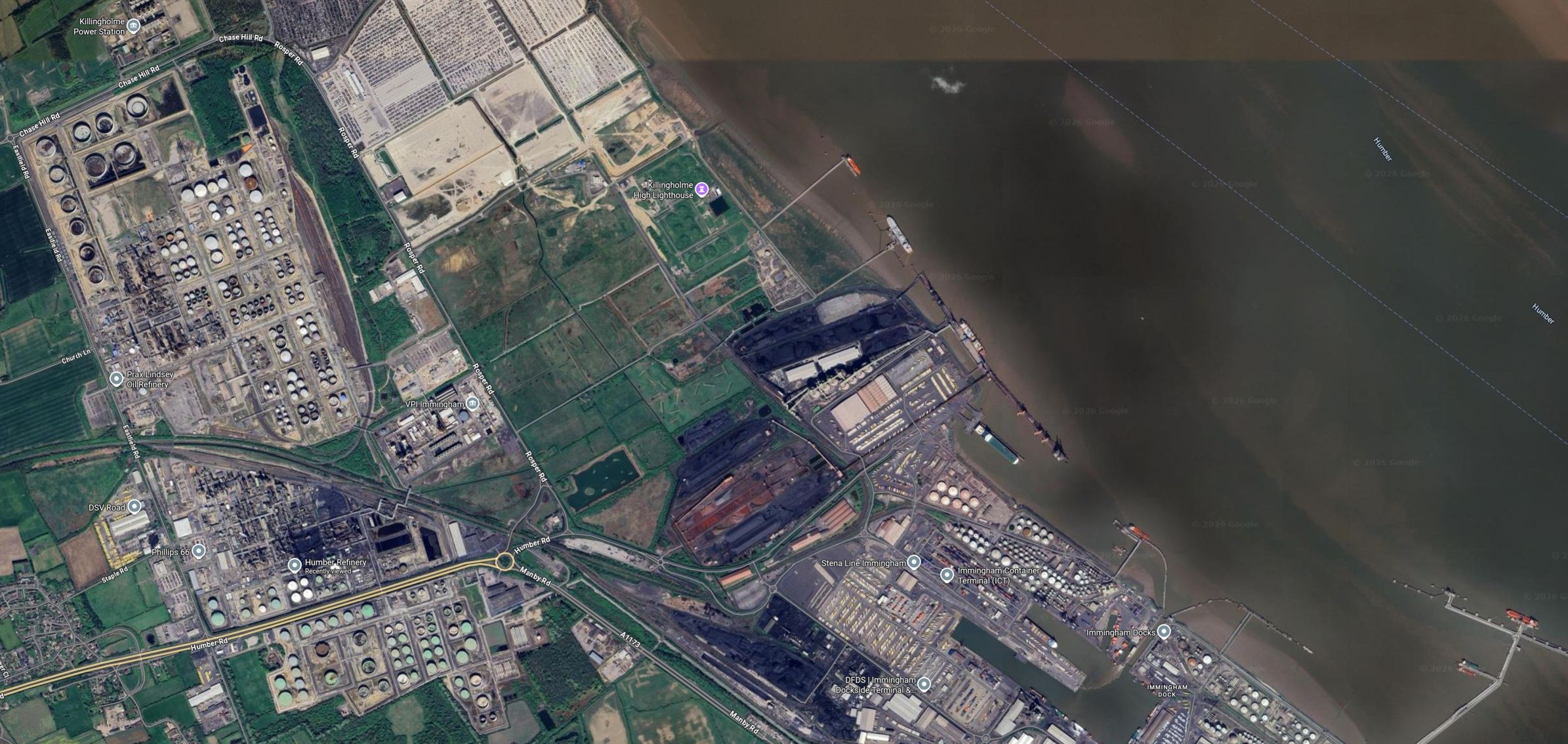
The Humber Refinery is Phillips 66 Limited's flagship UK asset, located at South Killingholme, North Lincolnshire, on the east coast of England, approximately 180 miles north of London. Commissioned in 1969 with an initial processing capacity of 80,000 barrels per day (BPD), it has been progressively expanded to its current nameplate throughput of 221,000 BPD. It is the only coking refinery in the United Kingdom and the world's largest producer of speciality graphite coke.
History
The origins of the Humber Refinery trace back to the mid-1950s, when Continental Oil Company (Conoco) — whose roots stretch to 1875 — made the strategic decision to expand beyond its US operations. A consortium involving Conoco discovered substantial crude oil reserves in Libya by the end of that decade, and to monetise those finds, the company set about building a vertically integrated downstream supply chain in Europe. After acquiring a series of independent fuel marketing companies across Europe in the early 1960s — including Jet Petroleum in the UK — Conoco identified the need for a European refinery and selected South Killingholme on Humberside over the alternative site of Milford Haven, partly due to the availability of UK government grant aid.
Construction began in 1966, with the refinery commissioned in 1969 at an initial capacity of 80,000 BPD, predominantly processing sweet, low-sulphur Es Sider equity crude from Libya. Capacity was expanded to 130,000 BPD in the mid-1970s and again to its current nameplate level of 221,000 BPD in the 1990s, with the addition of an FCC unit in the early 1980s significantly increasing the refinery's conversion capability.
Following the 1998 merger of Conoco and DuPont's oil interests, and then the 2002 merger with Phillips Petroleum to form ConocoPhillips, the refinery operated under the ConocoPhillips banner until 1 May 2012, when ConocoPhillips split into separate upstream and downstream entities — with the Humber Refinery passing to the newly independent Phillips 66.
In more recent years, Phillips 66 has repositioned the refinery as a forward-looking energy asset: it became the UK's first refinery to produce Sustainable Aviation Fuel (SAF) at scale, using waste feedstocks such as used cooking oil, with British Airways becoming the first airline in the world to use UK-produced SAF. The refinery is also advancing the Humber Zero carbon capture project — a joint venture with VPI Immingham targeting up to 8 million tonnes of CO₂ captured per year — as part of the broader Humber Industrial Cluster decarbonisation plan.
Crude Supply
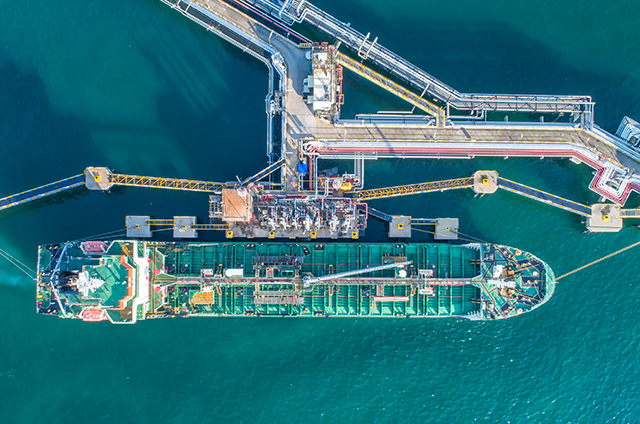
Crude oil is delivered by tanker to a mono-buoy off the Lincolnshire coast near Tetney, transferred via a 5-mile subsea/onshore pipeline to 10 shore storage tanks, then pumped into the refinery.
Processing Capacities
| Stream |
Capacity |
| Crude Throughput |
221,000 BPD |
| Total Throughput |
245,000 BPD (including non-crude feedstocks) |
| Gasoline Production |
95,000 BPD (max) |
| Distillates Production |
115,000 BPD (max) |
| FCC Unit |
~50,000 BPD |
| Naphtha Reforming |
~50,000+ BPD |
| Petroleum Coke Production |
700,000 tonnes/year (two coking units) |
| Other Feedstocks (e.g. SRFO) |
Up to 19,000 BPD |
Process Units & Technologies
The refinery operates a full conversion configuration, centred around two delayed coking units — the technology that underpins its specialty coke production and high Nelson Complexity rating:
- Crude Distillation Units (CDU) — two units; one for light/low-sulphur crudes, one configured for sour/acidic North Sea crudes
- Naphtha Reforming — produces high-octane gasoline blendstocks and hydrogen
- Fluid Catalytic Cracking (FCC) — added in the early 1980s, ~50,000 BPD capacity; converts vacuum gas oil to gasoline and distillates
- Hydrodesulfurisation (HDS) — multiple units for sulphur removal from naphtha, kerosene and diesel streams
- Thermal Cracking — upgrades residual streams
- Delayed Coking Units (DCU) — two units with associated calcining plants, producing anode-grade and speciality graphite coke
- Vacuum Distillation — feeds the coking and thermal cracking units
Products and Distribution
Finished products are distributed by pipeline (via CLH's GPSS network to south Manchester), rail, road tanker (RTW), barge/coaster and ship. Around 70% of production serves the UK inland market.
Specialty Products
The refinery holds a unique global position in specialty carbon products:
- Anode-grade petroleum coke — used in aluminium smelting; Europe's largest producer
- Speciality graphite coke — used in graphite electrodes for electric arc furnaces in steel production; world's largest producer
- Battery-grade coke (EV anode material) — Europe's only producer, targeting the growing EV lithium-ion battery anode market
- Sustainable Aviation Fuel (SAF) — UK's first production of SAF at a refinery
References
- Phillips 66 — Humber Refinery (accessed Jun 6, 2026)
- FuelOil News — The Humber refinery – a key indigenous source of supply (Mar 3, 2016)
- Best C.. Phillips 66 — Humber Refinery: The Refinery of the Future. Uploaded Sep 2022 at UK CCS Research Community