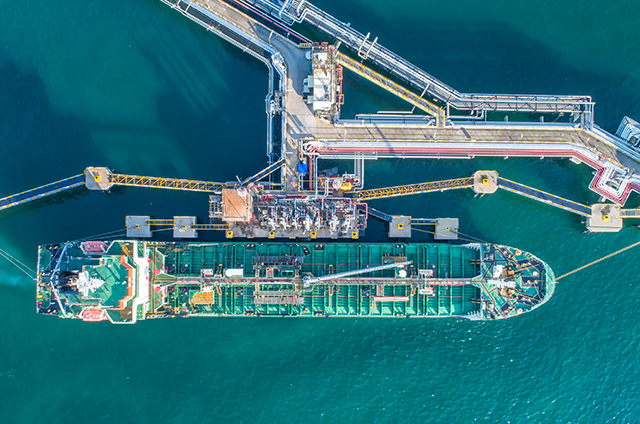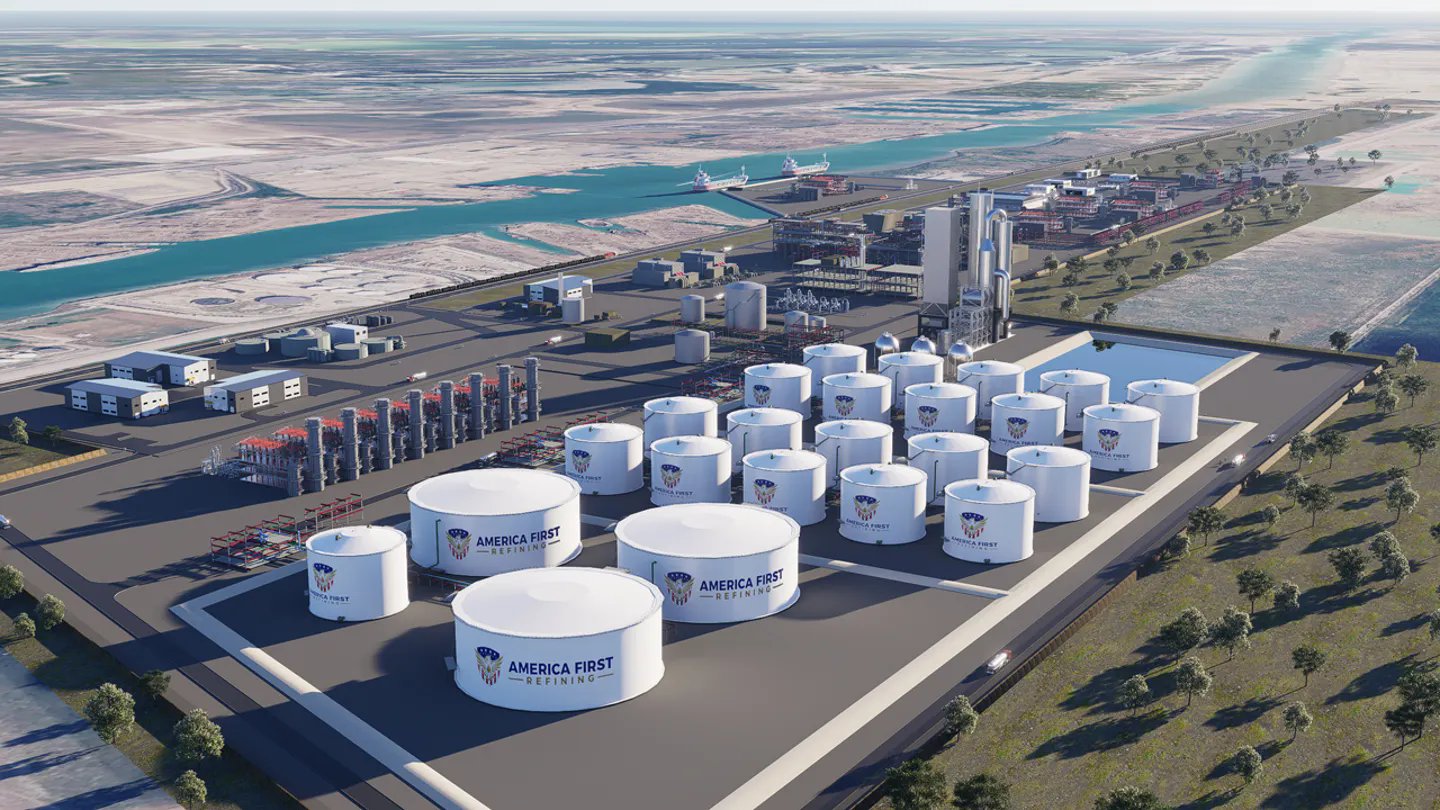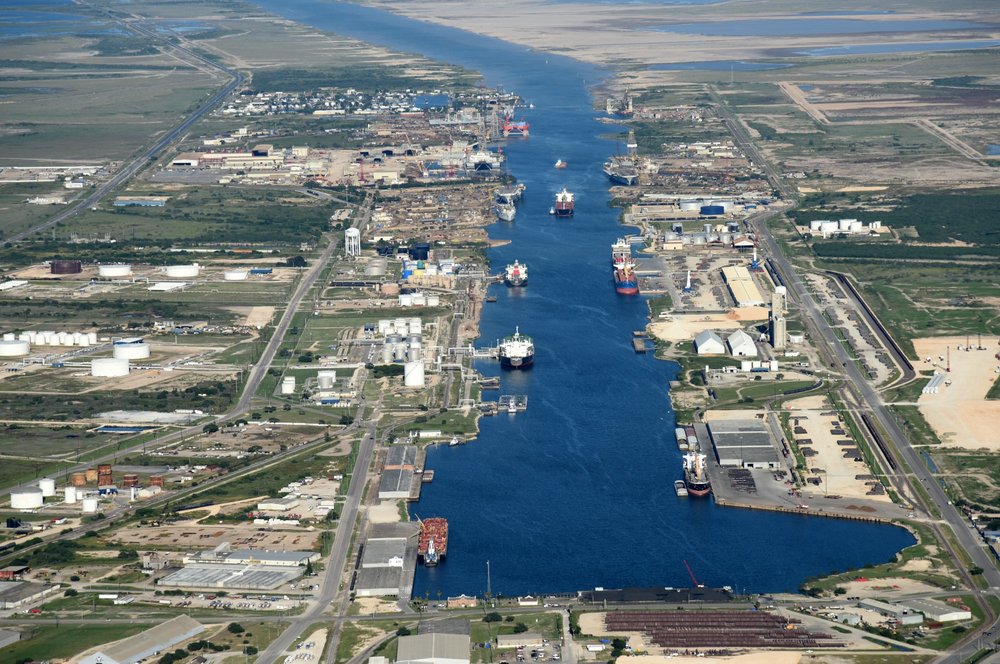
Port of Brownsville ship channel | Source: AFR website
The America First Refining (AFR) Brownsville Facility is the first greenfield oil refinery to be built in the United States in nearly 50 years, representing a landmark re-investment in domestic downstream infrastructure. Located on more than 240 acres within the Port of Brownsville in South Texas, the facility is purpose-built to process exclusively high-gravity domestic light shale crude from the Permian Basin — a feedstock for which the existing US refining fleet is largely unoptimised. Uniquely among US refineries, the facility integrates a hydrogen-powered energy system and a combined-cycle power plant, targeting ultra-low carbon intensity fuels and positioning itself as the cleanest refinery of its scale in the United States. Developed under the name Element Fuels Holdings from 2014, and rebranded as America First Refining in 2025 following presidential endorsement, the project is backed by a 20-year binding offtake agreement with a global supermajor widely identified as India's Reliance Industries Ltd., underpinning project financing at a self-reported 10-figure valuation. Front-End Engineering Design (FEED) is currently underway with Fluor Corporation, with groundbreaking scheduled for Q2 2026 and Phase 1 production targeted for 2027.
Capacity
| Parameter |
Detail |
| Full Build-out Throughput |
>160,000 bpd (~60 million bbl/year; ~6.7 million gal/day) |
| Phase 1 Throughput |
~50,000–55,000 bpd |
| Feedstock Type |
US domestic light shale crude oil |
| Feedstock API Gravity |
47° API (high gravity) |
| Feedstock Sulfur |
Low sulfur (consistent with WTI and Permian Basin grades) |
| Feedstock Source |
100% domestic — Permian Basin (West Texas) |
| Feedstock Rationale |
Existing US refineries are configured for heavier imported crudes; AFR is purpose-designed for the high-gravity, low-sulfur shale surplus |
Process Configuration
The refinery is built in three phases, with Phase 1 focused on the naphtha processing train. The full configuration reflects the light shale feedstock profile: no heavy oil upgrading units (FCC, hydrocracker, coker) are included or required, as high-gravity shale crude produces minimal residue.
Notes:
-
The Axens CCR unit reforms heavy naphtha into high-octaner reformate for gasoline blending. Isomerization recovers octane from light C5/C6 naphtha streams that bypass the CCR. Together they maximise the octane pool from a naphtha-rich shale crude slate.
-
On-site hydrogen production is designed to supply ~100% of the refinery's fuel requirements, effectively eliminating direct CO₂ emissions from refinery fuel combustion — a design feature unique at this scale in the US.
-
Excess hydrogen (beyond refinery needs) feeds the combined-cycle power plant, generating 100+ MW of low-carbon electricity exported to the ERCOT grid for the surrounding South Texas community.
Actual Status — April 9, 2026
As of today, the project status is:
- ✅ Site fully permitted and prepared (since 2024)
- ✅ Technology licensor contracted (Axens, April 7, 2026)
- ✅ FEED contractor contracted (Fluor, April 7, 2026)
- 🔄 FEED in progress — this phase alone typically takes 12–18 months before EPC procurement begins
- 📅 Groundbreaking ceremony expected imminently (April 2026), but a ceremonial groundbreaking does not equate to the start of meaningful civil works
- ❌ No EPC contractor publicly named
- ❌ No construction financing publicly confirmed
- ❌ No formal completion or start-up date published by AFR
The "2027" figure cited in early communications almost certainly refers to a Phase 1 partial commissioning of specific units — not a fully operational refinery. Even that target faces significant schedule pressure given that FEED only commenced in April 2026. A realistic Phase 1 mechanical completion before late 2028 to 2029 would require an exceptionally aggressive parallel-path execution strategy.