First U.S. Refinery in 50 Years: Energy Security, Geopolitical Realignment and a French Licensor


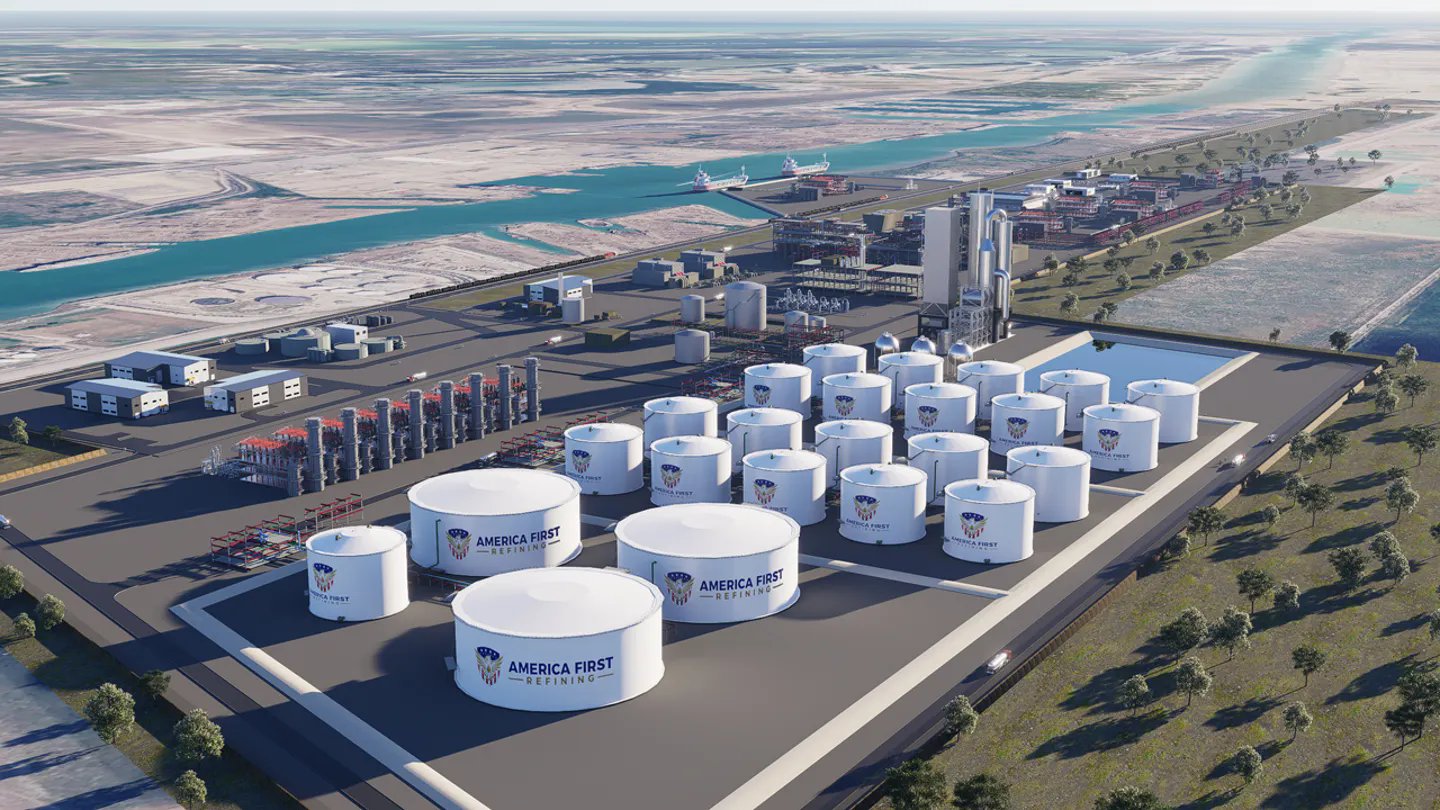
America First Refining is opening the first new U.S. oil refinery in nearly half a century in Brownsville, Texas.
A Country With Too Much Oil and Too Little Refining Capacity
The central paradox driving this project is deceptively simple: the United States floats on oil but cannot process it fast enough.
Decades of incremental expansion, regulatory friction, and capital aversion meant no new greenfield refinery had been built in America in half a century. Existing US facilities were largely designed in the 1960s and 70s for heavy imported crude — not for the light shale oil now pouring out of the Permian Basin. As Trey Griggs, AFR's president, put it bluntly at the project announcement: "The United States has a surplus of light shale oil but a shortage of refining capacity designed to process it."
The Brownsville project directly addresses that structural mismatch. Designed to process 100% domestic light shale crude from the Permian Basin, the facility will occupy more than 240 acres at the Port of Brownsville and produce over 160,000 barrels per day of finished gasoline, diesel, and jet fuel at full capacity — making it potentially the largest new US refinery since the 1970s. Groundbreaking is scheduled for Q2 2026, with Phase 1 production targeted as early as 2027.
The project was not born overnight. It originated as Element Fuels Holdings, quietly announced in June 2024 by the same Houston-based leadership now running AFR. By the time Trump unveiled it on Truth Social, the site was already fully permitted — a critical and often overlooked detail that dramatically separates this project from the graveyard of refinery announcements that never broke ground.
The $300 Billion Number — What It Really Means
The headline figure requires unpacking. The "$300 billion" does not represent construction capital expenditure — it is the projected cumulative economic value of the 20-year offtake agreement signed with India's Reliance Industries in February 2026:
-
$125 billion in US light shale oil purchased and processed (1.2 billion barrels over 20 years)
-
$175 billion in refined petroleum products produced and sold (50 billion gallons)
Reliance's role is that of a strategic off-taker and financial anchor, not a construction investor in the conventional sense. This distinction matters enormously for project finance. By providing a binding 20-year revenue commitment, Reliance has eliminated the single largest risk that kills refinery projects before the first shovel hits the ground: the absence of guaranteed demand.
For Reliance — the operator of the Jamnagar refinery complex in Gujarat, India, recognized as the world's largest refining facility at 1.24 million barrels per day with a Nelson Complexity Index of 21.1 — this is a strategic re-entry into US energy markets after exiting US upstream shale investments in 2021. The deal also carries geopolitical freight: Trump publicly framed it as correcting the US–India trade imbalance, with Modi's government receiving visible credit for a headline industrial investment in America. The energy deal is, in part, a diplomatic instrument.
Why Texas, and Why Now
The Port of Brownsville was not chosen by accident. It is one of the few US deepwater ports with available industrial land, direct pipeline access to Permian Basin crude, and an existing regulatory framework compatible with large-scale refinery construction. It also sits in a federally designated Economic Opportunity Zone, unlocking tax incentives. The deep-water channel enables the facility to serve both domestic Gulf Coast markets and international export destinations — a design feature that matters greatly given Reliance's global distribution network.
The timing is driven by two simultaneous crises unfolding in early 2026.
The first is California's accelerating refinery collapse. The state — the fourth-largest economy in the world — is a self-contained "energy island." No pipelines cross the Sierra Nevada, meaning every drop of transportation fuel consumed in California must either be refined in-state or imported by tanker. The closures of the Phillips 66 Southern California Los Angeles refinery and the Valero Northern California Bencia refinery have already removed approximately 17% of the state's crude processing capacity. Six refineries remain, but California Air Resources Board (CARB) regulations are tightening in ways that may push further closures. California's 30 million vehicles, 9 international airports, 30 major military airports, and three of America's busiest commercial ports — Los Angeles, Long Beach, and Oakland — now face a structural fuel supply deficit with no domestic pipeline remedy available.
It must be said clearly: the Brownsville refinery cannot solve California's problem. There are no pipelines over the Sierra Nevada, and there never will be. California's fuel imports will increasingly come from refineries in Africa, Asia, and the Middle East — a supply chain that raises acute national security questions for a state hosting 30 military installations. What the Brownsville project does do is demonstrate that refinery construction in America is economically viable and politically achievable — a proof of concept that California's own policymakers have spent a decade actively resisting.
The second crisis is the 2026 Strait of Hormuz blockade. Following US-Israeli strikes, Iran effectively shut the strait on February 28, 2026, removing an estimated 20 million barrels per day from global supply — the largest single disruption in oil market history. US military operations to reopen the strait began on March 19, 2026. Oil prices surged past $100 per barrel. US gasoline prices rose by more than $0.50 per gallon virtually overnight. The Hormuz crisis transformed the AFR project from a politically attractive infrastructure story into an urgent national security imperative — and provided the Trump administration with the geopolitical backdrop it needed to accelerate momentum.
The Axens Appointment — A Quiet Disruption in the Licensing Market
On April 7, 2026, AFR announced that Axens — the French process technology licensor, wholly owned subsidiary of IFP Energies nouvelles (IFPEN), a French public research organisation — had been selected as the primary technology provider for the refinery, with Fluor contracted for Front-End Engineering Design (FEED). The announcement was technical in tone but commercially significant in implication.
For a project branded "America First," the selection of a French licensor over UOP/Honeywell — the dominant US-based refining technology provider — is a notable contradiction. The explanation lies in continuity: Axens has been embedded in the AFR project since 2017, a nine-year working relationship that predates the Trump branding entirely. Switching licensors mid-development would have added cost, delay, and technical integration risk that no project developer would willingly absorb. Axens' technology package — continuous catalytic reforming (CCR), naphtha and diesel hydrotreating, and isomerization — is also specifically well-suited to light shale feedstock with its characteristic low sulfur content and high naphthenic profile.
There is likely a second factor: Reliance's institutional familiarity with Axens. The Jamnagar complex employs a broad portfolio of Axens-licensed units. When a 20-year off-taker with deep operational expertise in a particular licensor's technology has implicit influence over project decisions, that familiarity carries weight. UOP's absence from the largest US refinery project in 50 years is a commercial signal the licensing market will not ignore.
Project Credibility — Ambition Versus Execution Reality
By the standards of greenfield refinery development, the AFR project carries an unusually strong execution profile. It is fully permitted. It has a binding offtake agreement. It has contracted a licensor and a FEED contractor. It has presidential endorsement. It breaks ground in Q2 2026. These are not small achievements — most announced refinery projects never reach this stage.
Nonetheless, informed skepticism is warranted on several points.
The construction CAPEX for a 160,000 bpd greenfield refinery — likely in the range of $8–15 billion at current construction cost indices — has not been publicly disclosed or confirmed as financed. Reliance's offtake commitment provides revenue certainty; it does not directly fund concrete and steel. The project financing stack remains opaque, and any delay in securing construction debt or equity would push the Phase 1 timeline significantly beyond 2027.
The phased development plan is simultaneously reassuring and concerning. A Phase 1 capacity of 50–55,000 bpd is modest relative to the 160,000 bpd headline, which means the "largest new US refinery since the 1970s" title applies only to the fully built-out project — a vision that spans multiple budget cycles and potentially multiple presidential administrations.
Finally, the "cleanest refinery in the world" claim — based on hydrogen-powered systems producing ultra-low-carbon fuels — is aspirational marketing language that will face intense scrutiny from environmental groups. Texas' permissive regulatory environment eliminates many state-level obstacles, but federal environmental litigation remains a tool opponents can deploy to delay construction timelines.
The Larger Picture
Strip away the political theater and the $300 billion headline, and what remains is this: a genuine inflection point for US downstream infrastructure, made possible by the collision of domestic policy failure in California, a geopolitical emergency in the Persian Gulf, an Indian conglomerate's strategic bet on American energy, and a French licensor that spent nine years quietly doing the engineering work while waiting for the politics to catch up.
Whether AFR becomes a template for a broader US refinery renaissance — or remains a politically useful one-off — depends on what happens in the next 24 months of construction finance and project execution. The industry is watching Brownsville.
This article draws on the following sources: Port of Brownsville, America First Refining, Reuters, Bloomberg, Fox Business, Hydrocarbon Processing, Axens, ChemAnalyst, BIC Magazine, Times of India, Hindustan Times, ConstructConnect, Kavout Market Intelligence.
#brownsville #texas #refinery #r#afr #americafirstrefining #valero #phillips66 #reliance #axens #uop #honeywell #technologylicensor #lightshaleoil