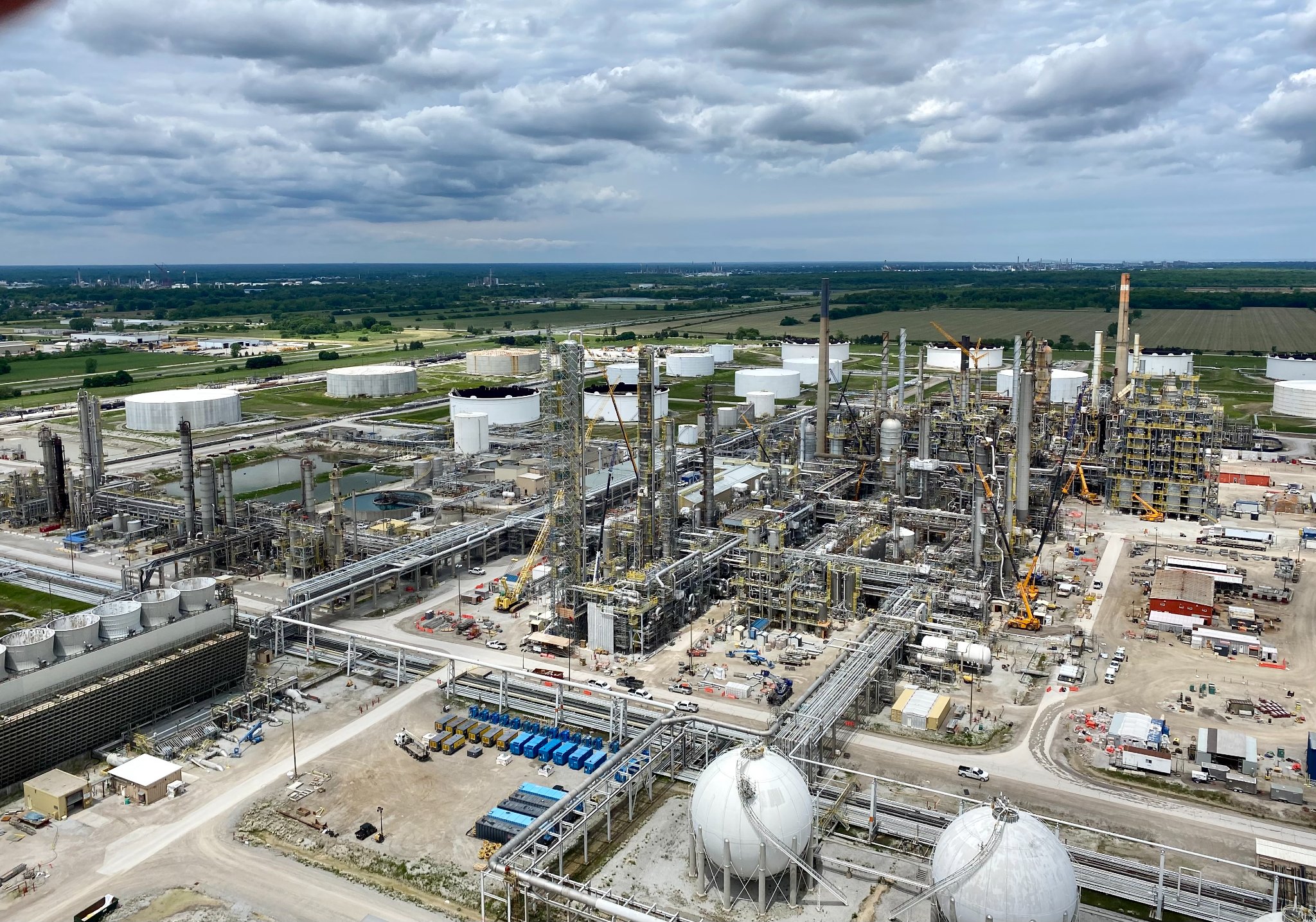
Bird’s eye view of 2022 turnaround activities at the Corunna site, captured from the top of the flare stack | Credit: Nova Chemicals Facebook page (June 13, 2022)
The Corunna Site was North America's first fully integrated cracker and petrochemical complex when it began operations in 1977. NOVA Chemicals purchased the facility in 1988. The site has undergone continuous evolution from an oil-based naphtha cracker to a modern, low-emission ethane cracker optimized for shale gas feedstocks.
The Corunna Site is NOVA Chemicals' largest facility in the Sarnia-Lambton region and serves as the petrochemical hub for Ontario operations, producing 1.8 billion pounds of ethylene annually.
Core Operations
Ethylene Production:
The facility operates as an ethane cracker that thermally cracks natural gas liquids (primarily ethane) delivered by pipeline and railcar to produce ethylene as the primary product. The cracker underwent a major Phase 3 expansion completed in 2022, which increased ethylene production capacity by more than 50 percent, bringing total capacity to 1.8 billion pounds annually. This expansion was driven by the need to supply feedstock to the new Rokeby polyethylene facility.
Feedstock Supply Hub:
Ethylene produced at Corunna is distributed via dedicated pipelines to NOVA's three downstream polyethylene facilities:
- Moore Site (840 million pounds PE/year)
- St. Clair River Site (395 million pounds PE/year)
- Rokeby Site (1 billion pounds PE/year)
Location and Employment
Located at 285 Albert Street (Petrolia Line area), Corunna, Ontario in St. Clair Township, the site employs approximately 450 employees and remains NOVA's largest operations facility in Ontario. The facility has been a cornerstone of the Sarnia-Lambton petrochemical complex for decades.
Feedstock Strategy
Corunna leverages ethane from natural gas liquids sourced from shale basins via pipeline infrastructure, providing cost-competitive feedstock and geographic advantages for serving North American polyethylene markets within a one-day drive radius of 70% of demand.