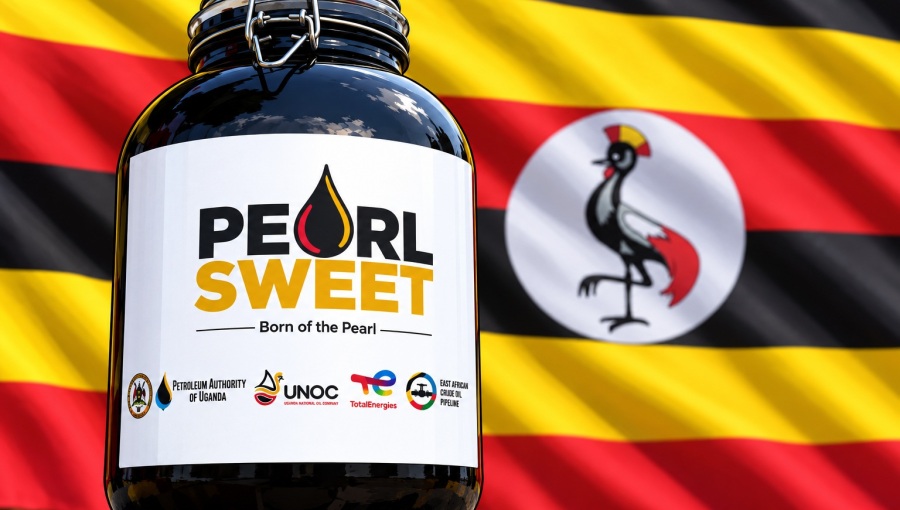
PEARL SWEET is Uganda's Lake Albert export crude, named after Uganda's moniker, the "Pearl of Africa". It is produced from the Albertine Graben — the country's sole producing petroleum province, with commercial discoveries made from 2006 onwards. Its quality profile is commercially distinctive: light and very low in sulphur, yielding attractive middle-distillate potential (low-sulphur diesel/jet fractions), good petrochemical naphtha, and — unusually — significant wax content that creates both a handling burden and a potential specialty-wax/lubricant opportunity. The high pour point is the grade's signature feature: Pearl solidifies near ambient temperatures, which dictated the engineering of the world's longest electrically heated crude pipeline and requires heated storage and marine loading at the export terminal. No public full assay is in hand; refining interest has historically centred on the distillate yields and the very low sulphur, offsetting the heated-logistics premium against freight and handling costs.
Grade Snapshot
| Field |
Detail |
| Grade name |
PEARL SWEET (Uganda's export crude grade) —
named after Uganda's moniker, the "Pearl of Africa" |
| Type / characterization |
Light, sweet, waxy paraffinic crude — high-pour-point grade requiring heated logistics |
| API gravity |
~31–32.5° (commonly cited ~31.5°) |
| Sulphur |
~0.05–0.1 wt% (commonly cited ~0.06%) — very sweet |
| Pour point |
Reported at or near ~40°C —
the defining logistical constraint of the grade |
| Wax content |
Reported in the mid-teens, wt% |
| Acidity (TAN) |
Not characterized as acidic/naphthenic in available reporting;
no TAN value in hand |
| Production sources |
Tilenga field (TotalEnergies EP Uganda, operator)
and Kingfisher field (CNOOC Uganda, operator),
Albertine Graben, Lake Albert basin |
| Plateau production |
~230,000 bpd combined
(Tilenga ~190,000; Kingfisher ~40,000) |
| FID / target first oil |
FID 1 February 2022;
first oil was targeted from 2025 per operator guidance |
| Evacuation |
EACOP — 1,443 km, 24-inch, electrically heated pipeline, Kabaale (Hoima, Uganda) → Tanga (Tanzania), Indian Ocean; design capacity 216,000 bpd |
| Export terminal |
Chongoleani, Tanga, Tanzania
(storage + marine loading; configuration to verify) |
| Resource base |
~6.5 billion bbl oil in place; ~1.4 billion bbl recoverable (commonly cited) |
| Marketing |
Entitlement holders: TotalEnergies, CNOOC, UNOC;
UNOC reportedly appointed Vitol as marketing agent
(2025 press reports) |
Production Sources
In-country call on PEARL SWEET barrels: a planned 60,000 bpd refinery at Kabaale (Hoima) remains at project stage; if built, it would consume roughly a quarter of plateau output, with the balance available for export. Developer consortium identity and current status require verification.
| Project |
Operator |
Equity |
Plateau |
Notes |
| Tilenga |
TotalEnergies EP Uganda |
TotalEnergies 56.67%, CNOOC 28.33%, UNOC 15% |
~190,000 bpd |
Buliisa district, north of Lake Albert; central processing facility; well/pad counts to verify |
| Kingfisher |
CNOOC Uganda |
CNOOC 85%, UNOC 15% |
~40,000 bpd |
Kikuube district, Lake Albert shoreline; first CNOOC-operated development in the basin |
Evacuation & Export Logistics
Until pipeline start-up, appraisal and early-production crude was trucked to storage at Gulu.
| EACOP parameter |
Detail |
| Length / diameter |
1,443 km (296 km Uganda; 1,147 km Tanzania); 24-inch |
| Design capacity |
216,000 bpd |
| Heating |
Electrically heated and insulated along entire route —
heated to keep Pearl above its pour point
(operating temperature reported ~50°C) |
| Ownership |
TotalEnergies 62% (operator),
TPDC (Tanzania) 25%, UNOC 15% |
| Cost |
~US$5 billion (commonly cited) |
| Export terminal |
Chongoleani peninsula, Tanga;
storage tanks with offshore tanker loading |
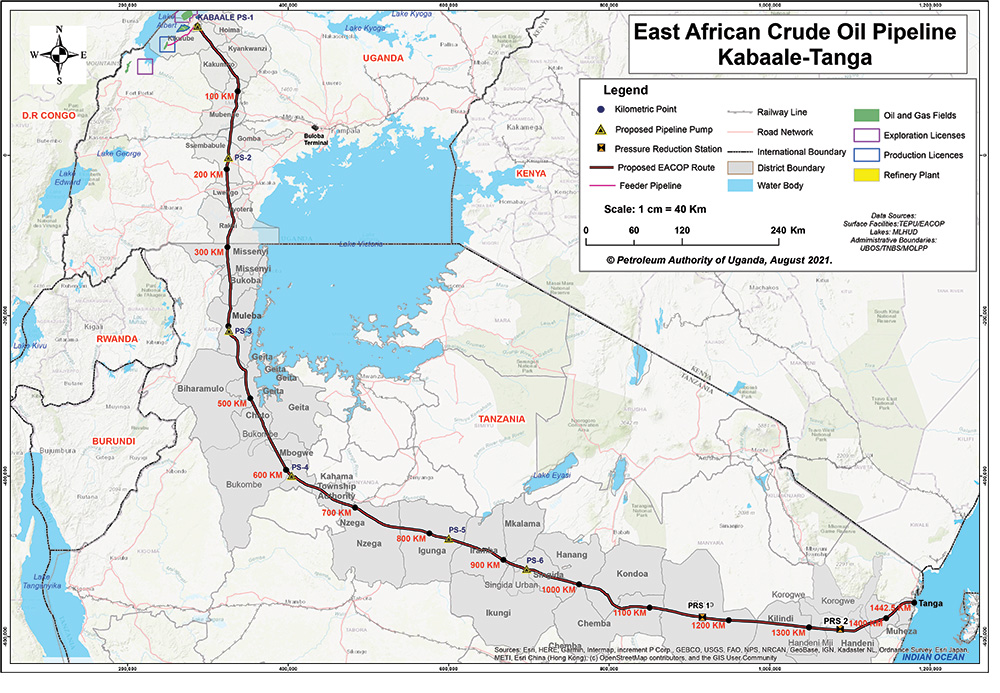
Source: Uganda National Oil company, EACOP
Context
PEARL enters the market as a structural novelty: a landlocked light-sweet grade whose economics are inseparable from a bespoke heated evacuation chain through two countries. Its natural competitive set is the Indian Ocean rim (East African, Indian and possibly Southeast Asian refiners), with the heated-pipeline tariff the key netback variable. The closest handling analogue among traded grades is Vietnam's Bach Ho — light, waxy, high-pour-point crude that historically commanded quality premiums; whether Pearl can replicate that depends on assay-level yields, which are not yet public. The project also carries well-documented controversy (financing and insurance withdrawals, the September 2022 European Parliament resolution, land-acquisition and ESG litigation), which has shaped its timeline and its sponsor base — relevant context for any commercial assessment of the grade.