
Product
Phthalic Anhydride
Names
2-Benzofuran-1,3-dione; Isobenzofuran-1,3-dione
Insight Articles
#PS814
phthalicanhydride phthalate plasticizer pvc
Main Product
Aromatic Anhydrides
Segment
Chemicals
Main-Family
Functional Organic Products
Sub-Family
Acid Anhydride
Physical State

Solid

Description

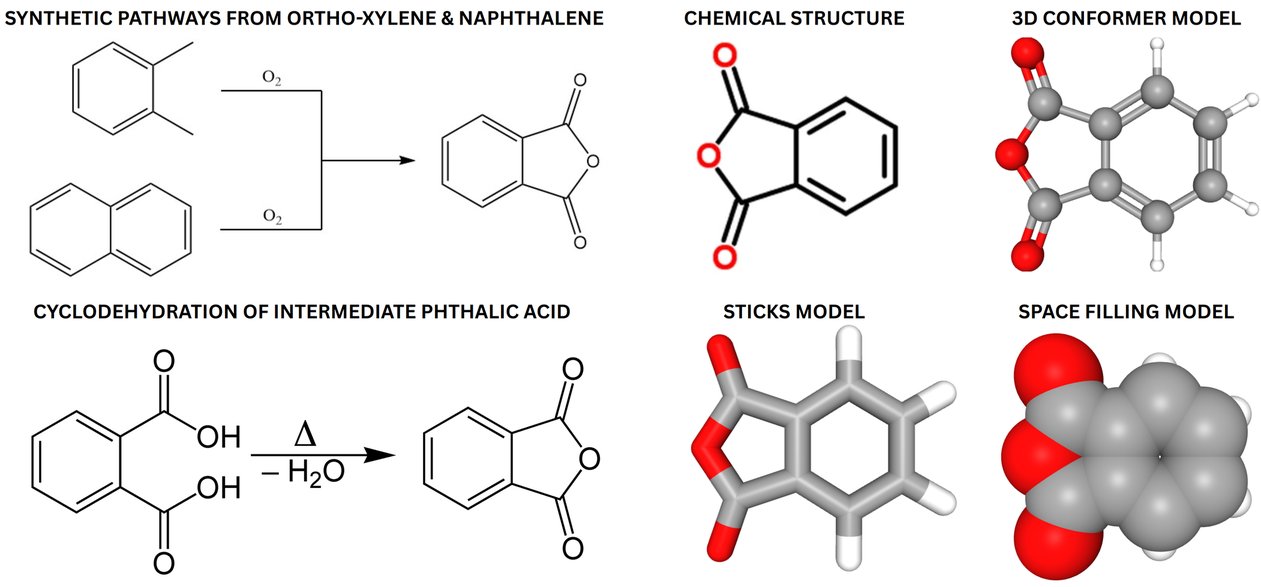
Phthalic anhydride is a bicyclic aromatic compound consisting of a benzene ring fused to a five-membered cyclic anhydride ring with the expanded molecular formula C₆H₄(CO)₂O, and it represents the principal commercial form in which phthalic acid is sold and used industrially. Phthalic anhydride has the expanded molecular formula C₆H₄(CO)₂O, CAS number 85-44-9, and a molecular weight of 148.12 g/mol. It was historically notable as the first anhydride of a dicarboxylic acid to be used commercially.


Physical Properties

Phthalic anhydride appears as a white to colorless lustrous solid, typically supplied as flakes, needles, or powder with a mild, distinctive odor.

  • Melting point: 130–134°C

  • Boiling point: ~284–285°C

  • Density: 1.53 g/cm³

  • Flash point: ~152°C

  • Solubility: Soluble in ethanol and acetone; slightly soluble in ether; decomposes/hydrolyzes in contact with water to form a corrosive phthalic acid solution


Chemical Behavior

As a reactive cyclic anhydride, phthalic anhydride readily undergoes esterification with alcohols to form phthalate esters, and it reacts with water to hydrolyze back to phthalic acid. It also reacts with primary amines and is used as a synthetic intermediate for producing various downstream chemicals, resins, and dyes. May cause corrosion to metals and is classified as capable of causing skin, eye, and respiratory irritation, along with potential organ damage upon repeated exposure.


Production

Phthalic anhydride is manufactured industrially by catalytic vapor-phase oxidation of either ortho-xylene or naphthalene with air, over a vanadium pentoxide (V₂O₅) fixed-bed catalyst at elevated temperature. Ortho-xylene has become the dominant feedstock globally due to its greater availability from catalytic reforming compared to naphthalene.


Applications

Historical EPA data indicates roughly 50% of phthalic anhydride production is directed to plasticizers (via phthalate esters for PVC), 25% to alkyd resins, 20% to unsaturated polyester resins, and the remainder to miscellaneous uses and exports. It also serves as a monomer for synthetic resins such as glyptal resins, and is used in synthesizing primary amines and various agricultural and dye intermediates. Commercial suppliers such as Lanxess market phthalic anhydride specifically as a "high purity crystalline molten PAN" building block for plasticizer, alkyd, and unsaturated polyester resin manufacturing across automotive, construction, and electronics sectors.


Health and Safety

Phthalic anhydride is classified as harmful if swallowed or inhaled, and it causes skin irritation, serious eye damage, and may trigger allergic skin or respiratory reactions (asthma-like symptoms) upon inhalation. Prolonged or repeated exposure is associated with organ damage, and the substance carries an aquatic toxicity classification (harmful to aquatic life with long-lasting effects). It requires storage under inert gas in a cool, dark location due to moisture sensitivity, and standard PPE (gloves, eye protection) is recommended when handling.


Insight Articles
Your insights will be shown here

Synthesis and molecular structure of phthalic anhydride | Sources: Chemcess, Wikimedia Commons, PubChem
Identifiers

logo CAS Number
85-44-9
logo EC Number
201-607-5
logo ECHA InfoCard
100.001.461
logo IUPAC Name
2-benzofuran-1,3-dione
logo PubChem ID
6811
Chemical Data

Chemical Formula

C8H4O3

Molecular Weight (g/mol)
148.12
Boiling Point (°C)
284
Melting Point (°C)
132
Sulfur Content (wt%)
0
Specific Gravity
1.53
Crude Data

API Gravity
-39.02
Country
Product Settings

Default
Status
A
Content provided by
Transaction Name Date
Modified by UserPic   Kokel, Nicolas 7/27/2026 9:14 AM
Added by UserPic   Kokel, Nicolas 7/26/2026 4:10 PM