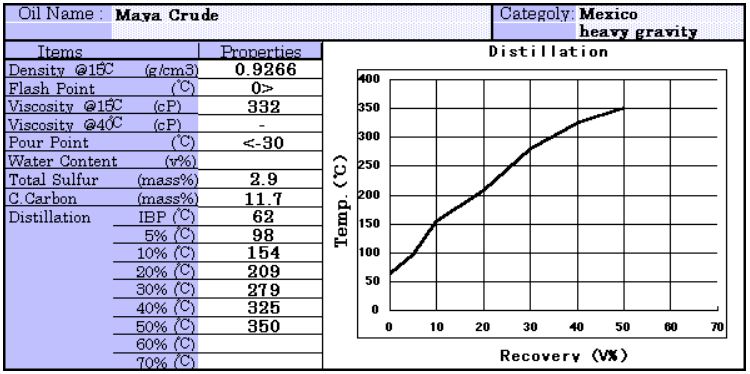

Maya crude oil is a heavy, sour benchmark grade produced in Mexico by PEMEX, widely traded as a reference for heavy sour crudes on the US Gulf Coast market.
Origin & Source Fields
Maya is a blend of crude oils from the Cantarell and Ku Maloob Zaap oil fields in the Gulf of Campeche. It is produced and marketed by PEMEX through its trading subsidiary PMI Comercio Internacional. Historically, Maya has represented roughly 49% of total Mexican crude production and 78% of Mexican crude exports.
Key Physical Properties
| Parameter |
Maya |
Notes |
| API Gravity |
21.0 – 22.0° |
Heavy crude |
| Sulfur Content |
3.4 – 3.8% wt |
High-sour |
| Viscosity (SSU @ 100°F) |
320 |
Moderately viscous |
| Pour Point |
–25°F |
Good cold flow |
| Reid Vapor Pressure |
6.0 psi |
|
| Water & Sediments |
0.5% vol |
|
| Vanadium |
~308 ppm |
High metals burden |
Sulfur & Contaminants Profile
With 3.4–3.8% sulfur by weight, Maya is firmly in the high-sour category and demands significant hydrotreatment capacity. Vanadium content (~308 ppm) is notably high, causing accelerated corrosion in thermal cracking units such as visbreakers and delayed cokers, and posing catalyst poisoning risks in FCC and hydrocracking units. Nickel is also elevated, compounding catalyst deactivation challenges.
Refinery Requirements
Maya's heavy fraction (vacuum residue) makes it uneconomical to process in simple topping or hydroskimming refineries. To maximize value, the host refinery must be equipped with:
-
Vacuum distillation units to recover additional gasoil
-
High-conversion units — delayed coker, visbreaker, or solvent deasphalting
-
Deep hydrodesulfurization (HDS/ULSD-grade) capacity
-
FCC or hydrocracker to upgrade the vacuum gasoil fraction
-
Metals-tolerant catalyst systems to handle V/Ni burden
Export Logistics
Loading ports are located in Mexico's Gulf and Pacific coasts:
-
Cayo Arcas (offshore Campeche, open sea terminal)
-
FPSO Yùum K'ak Naab (offshore Campeche)
-
Dos Bocas (Tabasco, Gulf of Mexico)
-
Salina Cruz (Oaxaca, Pacific Coast)
Delivery terms are typically FOB from Dos Bocas or Salina Cruz.
Pricing & Market Role
Maya is a benchmark grade for heavy sour crude in the US Gulf Coast (USGC) market. It is typically priced at a discount to WTI, historically in the range of WTI minus $5–$7/bbl net, though the actual differential widens significantly during periods of high light-heavy spreads. US Gulf Coast refineries with coking configurations — particularly those in Texas and Louisiana — are its primary buyers.
PEMEX Crude Quality Positioning
Within the PEMEX export slate, Maya sits at the heavier/sourer end of a four-grade spectrum:
-
Olmeca — 38–39° API, 0.73–0.95% S (lightest, petrochemical/lube feedstock)
-
Isthmus — 32–33° API, 1.8% S (medium sour, similar to Arab Light/Urals)
-
Maya — 21–22° API, 3.4–3.8% S (heavy sour, coker feedstock)
-
Altamira — 15.5–16.5° API, 5.5–6.0% S (extra-heavy, asphalt grade)