
Product
Precipitated Calcium Carbonate
Abbreviation
PCC
Names
Light Calcium Carbonate; Precipitated Chalk; Synthetic Calcium Carbonate
Insight Articles
#PS787
calciumcarbonate precipitatedcalciumcarbonate lightcalciumcarbonate syntheticcalciumcarbonate pcc
Main Product
Calcium Carbonate
Segment
Chemicals
Main-Family
Inorganics
Sub-Family
Inorganic Carbonates
Physical State

Solid

Description

Precipitated Calcium Carbonate (PCC) is a manufactured form of CaCO₃ produced by a controlled chemical precipitation process, in which quicklime (CaO) is first slaked with water to form milk of lime Ca(OH)₂, which is then carbonated with CO₂ gas to precipitate ultra-pure calcium carbonate crystals. Unlike GCC, PCC is a synthetically engineered product whose crystal form (calcite, aragonite, or vaterite), particle morphology, size, and surface area can be precisely controlled by adjusting temperature, CO₂ concentration, and reaction time during precipitation. This makes PCC the highest-purity, most performance-consistent grade of calcium carbonate available commercially.

Production Process

The carbonation route proceeds in two steps:​

CaO + H2O → Ca(OH)2 


Ca(OH)2 + CO2 → CaCO3↓ + H2O


Temperature control during precipitation determines crystal polymorph: calcite forms below 85°C, aragonite above 85°C, and vaterite at ~60°C.​

Physical & Chemical Properties

Property Value
Appearance Bright white, odorless powder
Purity (CaCO₃) ≥98.0%
Median particle size (d50) 0.5–8 µm
Specific surface area (BET) 5–40 m²/g
Density 2.70–2.83 g/cm³
Bulk density 300–900 kg/m³
pH (slurry) 8.0–9.5
Solubility in water 0.017 g/L
Melting point Decomposes at 825°C
Abrasivity Very low


Key Differentiators vs. GCC

Parameter GCC PCC
Origin Natural / mined Synthetic / precipitated
Particle size control Limited Precise
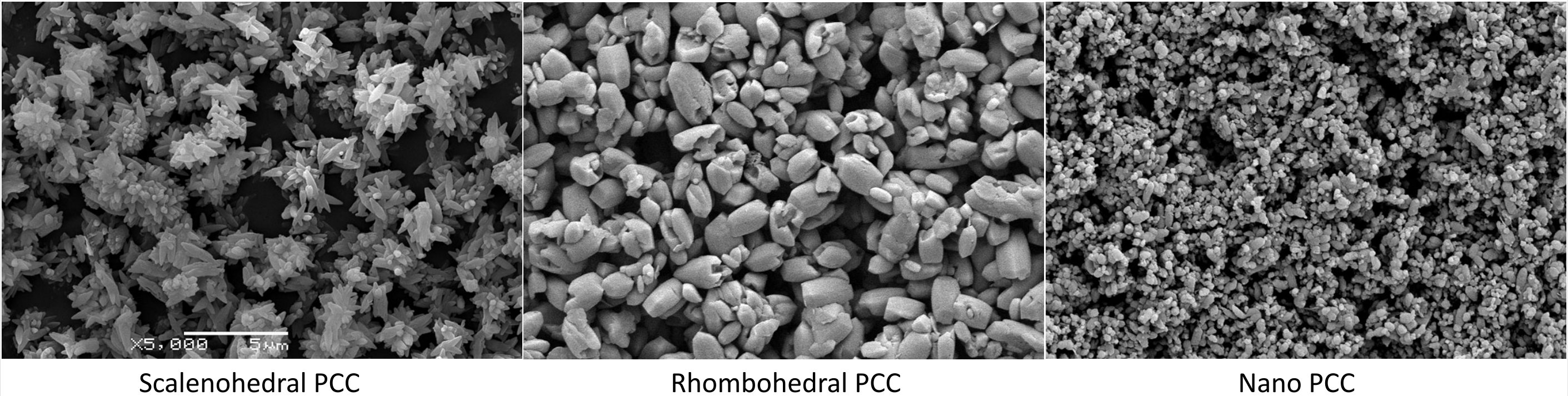
Particle shape Irregular Controlled (scalenohedral,
rhombohedral, acicular)
Particle size distribution Broader Narrow and uniform
Chemical purity 95–99.5% ≥98% (typically higher)
Specific surface area Lower Higher
Abrasivity Moderate Very low
Cost Lower Higher


Applications

PCC's superior purity, controlled morphology, and fine particle size make it the preferred grade for demanding applications:

  • Paper — internal filler and surface coating for high-brightness, high-opacity grades
  • Plastics and polymers — reinforcing filler in PVC, polyolefins, and engineering plastics
  • Elastomers and rubber — semi-reinforcing filler in natural and synthetic rubber
  • Sealants and adhesives — rheology modifier and reinforcing agent
  • Pharmaceuticals — antacid active ingredient, calcium supplement (USP/BP grade)
  • Food — E170 food additive; calcium fortification in beverages and dairy
  • Cosmetics — mild abrasive in toothpaste, filler in skincare formulations
  • Paints — high-opacity extender in architectural and industrial coatings​

References

  1. ATAMAN CHEMICALS. Calcium Carbonate (Accessed Mar 12, 2026)
  2. ATAMAN CHEMICALS. Precipitated Calcium Carbonate (Accessed Mar 12, 2026)
  3. Calcinor. (Dec 15, 2020). Precipitated calcium carbonate PCC
  4. Wikipedia. Calcium carbonate (Page version: Feb 20, 2026)

Insight Articles
Your insights will be shown here

Precipitated calcium carbonate (PCC) types | Source: STM Technologies https://www.stm-technologies.com/pcc-precipitated-calcium-carbonate-plants/
Identifiers

logo CAS Number
471-34-1
logo EC Number
207-439-9
logo ECHA InfoCard
100.006.765
logo IUPAC Name
Calcium carbonate
logo PubChem ID
10112
Chemical Data

Chemical Formula

CaCO3

Molecular Weight (g/mol)
100.09
Melting Point (°C)
825
Sulfur Content (wt%)
0
Specific Gravity
2.76
Crude Data

API Gravity
-80.23
Country
Product Settings

Default
Status
A
Content provided by
Transaction Name Date
Modified by UserPic   Kokel, Nicolas 3/12/2026 1:22 PM
Added by UserPic   Kokel, Nicolas 3/12/2026 12:53 PM