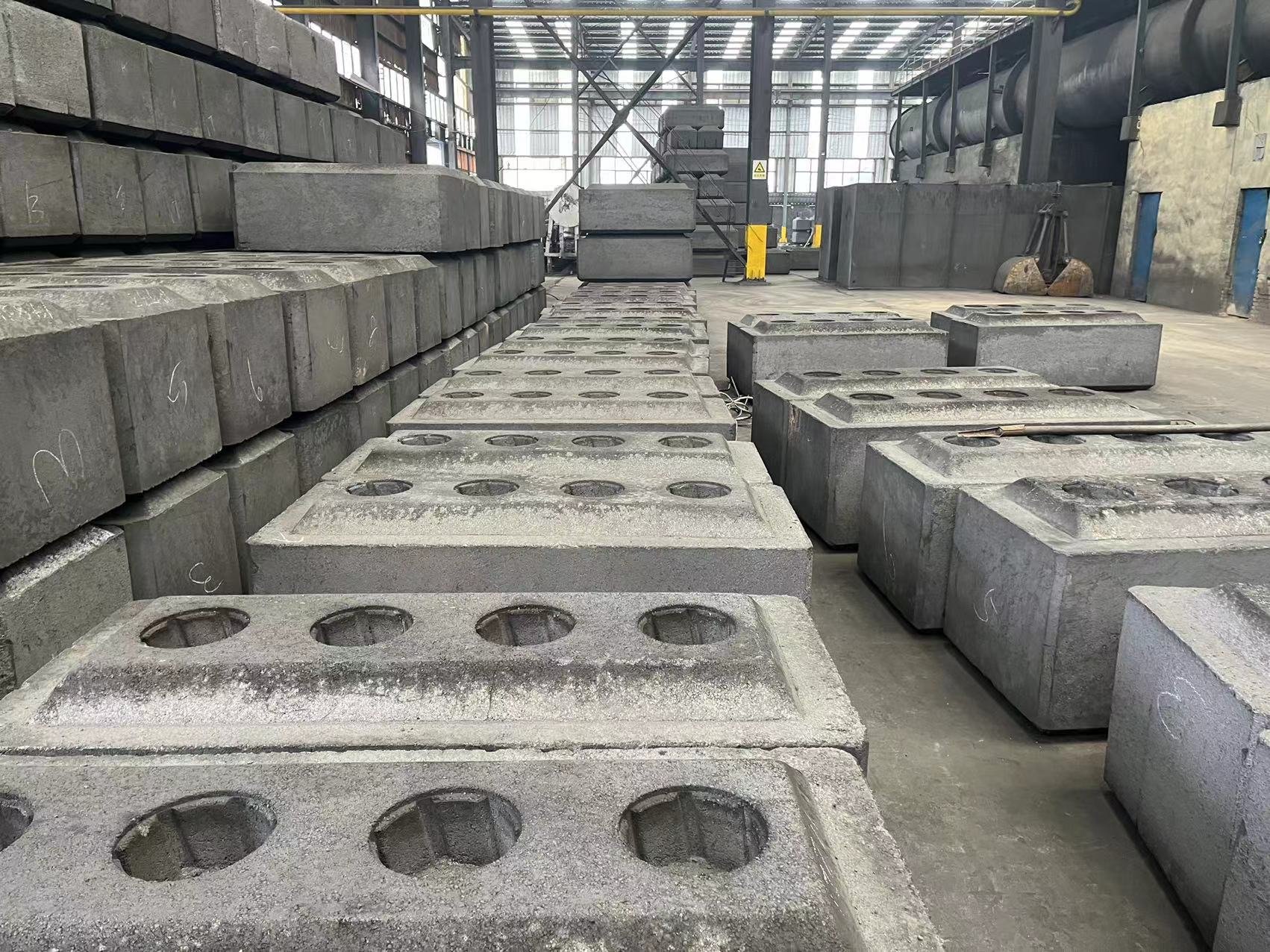
A prebaked carbon anode (PBA) is a pre-manufactured, shaped carbon block used as the positive electrode (anode) in primary aluminium production via the Hall-Héroult electrolysis process. Unlike the older Söderberg continuous anode technology, prebaked anodes are fully manufactured and baked in dedicated carbon plants before installation in the electrolysis cell — hence the designation "prebaked".
Composition & Raw Materials
Prebaked anodes are manufactured from two principal raw materials:
- Calcined Petroleum Coke (CPC) — the primary solid aggregate, typically constituting 65–75% of the anode mix; provides the carbon matrix, mechanical strength, and electrical conductivity
- Coal Tar Pitch (CTP) — the binder, typically 13–17% of the mix; fills the pores between CPC particles and carbonises during baking to bond the aggregate into a rigid structure
- Recycled anode butts and rejects — crushed and reintroduced as aggregate to reduce raw material costs and improve anode consistency
Manufacturing Process
Anode production follows a well-defined sequence of steps:
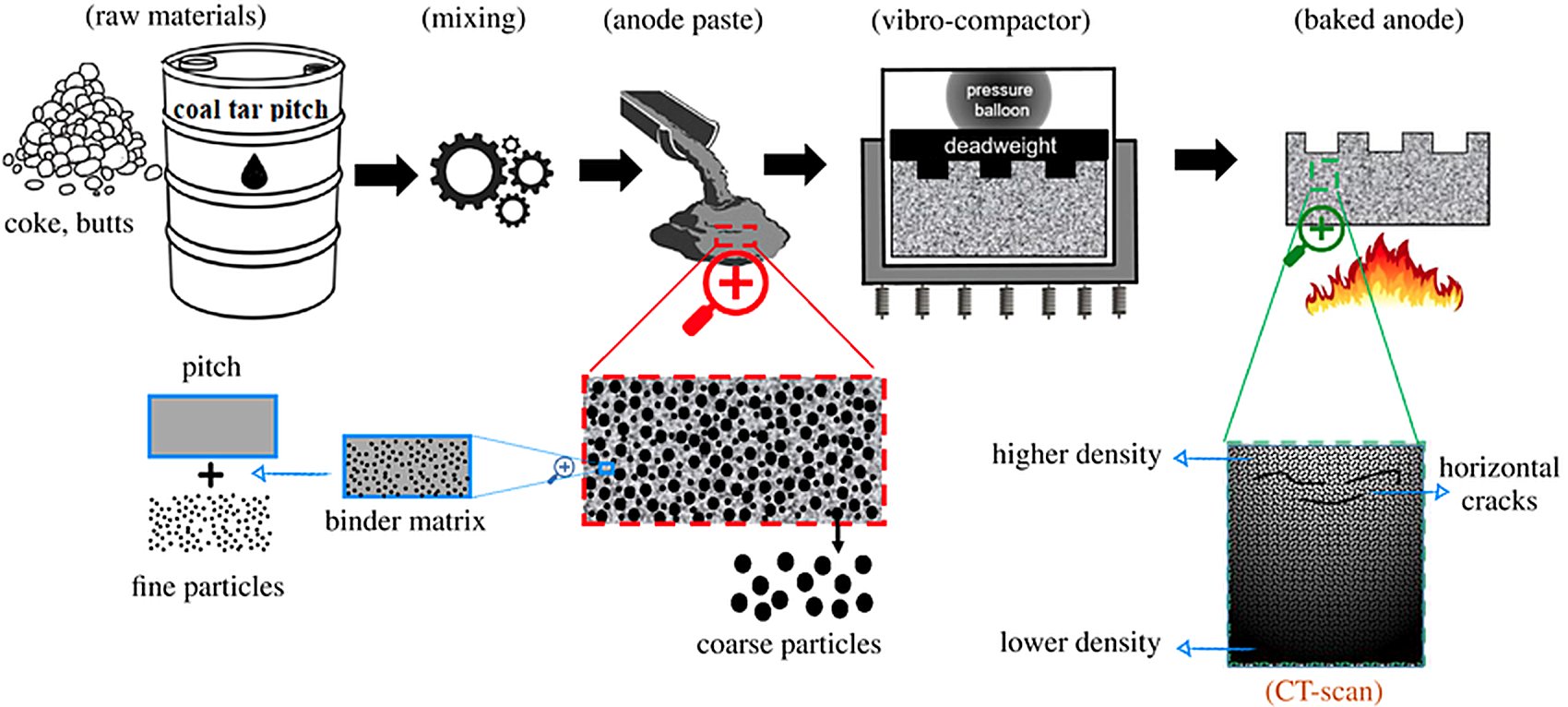
- Aggregate preparation — CPC is crushed and screened to a controlled particle size distribution with defined coarse, medium, fine, and flour fractions
- Mixing — CPC aggregate and coal tar pitch binder are combined at 155–180°C to ensure full wetting of coke particles by the pitch
- Forming (green anode) — the hot paste is compacted by vibration moulding or pressing to produce the green anode block; typical green apparent density: 1.47–1.52 g/cm³
- Baking — green anodes are loaded into ring furnaces and heated to 1,100–1,200°C over a controlled heating schedule lasting 300–400 hours; pitch volatiles are driven off and the binder is fully carbonised; baked apparent density reaches 1.53–1.64 g/cm³
- Rodding — baked anode blocks are assembled with a steel stub/yoke system using cast iron or thimble connections, forming the complete anode assembly ready for cell installation
Figure 1 — Prebaked Carbon Anode production process schematics[6]
Physical & Chemical Specifications
Key quality parameters are defined by ISO standards:
| Property |
Standard |
Typical Range |
| Baked apparent density |
ISO 12985-1 |
1.53–1.64 g/cm³ |
| Electrical resistivity |
ISO 11713 |
55–62 μΩm |
| Compressive strength |
ISO 18515 |
40–48 MPa |
| Tensile strength |
ISO 12986-1 |
8–10 MPa |
| Young's modulus |
RDC-144 |
3.5–5.5 GPa |
| Thermal conductivity |
ISO 12987 |
3.5–4.5 W/mK |
| Coefficient of thermal expansion |
RDC-158 |
3.5–4.5 × 10⁻⁶ K⁻¹ |
| Air permeability |
ISO 15906 |
0.5–1.5 nPm |
| CO₂ reactivity residue |
ISO 12988-1 |
84–96% |
| Air reactivity residue |
ISO 12989-1 |
0.05–0.3% per minute |
Performance in the Electrolysis Cell
Once installed in an aluminium electrolysis cell, the prebaked anode is immersed in molten cryolite bath at approximately 960°C. As current passes through the cell, alumina (Al₂O₃) dissolved in the bath is reduced at the cathode to produce liquid aluminium, while oxygen ions are discharged at the anode surface, reacting with the carbon to form CO and CO₂ — consuming the anode at a rate of approximately 400–450 kg of carbon per tonne of aluminium produced. Each anode block has a service life of 24–33 days before it is replaced. The anode is lowered progressively as it is consumed to maintain a constant anode-cathode distance (ACD), typically 3–5 cm, which directly controls cell voltage and energy efficiency.
Advantages over Söderberg Technology
| Parameter |
Prebaked Anode |
Söderberg Anode |
| PAH emissions |
~0.05 kg/tonne Al |
~25 kg/tonne Al |
| Voltage drop |
~300 mV |
~500 mV |
| Current density |
>0.8 A/cm² |
Lower |
| Automation compatibility |
High |
Low |
| Environmental compliance |
Meets modern standards |
Being phased out globally |
Market & Supply Chain
The prebaked anode supply chain is structurally tied to the availability of anode-grade CPC (low sulphur, low metals) and coal tar pitch — both of which are strategically constrained commodities. Many large aluminium producers operate captive carbon plants co-located with smelters to secure supply and control anode quality. Global prebaked anode consumption tracks primary aluminium production closely, with demand exceeding 25 million tonnes per year globally.
References
- Wikipedia. Prebaked consumable carbon anode (Page version: Nov 7, 2025)
- Khaji K., & Al Jabri N. (2016). Optimum baking level of carbon anodes for aluminum
- production. Proceedings of ICSOBA 2016, Quebec City, Quebec, Canada, October 3–6.
- Chen B., Chaouki H., Picard D., Lauzon-Gauthier J., Alamdari H., Fafard M. (Feb 15, 2021). Physical Property Evolution of the Anode Mixture during the Baking Process. Materials (Basel). 14(4):923. DOI: 10.3390/ma14040923. PMID: 33672082; PMCID: PMC7919669.
- Oreate AI (Jan 7, 2026). Comprehensive Analysis of the Production Process for Prebaked Anode Materials
- Mollaabbasi R., Hansen L., Grande T., Taghavi S.M., & Alamdari H. (May 2021). Effect of fine coke particles on rheological properties of the binder matrix of carbon anodes in aluminium production process. The Canadian Journal of Chemical Engineering, 100(S1), S58–S71. DOI: 10.1002/cjce.24108
- TechSolutions (Oct 23, 2021). Pre-baked Anode Carbon Block
- Amara B., Kocaefe D., & Kocaefe Y. (2025). A review of the studies on the utilization of petroleum pitch and its blends with coal tar pitch for carbon anode production in aluminum industry. Next Research, 2(2), 100250. DOI: 10.1016/j.nexres.2025.100250
- Verified Market Research (Jun 2025). Report 525790: Carbon Anode for Aluminum Electrolysis Market