
Product
Alumina
Names
Aluminium Oxide; Aluminium(III) Oxide; Dialuminium Trioxide; Aluminium Sesquioxide
Insight Articles
#PS749
Main Product
Aluminium Oxides
Segment
Chemicals
Main-Family
Inorganics
Sub-Family
Inorganic Oxides
Physical State

Solid

Description

Alumina (Al₂O₃) is the most important oxide of aluminium and one of the most widely used industrial minerals globally. It occurs naturally as corundum and is the principal intermediate in the production of aluminium metal, as well as a critical material in its own right across ceramics, refractories, catalysis, and electronics.

Natural Occurrence

Pure corundum is colourless, but trace impurities produce some of the world's most valued gemstones: chromium imparts the red colour of ruby, while iron and titanium produce the blue of sapphire. Synthetic corundum and alumina are produced at large scale for abrasive and technical ceramic applications.

Production

The Bayer Process is the industry standard for alumina production, using bauxite ore as the starting material. Bauxite is digested in hot sodium hydroxide solution, which selectively dissolves the aluminium-bearing minerals into a sodium aluminate liquor. After clarification and seeding, aluminium hydroxide precipitates out and is subsequently calcined at high temperatures to yield alumina. World production of alumina exceeds 130 million tonnes per year, the vast majority destined for aluminium smelting.

Primary Use — Aluminium Smelting

Alumina is the essential feedstock for producing aluminium metal via the Hall–Héroult process. In this electrolytic process, alumina is dissolved in molten cryolite (Na₃AlF₆) at approximately 960°C and subjected to a powerful direct current, causing aluminium to deposit at the cathode while oxygen is released at the carbon anode. The resulting primary aluminium is used across a vast range of applications, from beverage cans and packaging foil to aerospace structural components.

Physical & Chemical Properties

Property Value
Molecular formula Al₂O₃
Molar mass 101.96 g/mol
Appearance White crystalline solid
Melting point ~2,054–2,072°C*
Boiling point ~2,977°C
Density 3.95–4.1 g/cm³ (α-phase)**
Hardness (Mohs) ~9
Solubility in water Insoluble
Chemical character Amphoteric

Legend: *The value of 2,054°C is commonly cited in chemical databases, while 2,072°C appears in materials science references for high-purity α-alumina (corundum); **α-alumina (corundum) — the densest and most compact phase, typically cited at 3.99–4.02 g/cm³ for high-purity sintered material, γ-alumina — more porous and disordered, with a significantly lower density of around 3.2–3.7 g/cm³, Polycrystalline or sintered alumina ceramics — density varies with manufacturing conditions and porosity


Crystal Phases

Alumina exists in several crystalline phases, the most significant being:

  • α-alumina (corundum) — the thermodynamically stable form, produced by high-temperature calcination; extremely hard and dense
  • γ-alumina — a metastable, highly porous form with large surface area, preferred as a catalyst support and adsorbent
  • β-alumina — a sodium-containing phase relevant to solid-state electrolyte applications

Non-Metallurgical Applications

Beyond aluminium smelting, alumina's exceptional hardness, thermal stability, and chemical inertness make it valuable across numerous industries:

  • Refractories — kiln linings, furnace bricks, and crucibles exploiting its high melting point and resistance to thermal shock
  • Abrasives — grinding wheels, sandpaper, and polishing compounds due to its Mohs hardness of ~9
  • Advanced ceramics — electrical insulators, substrates for semiconductors, and cutting tool inserts
  • Catalyst support — γ-alumina is widely used as a support material in refinery hydrotreating, reforming, and Claus sulfur recovery units
  • Medical & dental — biocompatible implants, prosthetic joints, and dental crowns
  • Flame retardants — aluminium hydroxide (precursor to alumina) is used as a halogen-free flame retardant in polymers


References

  1. Wikipedia. Aluminium oxide. (last edited 2026)​
  2. Hindustan Abrasives (Jan 28, 2025). Aluminium oxide (Al₂O₃) – Definition, structure, properties and uses
  3. AZoM / AZO Materials (May 15, 2024). Alumina (aluminium oxide) – Properties and applications ​
  4. BYJU'S Chemistry (Dec 13, 2022). Properties of aluminium oxide – Al₂O₃
  5. Stanford Advanced Materials (Feb 13, 2025). Aluminum oxide: Properties, applications, and production ​
  6. ScienceDirect Topics. Aluminum oxide – An overview (Retrieved Feb 24, 2026) ​

Insight Articles
Your insights will be shown here

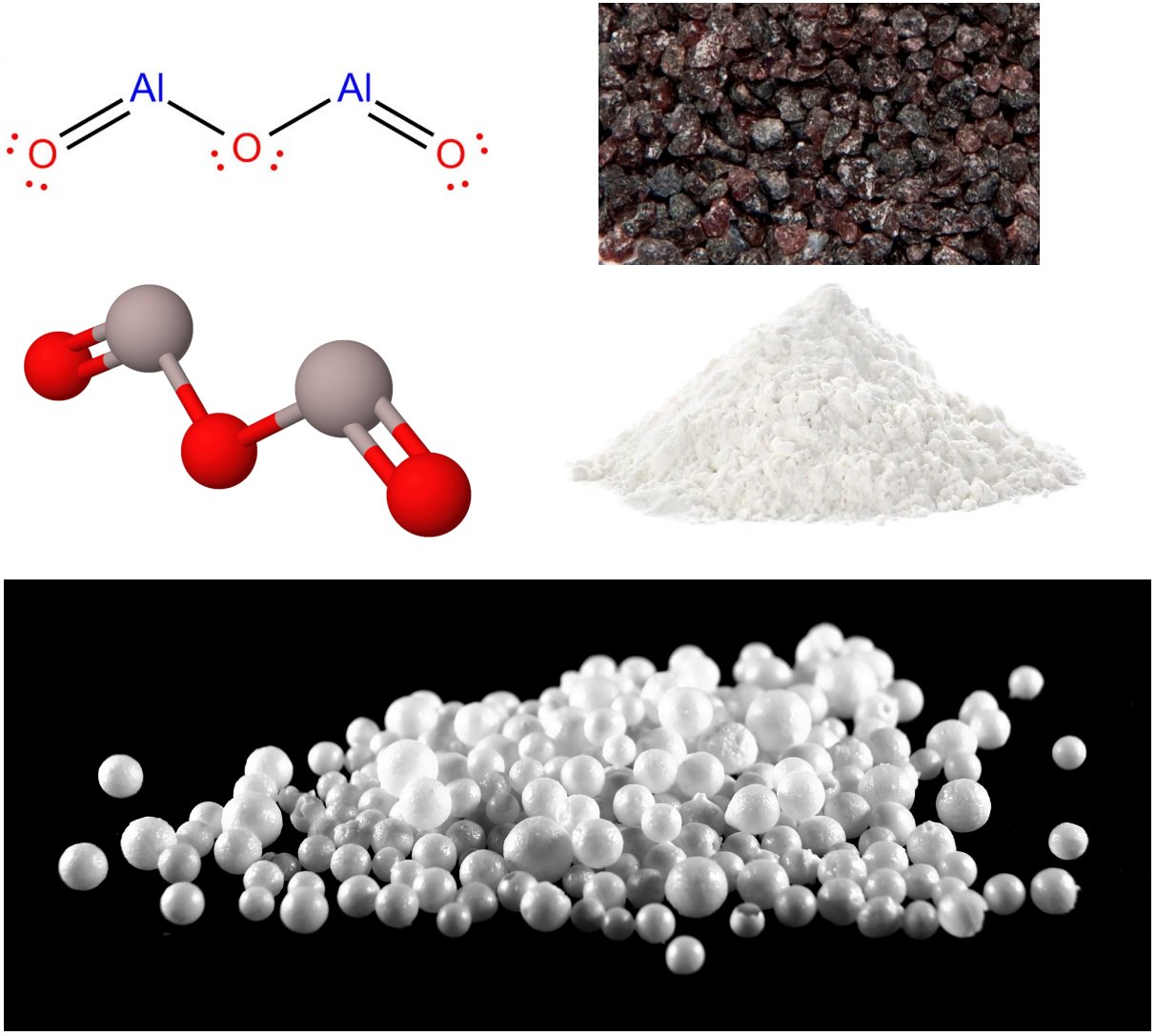
Molecular representation of alumina (top & middle left) - Corundum Gemstones (top right) - Alumina powder (middle right) - Alumina Spheres 3 to 6 mm | Various sources
  Product Communicator
Identifiers

logo CAS Number
1344-28-1
logo EC Number
215-691-6
logo ECHA InfoCard
100.014.265
logo IUPAC Name
Aluminium(III) oxide
logo PubChem ID
9989226
Chemical Data

Chemical Formula

Al2O3

Molecular Weight (g/mol)
101.96
Boiling Point (°C)
2977
Melting Point (°C)
2054
Sulfur Content (wt%)
0
Specific Gravity
4.00
Crude Data

API Gravity
-96.13
Country
Product Settings

Default
Status
A
Content provided by
Transaction Name Date
Modified by UserPic   Kokel, Nicolas 2/24/2026 8:25 AM
Added by UserPic   Fournier-Paradis, Jacob 2/21/2026 7:22 PM