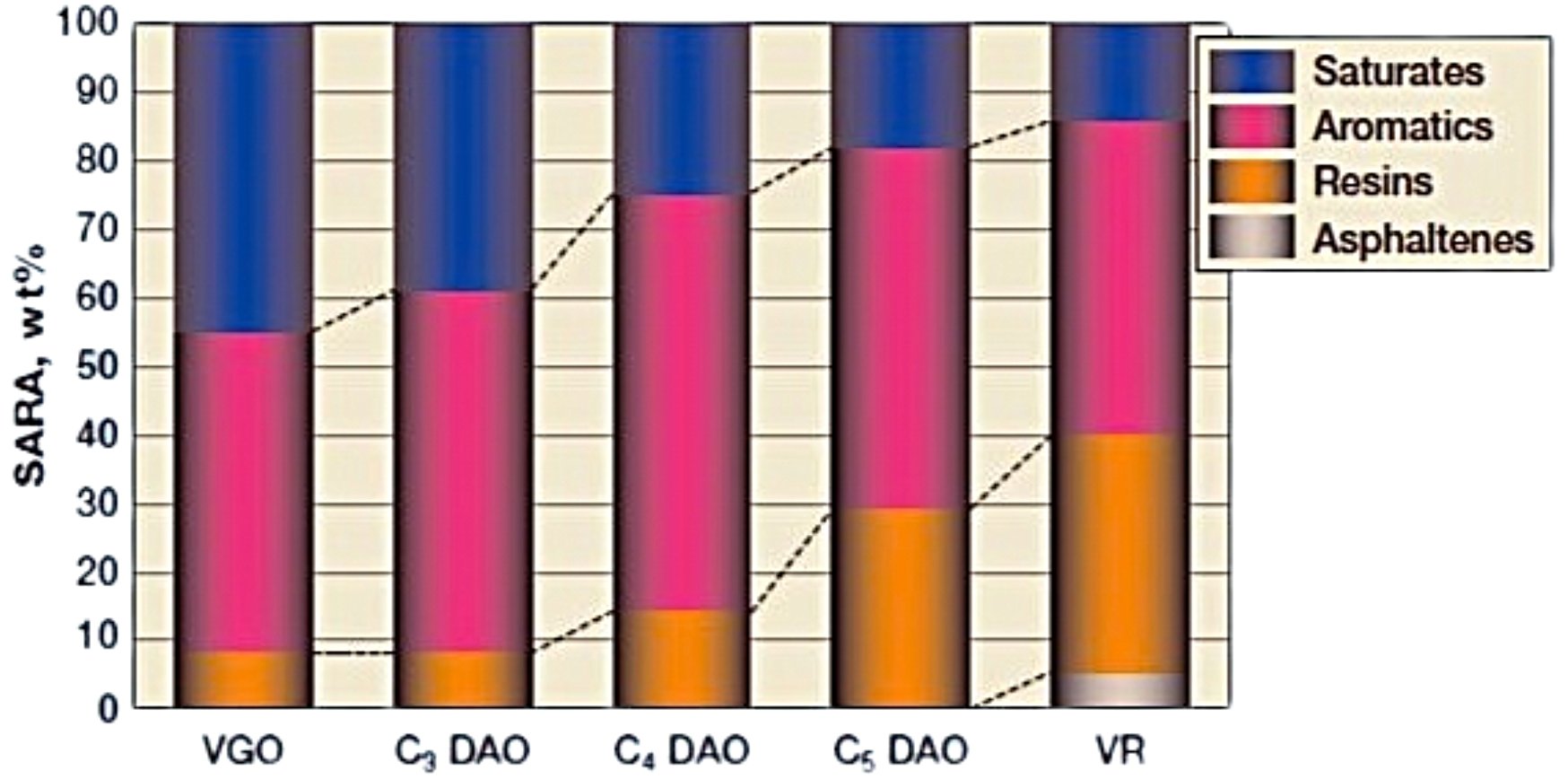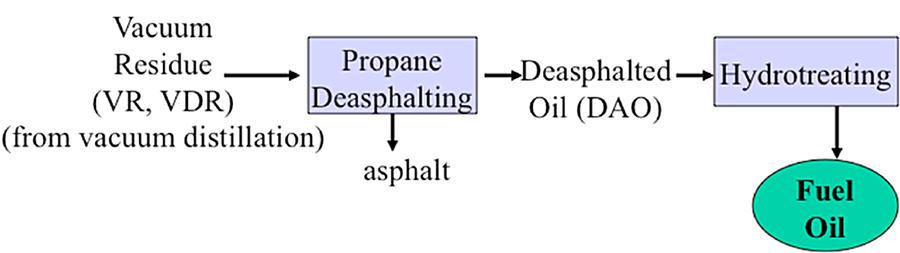

Deasphalted oil (DAO) is a refined petroleum product obtained by removing asphaltenes from heavy crude oil fractions, particularly vacuum residue, through a solvent extraction process known as solvent deasphalting (SDA). This process uses light hydrocarbon solvents (typically propane, butane, or pentane) under controlled temperature and pressure conditions to selectively dissolve paraffinic and naphthenic hydrocarbons while precipitating asphaltenes, which contain high concentrations of sulfur, nitrogen, metals, and other undesirable compounds.
Figure 1 - SARA analysis for various SDA solvents | Source: Axens

Chemical Composition and Properties
DAO exhibits significantly improved properties compared to the original vacuum residue feedstock. The removal of asphaltenes results in substantially reduced sulfur, nitrogen, and metal content (particularly vanadium and nickel), lower carbon residue, decreased viscosity, and improved color. DAO contains primarily saturates, aromatics, and resins (without asphaltenes in the SARA analysis), with higher API gravity and better viscosity index compared to the parent vacuum residue. The resin and aromatic content remaining in DAO provides it with strong solvent characteristics, making it an effective natural asphaltene solvent.
Table 1 - Yields and product properties of deasphalting of base oil feedstock
| Crude source |
Oklahoma |
Peru |
East Texas |
Kuwait |
Kuwait |
| Vacuum residuum |
| API gravity |
19.3 |
14.9 |
14.3 |
8.6 |
5.4 |
| Viscosity SUS (210°F) |
385 |
740 |
920 |
950 |
23000 |
| Carbon residue wt% |
7.3 |
6.7 |
11.5 |
16.0 |
24.0 |
| Deasphalted oil |
| Yield, vol% |
77.0 |
76.3 |
60.0 |
36.8 |
25.0 |
| API gravity |
23.3 |
19.4 |
23.0 |
24.3 |
21.2 |
| Viscosity SUS (210°F) |
150 |
207 |
155 |
94 |
163 |
| Carbon residue wt% |
1.7 |
1.7 |
1.5 |
0.7 |
1.3 |
The rheological behavior of DAO is temperature-dependent, exhibiting non-Newtonian fluid characteristics below approximately 70°C (the softening point) and Newtonian behavior above this temperature. Viscosity decreases significantly with increasing temperature, with a distinctive transition occurring around the softening point that dramatically improves fluidity.
Applications
DAO serves as a premium feedstock for multiple downstream applications. It is primarily used as feedstock for lubricating base oil production, where it may be further refined through solvent extraction, dewaxing, and hydrofinishing to produce high-viscosity base oils known as "Bright Stock". Additionally, DAO can be processed in catalytic cracking or hydrocracking units to produce transportation fuels and petrochemical raw materials. The low metal and sulfur content of DAO makes it particularly suitable for catalytic conversion processes, as it minimizes catalyst poisoning and extends catalyst life.
The solvent deasphalting process represents a physical carbon rejection method that upgrades low-value vacuum residue into valuable products while concentrating undesirable components in the asphalt byproduct.
References
- ScienceDirect Topics. Deasphalted Oil - an overview.
- Frecon J. (Q3, 2017). What type of catalyst would you recommend for processing deasphalted oil in our hydrocracker? Axens
- Van Loc H. et al. (Uploaded Nov 21, 2019). Lubricant Base Oil Deasphalting Process. SCRIBD
- Ahn S., et al. (Dec 1, 2014) Physical and rheological properties of deasphalted oil produced from a solvent deasphalting process. Chemical Engineering Journal, 257, 242-247. DOI: 10.1016/j.cej.2014.07.037
- Jamaluddin, A. K. M., Nazarko, T. W., Sills, Suzanne, and B. J. Fuhr. Deasphalted Oil: A Natural Asphaltene Solvent. SPE Prod & Fac 11 (1996): 161–165. DOI: 10.2118/28994-PA