Base oils are refined petroleum products or synthetic hydrocarbons that serve as the primary component (70-99%) in lubricant formulations. They are produced through two main routes:
The American Petroleum Institute classifies base oils into five groups (I-V) based on saturates content, sulfur level, and viscosity index, with Groups I-III being mineral oils of increasing quality, Group IV comprising synthetic PAOs, and Group V including all other base stocks. These base oils are blended with performance additives to manufacture automotive engine oils, industrial lubricants, metalworking fluids, and greases for diverse applications.
Chemical Composition
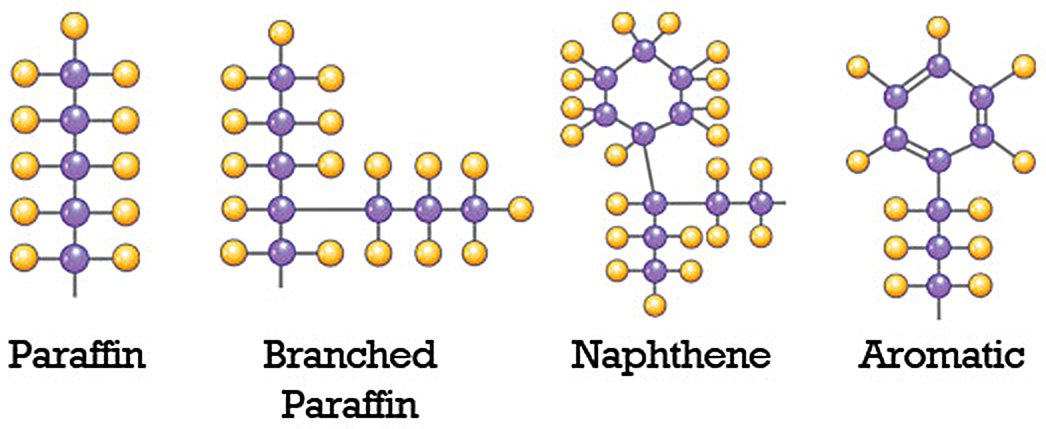
Base oils consist predominantly of hydrocarbons with carbon numbers ranging from C15 to C50, with light base oils generally containing C15-C30 components and heavy base oils containing C20-C50 components. The hydrocarbon composition can be classified into three primary categories that fundamentally determine base oil quality and performance characteristics:
Paraffinic hydrocarbons (CP): Saturated linear (n-paraffins) and branched-chain alkanes (iso-paraffins) that provide excellent high-temperature stability and high viscosity index. Normal paraffins above C20 are solid at room temperature and are removed during dewaxing processes. Iso-paraffinic structures exhibit the most desirable lubricant properties, offering optimal viscosity-temperature characteristics.
Naphthenic hydrocarbons (CN): Saturated cycloalkanes based primarily on five- and six-membered rings (cyclopentane and cyclohexane derivatives). Naphthenic compounds enable low-temperature operation, improve additive solubility, and contribute to superior solvency characteristics. These cyclo-paraffins are particularly abundant in naphthenic crude oils and impart a pale color to the resulting base oils.
Aromatic hydrocarbons (CA): Cyclic structures with conjugated double bonds based on the benzene ring, including mono-aromatics, di-aromatics, and polycyclic aromatic hydrocarbons (PAHs). High aromatic content indicates lower base oil quality, as aromatics reduce oxidation stability and viscosity index. Modern refining processes, particularly hydroprocessing, can reduce aromatic content to near-zero levels in high-quality base oils.
Figure 2 - Chemical components of base oils
Additionally, base oils contain heteroatomic compounds (heterocyclic compounds) with sulfur, nitrogen, and oxygen atoms, the concentration of which varies depending on crude oil source and refining severity. These compounds, along with PAHs, represent the components of greatest concern for base oil quality and performance.
Production Technologies
Two primary refining approaches are employed for base oil production:
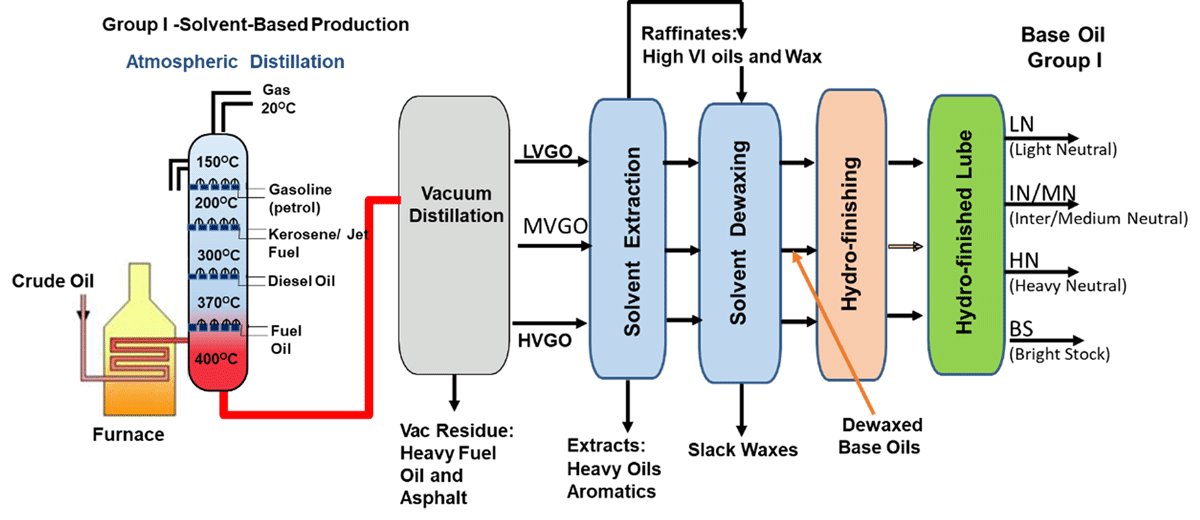
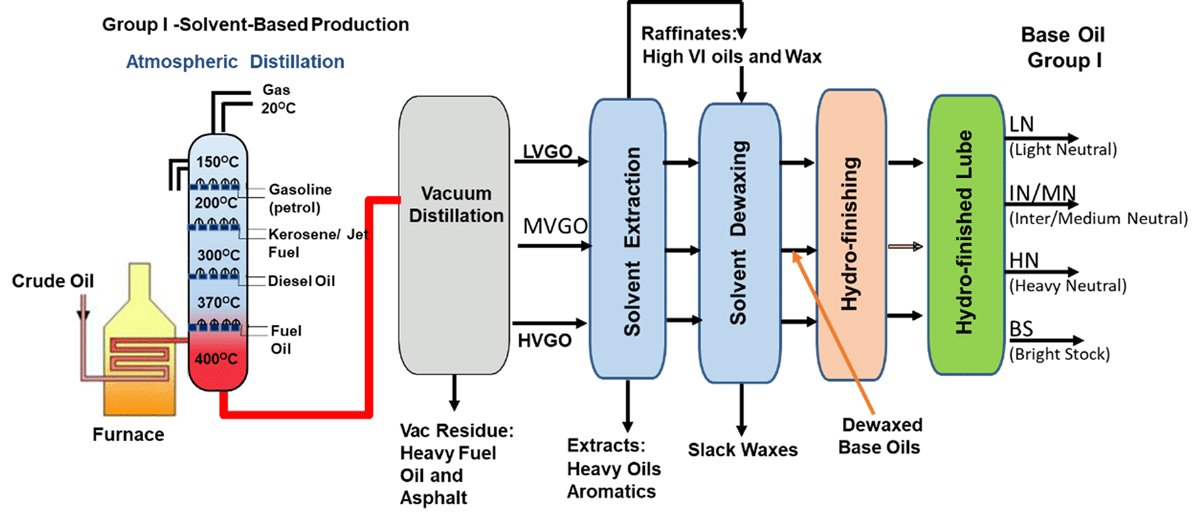
Solvent refining (Separation method): Traditional process consisting of solvent extraction to remove aromatics, solvent dewaxing to reduce pour point, and hydrofinishing to remove polar compounds like sulfur and nitrogen. This lower-cost method produces Group I base oils with viscosity index of 80-120 and higher sulfur content (>0.03%).
Figure 1 - Base Oil Group I solvent-based production [6]
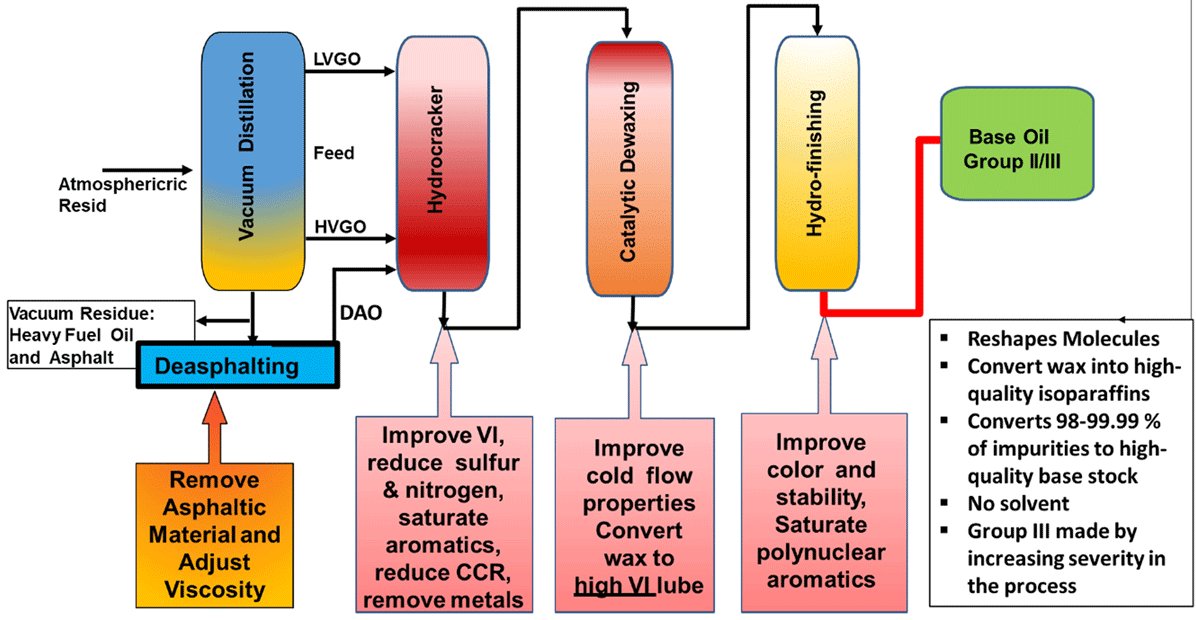
Hydroprocessing (Conversion method): Advanced technique involving severe hydrotreating or hydrocracking/hydroisomerization where naphthenic and aromatic rings are opened and reformed into iso-paraffinic structures using hydrogen and catalysts. This process removes sulfur, nitrogen, and aromatics while reshaping molecular structures to create Group II (hydrotreated) and Group III (hydrocracked/isomerized) base oils with superior properties.
Figure 1 - Base Oil Group II & III hydro-processing conversion [6]
The base oil manufacturing process fundamentally determines the composition of the base oils produced.
Figure 2 - Conversion of feed molecules vs. relative hydrocracking severity [10]
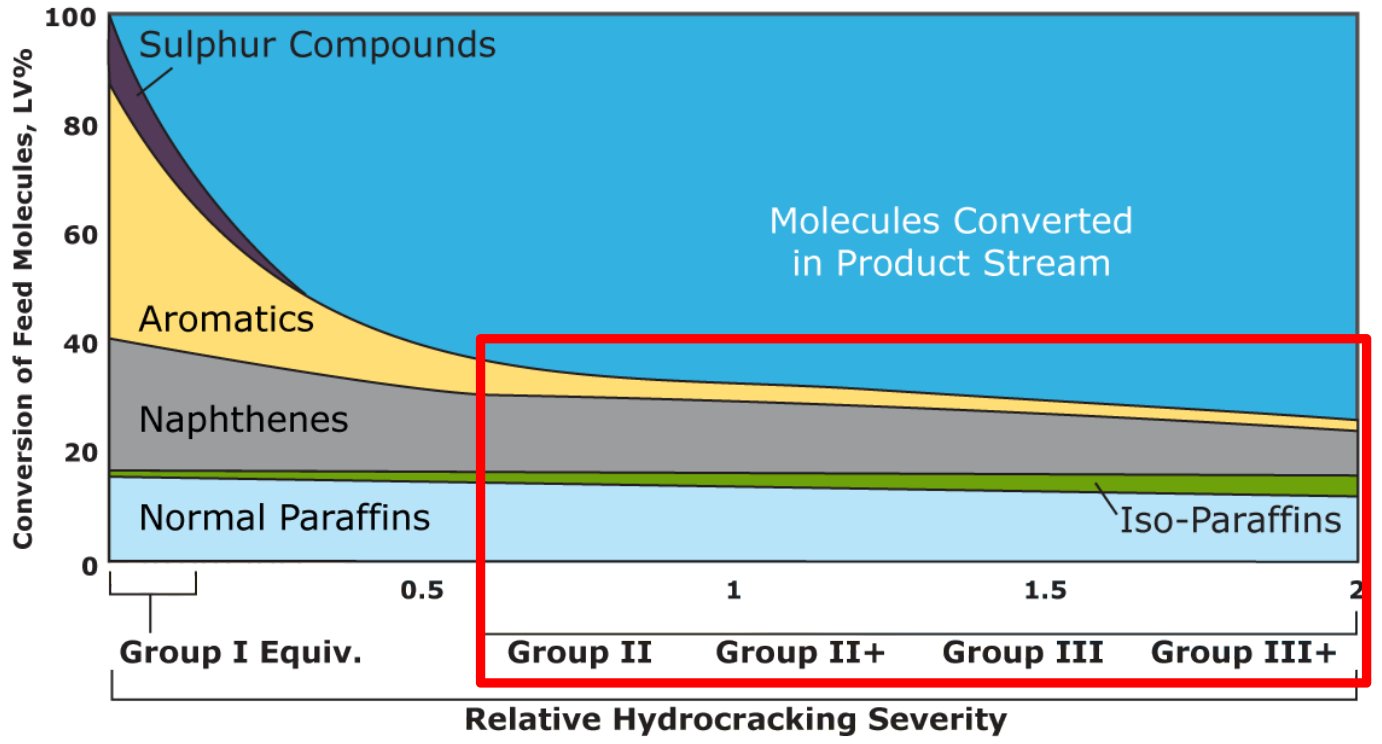
Residual normal paraffins are converted to iso-paraffins during catalytic dewaxing.
Residual aromatics are converted to iso-naphthenes during hydrofinishing.
API Classification System
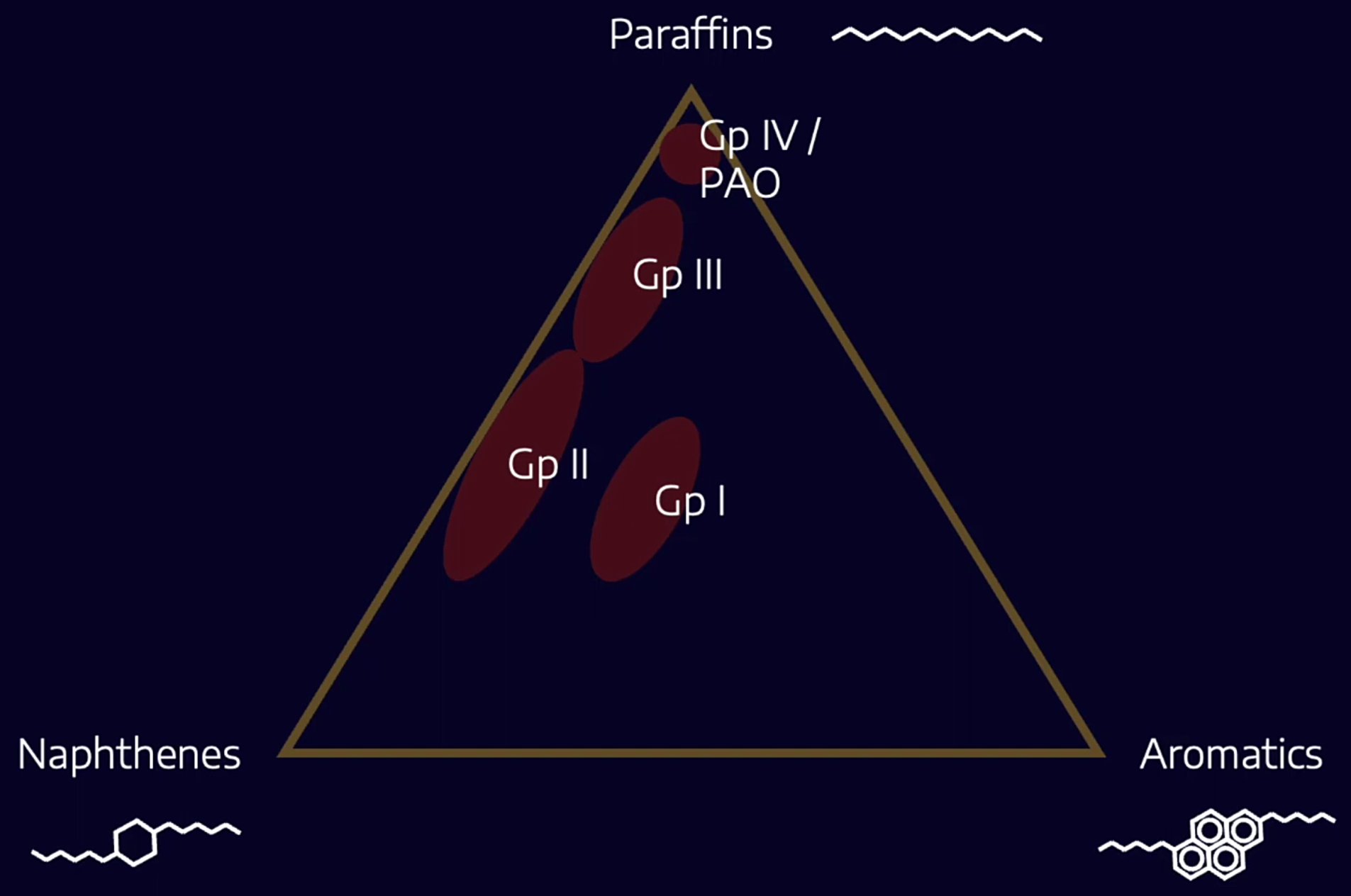
The American Petroleum Institute established five base oil groups in 1993, defined by sulfur content, saturates level, and viscosity index:
- Group I: Solvent-refined oils with <90% saturates, >0.03% sulfur, VI 80-120
- Group II: Hydrotreated oils with ≥90% saturates, ≤0.03% sulfur, VI 80-120
- Group III: Severely hydroprocessed oils with ≥90% saturates, ≤0.03% sulfur, VI ≥120
- Group IV: Polyalphaolefins - fully synthetic base stocks
- Group V: All other base stocks including esters, polyglycols, and naphthenic oils
Figure 3 - Base Oil Groups vs. Composition [11]
Applications and Formulation
Base oils constitute 70-99% of finished lubricant formulations, serving as the carrier fluid for performance additives in:
- Automotive engine oils and transmission fluids
- Industrial hydraulic fluids and gear oils
- Metalworking fluids and cutting oils
- Lubricating greases
Performance additives (5-30% of formulation) provide viscosity modification, oxidation resistance, wear protection, friction reduction, detergency, and dispersancy. Premium synthetic lubricants may contain over 20% additives to meet demanding specifications.
Critical Quality Parameters
Key base oil properties include viscosity index (resistance to viscosity change with temperature), carbon type composition (CA/CN/CP ratios), pour point, volatility, oxidation stability, and sulfur content. The suitability of crude oil for base oil production depends on paraffinic content, low aromatic and sulfur levels, and favorable viscosity-temperature characteristics. Higher paraffinic content and lower aromatic content correlate with superior base oil quality and performance.
References
- Wikipedia. Base oil.
- Eser S. FSC 432: Petroleum Processing — Processing and Conversion of Vacuum Distillation Residue. PennState - College of Earth and Mineral Sciences.
- Wright J. (Jun 27, 2012). The Fundamentals of Mineral Base Oil Refining. Machine Lubrication.
- S-Oil Corporation. Ingredients and properties of base oil. S-Oil7 Expert Knowledge.
- Develub (Jan 7, 2024). Mineral Base Oil Composition.
- Kathait A.S., Machinery Lubrication India. Base Oil: Building Blocks for Lubricants. March-April 2019.
- Esmaili Z. (Sep 2, 2023). Base Oil Physical and Chemical Properties. Infinite Galaxy.
- Pakelo Lubricants (Aug 29, 2021). Base Oil Classification: Mineral and Synthetic with API Standards.
- Health Canada (Jul 10, 2020). Base oils - information sheet. October 2018.
- Outhwaite A. & Rosenbaum, J. (2011). Base oils – An evolving landscape. Lubrisense White Paper, 11-11. Axel Christiernsson AB
- Lubrication Explained (October 25, 2021). Bright Stocks (BS) and Solvent Neutral (SN) base oils explained. Youtube Video.