Product
Acrylic Acid
Segment
Chemicals
Main-Family
Functional Organic Products
Sub-Family
Carboxylic Acids
Link
Insight Articles
#PS77

Description

Acrylic acid is the simplest unsaturated carboxylic acid and one of the most important bulk intermediates in the acrylates value chain. It is highly reactive (both at the double bond and the carboxyl group), polymerises readily, and is always shipped with an inhibitor — typically the methyl ether of hydroquinone (MEHQ) — plus dissolved oxygen to ensure safe storage and transport.

Safety Note

Acrylic acid is corrosive to skin and eyes, combustible, prone to uncontrolled exothermic polymerisation; storage generally at 15–25 °C under air to keep MEHQ effective.

Forms / Commercial Grades

  • Glacial acrylic acid (GAA) – high purity, typically ≥99.5%; used for polymerisation applications where water content and impurities matter (superabsorbent polymers, high-performance polymers).

  • Crude acrylic acid (CAA) /Technical Grade ~94% – aqueous grade, mainly used as feedstock for ester production.

  • Acrylate esters (downstream derivatives, often considered part of the same product family):

    • Methyl acrylate (MA)

    • Ethyl acrylate (EA)

    • Butyl acrylate (BA) – the largest-volume ester

    • 2-Ethylhexyl acrylate (2-EHA)

    • Specialty acrylates: hydroxyethyl acrylate (HEA), multifunctional acrylates (TMPTA, HDDA, DPGDA) for UV/EB curing

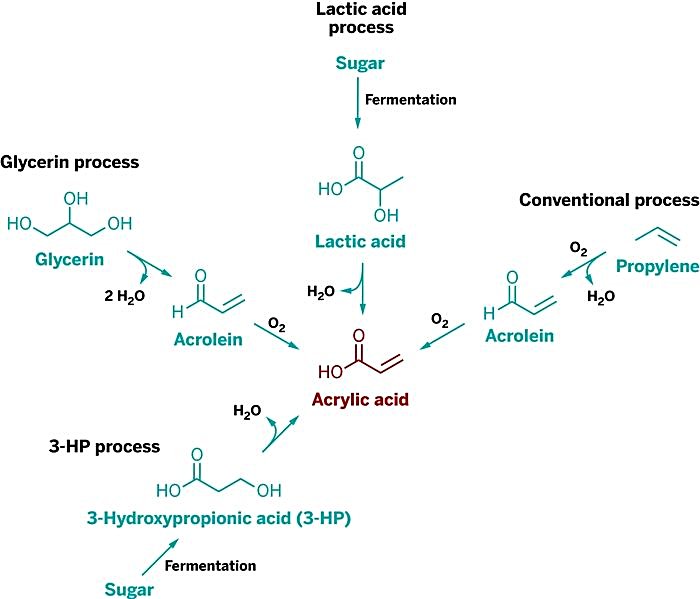
Manufacturing Routes

Mainstream route – two-step propylene oxidation (dominates global capacity):

  1. Propylene is oxidised over bismuth-molybdate catalysts to acrolein.

  2. Acrolein is further oxidised over vanadium-molybdenum oxide catalysts to acrylic acid, followed by absorption, extraction, and distillation. The crude acid is then either purified to GAA or esterified with alcohols (acid-catalysed) to the various acrylate esters.

Alternative and emerging routes:

Propylene-based oxidation remains overwhelmingly dominant due to feedstock economics, though bio-routes are under active development for sustainability.

Uses and Applications

~50% of acrylic acid is converted to acrylate esters; ~45% used directly in polymers.

Direct polymerisation uses (mostly GAA):

  • Superabsorbent polymers (SAP) – sodium polyacrylate for diapers, adult incontinence products, feminine hygiene – the single largest end use of GAA

  • Polyacrylic acid and dispersants – water treatment (scale inhibitors), detergent builders, mineral processing

  • Polymer flocculants (with acrylamide)

  • Thickeners (carbomers, alkali-swellable emulsions)

Acrylate ester applications

  • Coatings and paints – architectural emulsion paints, industrial and automotive coatings (BA, EA, 2-EHA)

  • Adhesives and sealants – pressure-sensitive adhesives (2-EHA, BA)

  • Textiles and nonwovens – binders, finishes

  • Paper – coatings and saturation

  • Plastics modification – impact modifiers, processing aids (MA, EA)

  • UV/EB-curable resins – inks, overprint varnishes, electronics (specialty acrylates)

  • Leather finishing, construction chemicals (mortar modifiers, caulks)

Market Context (brief)

Global capacity is in the order of ~8–9 million t/yr, concentrated in China, the US, and Europe; major producers include BASF, Dow, Nippon Shokubai, LG Chem, Arkema, and Sasol. Demand growth is driven by SAP/hygiene products and waterborne coatings, with growing interest in bio-based acrylic acid.


Insight Articles
Your insights will be shown here

Acrylic acid manufacturing routes
Settings

Status
A
Unit of Measure
Metric tonne (1,000 kg)
Physical State

Liquid

Building Block / Value Chain Info

Value Chain-I
Propylene
Content provided by
Transaction Name Date
Modified by UserPic  Kokel, Nicolas 8/16/2026 8:11 AM
Added 2/21/2021 10:01 PM