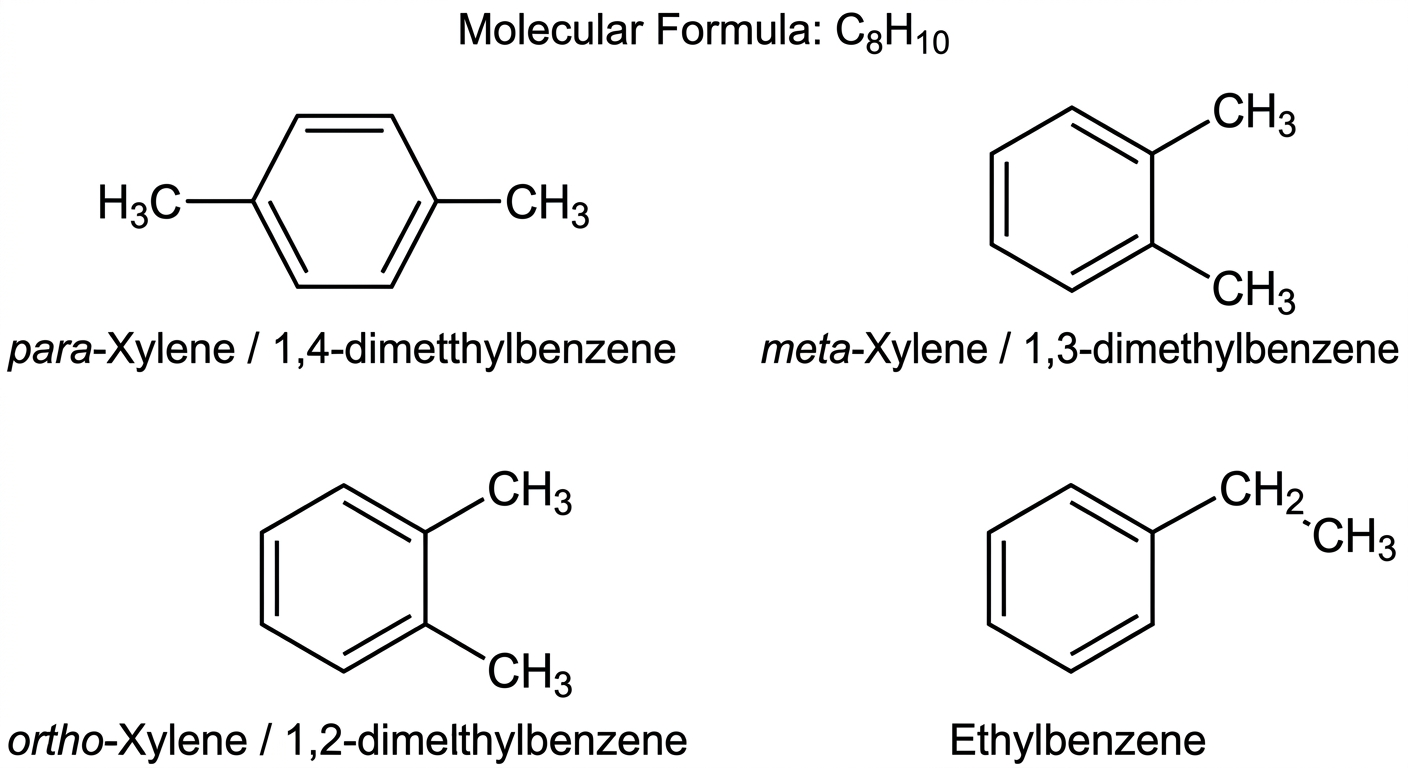
The C8 aromatics fraction is the mixed xylenes cut produced downstream of the aromatics extraction unit, containing four structural isomers with the molecular formula C₈H₁₀ — three xylene isomers and ethylbenzene. It is the second-most important aromatic product in world chemical consumption, ranking behind benzene.
Origin and Composition
The C8 aromatics fraction originates primarily from catalytic reforming of naphtha, where the reformate stream is rich in C₆–C₈ aromatics. After solvent extraction (typically using Sulfolane or N-Formylmorpholine) separates the aromatic fraction from paraffins and naphthenes, the BTX block fractionates benzene and toluene overhead, leaving the C8 cut as the heavier bottom product. A secondary source is pyrolysis gasoline (pygas) from steam cracking units.
The four components of the C8 fraction are:
| Component |
Formula |
Boiling Point |
Typical Content |
Primary Use |
para-Xylene
(PX) |
C₈H₁₀ |
138.4°C |
~20–24% |
Terephthalic acid
(PET, polyester fibers) |
| meta-Xylene (MX) |
C₈H₁₀ |
139.1°C |
~40–45% |
Isophthalic acid, solvents |
| ortho-Xylene (OX) |
C₈H₁₀ |
144.4°C |
~20–25% |
Phthalic anhydride |
| Ethylbenzene (EB) |
C₈H₁₀ |
136.2°C |
≤18.5% |
Styrene monomer production |
All four components share the same molecular weight (106.17 g/mol) and are colorless liquids at ambient conditions.
Separation Challenges
Because the four isomers have very similar boiling points (136–144°C), simple distillation is insufficient to separate them. The industry uses a combination of techniques:
- Fractional distillation: Separates OX (highest BP, 144.4°C) from the rest
- Simulated Moving Bed (SMB) adsorption: Selectively adsorbs PX from the mixed C8 stream using molecular sieves
- Crystallization: Exploits PX's relatively high melting point (13.3°C vs. −47.9°C for MX) to freeze it out
- Isomerization: Converts the less valuable MX and OX back to an equilibrium mixture enriched in PX, feeding a recycle loop known as the "xylenes loop"
Downstream Value Chain
Para-xylene is by far the highest-value C8 isomer, as it is the precursor to purified terephthalic acid (PTA), the monomer for PET bottles, polyester textiles, and films. Ortho-xylene feeds phthalic anhydride production (plasticizers, resins), while ethylbenzene is almost entirely converted to styrene for polystyrene and ABS plastics. The mixed C8 stream as a whole is also used as a high-octane gasoline blendstock when further separation is not economically justified.