Product
Toluic Acid
Segment
Chemicals
Main-Family
Functional Organic Products
Sub-Family
Carboxylic Acids
Link
Insight Articles
#PS818

Description

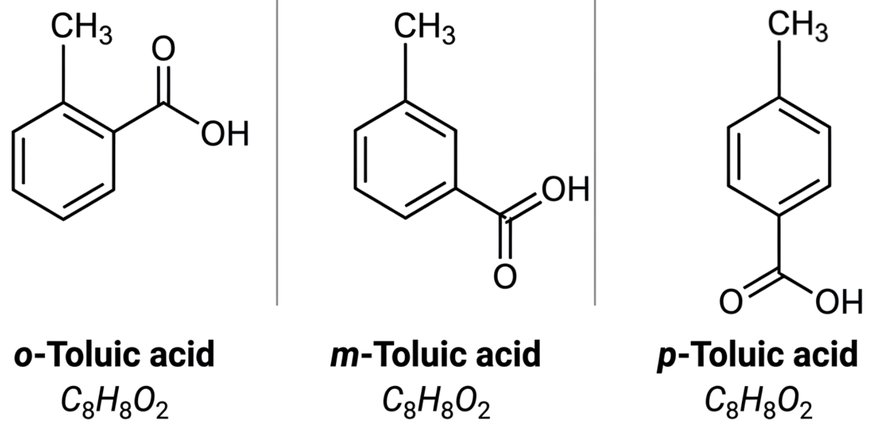
Toluic acid, also known as toluylic acid or methylbenzoic acid, is a family of aromatic carboxylic acids derived from toluene, formed when one hydrogen atom on the toluene ring is replaced by a carboxylic acid group. The term refers collectively to three positional isomers — ortho, meta, and para — which share the same molecular formula (C8H8O2) and molecular weight (136.15 g/mol) but differ in the relative placement of the methyl and carboxylic acid substituents on the benzene ring.


The Three Isomers

  • o-Toluic acid (2-methylbenzoic acid, CAS 118-90-1) — the methyl and carboxylic acid groups sit adjacent to each other on the ring; it forms needle-shaped crystals when purified and was first characterized by Sir William Ramsay, the Nobel laureate best known for discovering the noble gases

  • m-Toluic acid (3-methylbenzoic acid, CAS 99-04-7) — the two groups are separated by one ring position; it has a distinctive floral, honey-like odor

  • p-Toluic acid (4-methylbenzoic acid, CAS 99-94-5) — the two groups sit directly opposite each other on the ring, giving it the most symmetric structure of the three isomers


Shared Chemical Character

All three isomers are white to pale yellow (occasionally off-white) crystalline solids that are only sparingly soluble in water but dissolve readily in common organic solvents such as alcohol, ether, acetone, and methanol. As substituted benzoic acids, they behave chemically much like benzoic acid itself, participating in typical carboxylic acid reactions such as esterification and salt formation, while the methyl group provides a site for further oxidation or functionalization.


Production Routes

The toluic acids are generally produced by oxidizing the corresponding xylene isomer (ortho-, meta-, or para-xylene) with an oxidizing agent such as nitric acid in laboratory-scale synthesis, or through catalytic air oxidation in industrial settings. p-Toluic acid specifically arises through two distinct pathways relevant to industrial terephthalic acid manufacturing: directly from the partial oxidation of para-xylene, and separately from the hydrogenolysis (hydrogenation) of 4-carboxybenzaldehyde, in which the aldehyde group of 4-CBA is reduced back to a methyl group.


Industrial and Commercial Relevance

Among the three isomers, p-toluic acid holds by far the greatest industrial importance, since it functions as a key process intermediate in the conversion of para-xylene into terephthalic acid, the essential building block of polyethylene terephthalate (PET). The ortho and meta isomers, by contrast, find their primary commercial use as organic intermediates in the synthesis of pharmaceuticals and pesticides, playing a comparatively minor role in large-scale petrochemical manufacturing.


Insight Articles
Your insights will be shown here

Molecular structure, name and chemical formula of the three toluic acid isomers
Settings

Status
A
Unit of Measure
Metric tonne (1,000 kg)
Physical State

Solid

Content provided by
Transaction Name Date
Modified by UserPic  Kokel, Nicolas 7/30/2026 3:02 PM
Added 7/30/2026 8:11 AM