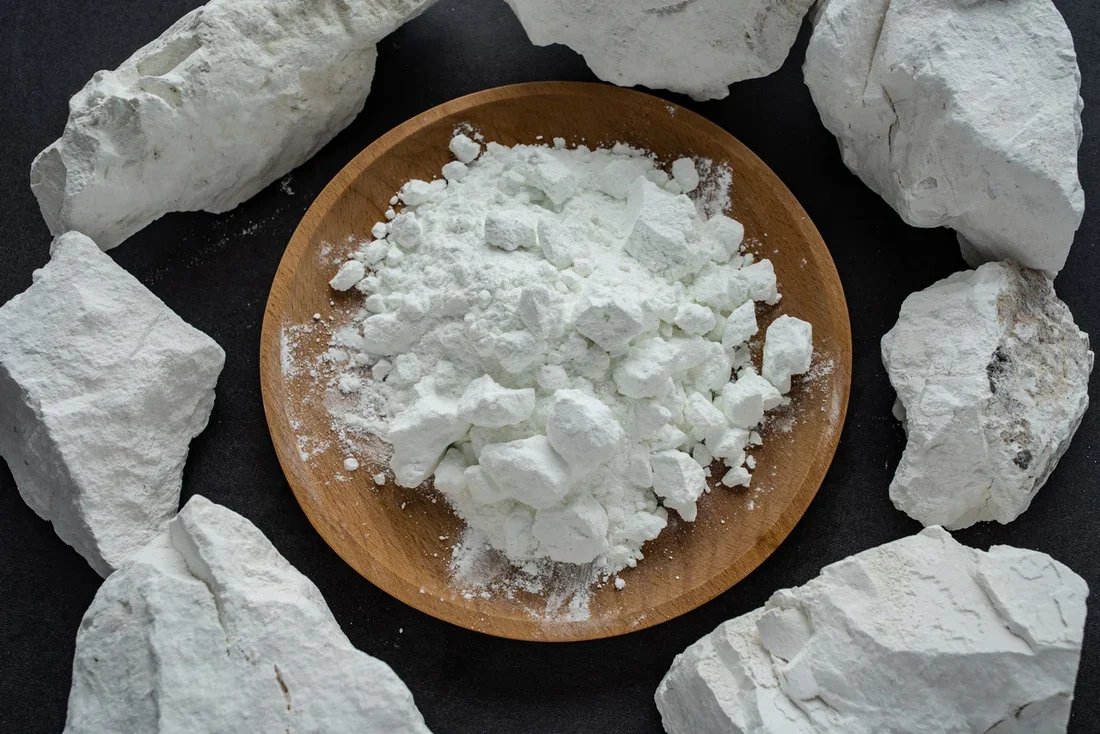
Calcium oxide (CaO), universally known as quicklime or burnt lime, is one of the oldest and most widely produced inorganic chemical compounds in the world, with recorded use dating back to the Middle Ages. It is a white to pale grey, odorless, crystalline solid belonging to the class of alkaline earth metal oxides, produced industrially by the high-temperature calcination of calcium carbonate (limestone). Calcium oxide is classified as a basic oxide — strongly alkaline in character — and its defining chemical reactivity, particularly its vigorous exothermic reaction with water, underpins its indispensable role across a wide spectrum of industrial sectors.
Crystal Structure
Calcium oxide crystallizes in the cubic rock salt (NaCl-type) structure (space group Fm3̄m), in which each Ca²⁺ ion is octahedrally coordinated by six O²⁻ ions and vice versa. Strong electrostatic forces between the Ca²⁺ and O²⁻ ions give CaO its exceptionally high thermal stability and one of the highest melting points among common inorganic oxides. Notably, CaO has no polymorphs — unlike calcium carbonate — and exists as a single stable crystal form under all practical conditions.
Physical & Chemical Properties
| Property |
Value |
| Appearance |
White to pale grey lumps, granules, or powder |
| Density |
3.35 g/cm³ |
| Melting point |
2,613°C |
| Boiling point |
2,850°C |
| Molar entropy |
40 J·mol⁻¹·K⁻¹ |
| Solubility |
Reacts with water (not simply dissolves) |
| pH in water |
~12.4 (strongly alkaline) |
| Refractive index |
1.838 |
CaO is a hard, refractory material with very high thermal resistance, yet paradoxically it is chemically highly reactive toward water, acids, and acidic gases — a dual nature that defines its industrial utility.
Production
Calcium oxide is produced exclusively by the calcination of calcium carbonate (limestone, chalk, or shells) in rotary or shaft kilns at temperatures above 900°C, releasing carbon dioxide as a by-product:
CaCO3 → CaO + CO2↑ (>900 °C)
The quality of the resulting CaO — in terms of reactivity, purity, and porosity — depends on the calcination temperature, residence time, and the purity of the limestone feedstock. High-calcium limestone (>95% CaCO₃) yields high-calcium quicklime, while dolomitic limestone yields dolomitic quicklime containing both CaO and MgO.
Key Chemical Reactions
1. Hydration (slaking) — exothermic reaction with water to form slaked lime:
CaO + H2O → Ca(OH)2 + heat
2. Reaction with CO₂ — carbonation back to calcium carbonate:
CaO + CO2 → CaCO3
3. Reaction with acids — neutralization, e.g. with hydrochloric acid to form calcium chloride:
CaO + 2 HCl → CaCl2 + H2O
4. Flue gas desulfurization — capture of SO₂ and formation of calcium sulfate:
CaO + SO2 → CaSO3
Calcium Oxide — Commercial Forms
These are the three foundational commercial types based on the CaO/MgO ratio of the source limestone:
| Type |
CaO Content |
MgO Content |
Source Rock |
Commercial Status |
| High-calcium quicklime |
>93–95% |
0.5–2.5% |
High-calcium limestone |
Dominant commercial grade; widely produced and branded by all major lime producers |
| Magnesium Enhanced Quicklime (MEL) |
Moderate–high |
Moderate (unbonded) |
High-calcium limestone naturally
enriched in Mg |
Distinct commercial product; specifically engineered for wet FGD applications |
| Dolomitic quicklime |
55–65% |
35–40% |
Dolomite (CaMg(CO₃)₂) |
Well-established commercial grade; widely produced and branded |
- High-calcium quicklime is the dominant commercial grade, preferred for steelmaking, glass manufacturing, chemical production, and water treatment where high CaO content and purity are critical
- Magnesium Enhanced Quicklime (MEL) is specifically engineered for wet flue gas desulfurization (FGD) scrubbing systems, where unbonded MgO enhances SO₂ capture efficiency and prevents scaling — it is not the same as magnesian/semi-dolomitic quicklime
- Dolomitic quicklime is widely used as a steelmaking flux and in refractory applications where both CaO and MgO contribute beneficially to the process
Industrial Applications
Calcium oxide is a cornerstone commodity chemical used across virtually every major industrial sector:
- Iron & Steel — primary flux in basic oxygen steelmaking (BOS), consuming 30–50 kg of quicklime per tonne of steel to remove silica, phosphorus, and sulfur as slag
- Cement — key ingredient in Portland cement clinker alongside silica and alumina
- Construction — component of mortars, plasters, and soil stabilization
- Water & Wastewater treatment — raises pH, precipitates heavy metals, neutralizes acidic effluents
- Pulp & Paper — regenerates sodium hydroxide from sodium carbonate in the kraft process
- Agriculture — soil amendment to correct acidity
- Chemical manufacturing — production of calcium carbide (CaC₂), calcium hypochlorite, precipitated calcium carbonate (PCC), and caustic soda
- Environmental — flue gas desulfurization (FGD), carbon capture via calcium looping
- Petroleum — water detection in fuel tanks; desulfurization of process streams
- Food — approved food additive (E529) as an acidity regulator and flour treatment agent
Global Production & Market
Calcium oxide is one of the top five highest-volume inorganic chemicals produced globally. World quicklime production exceeds 350–400 million metric tonnes per year, with China accounting for over 70% of global output. The steel and construction industries together account for the vast majority of consumption, with environmental applications (FGD, water treatment) representing the fastest-growing demand segment.
Safety & Handling
CaO is classified as a strong irritant to skin, eyes, and mucous membranes. Contact with moisture — including perspiration — triggers the exothermic hydration reaction, which can cause burns. It must be stored in sealed, moisture-proof containers and handled with appropriate PPE including gloves, goggles, and dust masks.
References
- Calcinor (Dec 9, 2020). Calcium oxide (CaO) — quicklime
- Tradeasia International (Nov 3, 2020). Calcium oxide (CaO): From ancient to modern industry
- LB Minerals (Jul 2, 2024). Calcium oxide
- MFF Chemical (Apr 12, 2023). What is CaO Quicklime and How is it Used in Industry?
- Nanografi Advanced Materials. 10 uses of calcium oxide in daily life (Accessed Mar 13, 2026)
- National Center for Biotechnology Information (PubChem). Calcium oxide (Accessed Mar 13, 2026)
- Noah Chemicals (May 7, 2018). Calcium oxide: One of history's most versatile chemicals
- Via Port. (Sep 30, 2024). The characteristics and applications of quicklime
- Wikipedia. Calcium oxide (Accessed Mar 13, 2026)
- Hebei Yayang Spodumene Company (Oct 11, 2023). Calcium oxide (CaO): Definition, properties & uses
- HiTech Minerals and Chemicals Group. Understanding Quick Lime: Types, Properties, and Applications (Accessed Mar 14, 2026)
- Tradeasia International (Feb 2, 2020). What Is Quicklime? Types, Properties, And Uses
- Peter Chemical Company. 019). Calcium Oxide or Quicklime (Accessed Mar 14, 2026)
- Carmeuse Americas (Mar 2024). Product Safety Datasheet: Magnesium Enhanced Quicklime