Product
Air
Segment
Chemicals
Main-Family
Industrial Gases
Sub-Family
Atmospheric gases
Link
Insight Articles
#PS332

Description

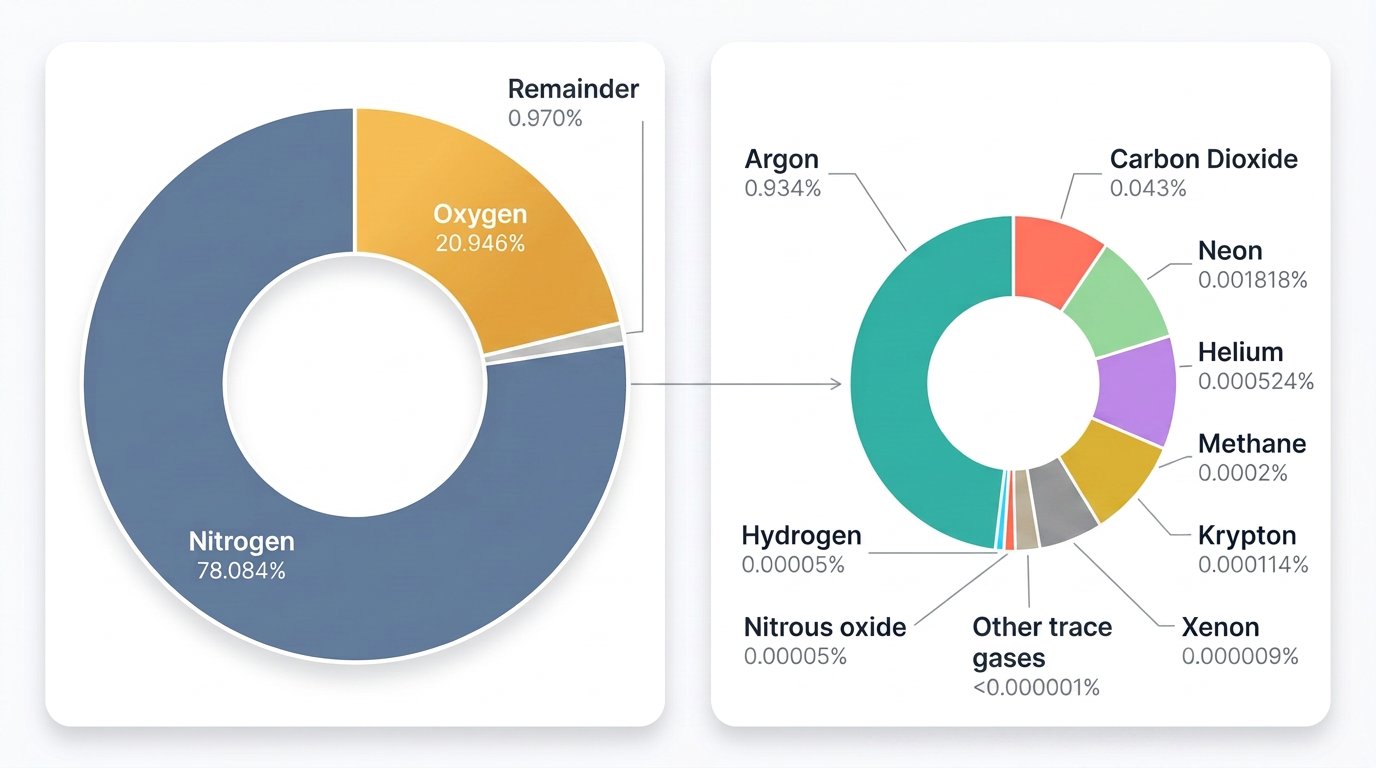
Air is the mixture of gases that forms Earth's atmosphere, sustaining respiration, combustion, and countless industrial processes. By mole fraction (i.e., by number of molecules), dry air consists of 78.08% nitrogen, 20.95% oxygen, 0.93% argon, and 0.04% carbon dioxide, together with trace amounts of neon, helium, methane, krypton, hydrogen, and ozone. This composition remains remarkably stable up to an altitude of approximately 100 km (the homosphere), maintained by continuous atmospheric mixing.

Air also contains a variable amount of water vapor, averaging around 1% at sea level but dropping to roughly 0.4% when averaged over the entire atmospheric column, since water vapor concentration decreases sharply with altitude and varies significantly with temperature, humidity, and geography. Water vapor plays a disproportionate role relative to its abundance: it is the most important greenhouse gas by volume, drives cloud formation and precipitation, and governs much of the atmosphere's thermal and radiative behavior.

Physically, air is colorless, odorless, and behaves as an ideal gas under standard conditions, with a molar mass of approximately 28.97 g/mol and a density of about 1.225 kg/m³ at sea level and 15°C. Its total atmospheric mass is estimated at roughly 5.15 × 10¹⁸ kg, of which the lower troposphere (up to ~12 km) contains the vast majority.

Beyond its natural role, air is one of the most important industrial raw materials in the world. Because its major constituents — nitrogen, oxygen, and argon — occur in fixed, predictable proportions, air can be liquefied and separated into its pure components through cryogenic fractional distillation, a process known as air separation. This technology, operated at large-scale Air Separation Units (ASUs) by companies such as Air Liquide, Linde, and Air Products, supplies the majority of global industrial gas demand: nitrogen for inerting and cryogenics, oxygen for steelmaking, medical use, and combustion enhancement, and argon for welding shielding and specialty atmospheres. Trace gases such as neon, krypton, and xenon are also recovered as valuable byproducts of this same process, despite their extremely low natural concentrations.


Insight Articles
Your insights will be shown here

Composition of atmosphere as of mid-2026
  Product Communicator
 (*=Default)
Settings

Status
A
Unit of Measure
Metric tonne (1,000 kg)
Physical State

Gas

Content provided by
Transaction Name Date
Modified by UserPic  Kokel, Nicolas 7/27/2026 3:05 PM
Added 3/28/2022 4:15 PM
Map of Air Products producing locations in ppPLUS

ppPLUS Insights: Please register to view the Map!
Production Analysis