Oil and Natural Gas Corporation Limited (ONGC) is India’s largest crude oil and natural gas producer and one of the country’s most valuable public sector enterprises. A state-owned “Maharatna” company under the administrative control of the Ministry of Petroleum and Natural Gas, ONGC is headquartered in New Delhi and accounts for roughly two-thirds to 70% of India’s domestic crude oil output and a comparable share of its natural gas production (including its share from joint ventures and production-sharing contracts).
Originally an exploration and production (E&P) company, ONGC has evolved into a vertically integrated energy major with interests spanning the entire hydrocarbon value chain — exploration, production, refining, petrochemicals, and power generation — as well as international upstream operations through its subsidiary ONGC Videsh Limited. The company is listed on the National Stock Exchange (NSE: ONGC) and the Bombay Stock Exchange (BSE: 500312) and is a consistent Fortune Global 500 constituent.
History
ONGC traces its origins to August 1956, when the Government of India established the Oil and Natural Gas Commission to systematically develop the country’s petroleum resources; it became a statutory body under the ONGC Act of 1959. Early exploration campaigns yielded major onshore discoveries in the Cambay basin of Gujarat (Ankleshwar, Kalol, Gandhar) and in the Assam-Arakan basin in the northeast. The defining moment in the company’s history came in 1974 with the discovery of the Mumbai High (formerly Bombay High) field off India’s west coast, which transformed the nation into a significant offshore oil producer and remains ONGC’s flagship producing asset nearly five decades later.
In 1993–94, the Commission was converted into a public limited company under the Companies Act, marking the beginning of its corporatization. The government subsequently disinvested minority stakes in several tranches between 1999 and 2022, while ONGC expanded downstream: it acquired a majority stake in Mangalore Refinery and Petrochemicals Limited (MRPL) in 2003, and in January 2018 completed the landmark acquisition of a 51.11% stake in Hindustan Petroleum Corporation Limited (HPCL) for approximately ₹36,900 crore (~US$5.8 billion), instantly making it one of India’s largest integrated oil and gas groups. ONGC was conferred Maharatna status — the highest classification for Indian state-owned enterprises — in 2010, and in 2024 it incorporated ONGC Green Limited to house its renewable energy and low-carbon ventures.
Upstream Operations
Exploration and production remains ONGC’s core business. The company has been instrumental in establishing most of India’s producing sedimentary basins and operates a vast portfolio of onshore and offshore assets. Its producing regions include:
-
Western Offshore (Arabian Sea): Mumbai High, Bassein, Heera, Neelam, and allied fields off the Maharashtra and Gujarat coasts — the historical backbone of Indian crude production.
-
Gujarat (onshore): Cambay, Ankleshwar, Gandhar, and the Ahmedabad-Mehsana fields.
-
Assam-Arakan basin (northeast): Naharkatiya, Rudrasagar, Geleki, and Lakwa fields, plus gas production in Tripura.
-
Krishna-Godavari basin (east coast): Onshore fields in Andhra Pradesh and a growing offshore position, anchored by the KG-DWN-98/2 deepwater block in the Bay of Bengal — ONGC’s flagship deepwater development, which began oil production in 2020 and is being ramped up toward plateau rates of around 45,000 barrels of oil per day and over 10 million standard cubic metres of gas per day.
-
Cauvery basin (Tamil Nadu): Smaller but established onshore production.
Beyond conventional production, ONGC operates coal-bed methane blocks in eastern India, maintains a significant enhanced oil recovery (EOR) programme to extend the life of mature fields such as Mumbai High, and produces value-added products — LPG, naphtha, and C2-C3 fractions — at processing plants at Hazira, Uran, Dahej, and Gandhar. The company typically delivers standalone output of around 19–20 million tonnes of crude oil and about 20 billion cubic metres of natural gas per year, with joint-venture and PSC equity share adding to these volumes.
Refining and Petrochemicals
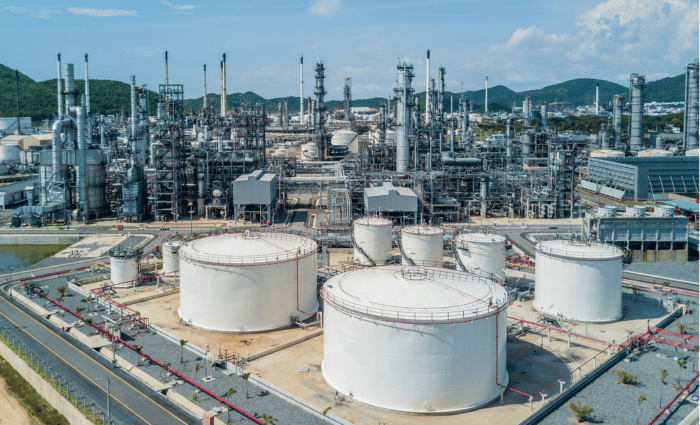
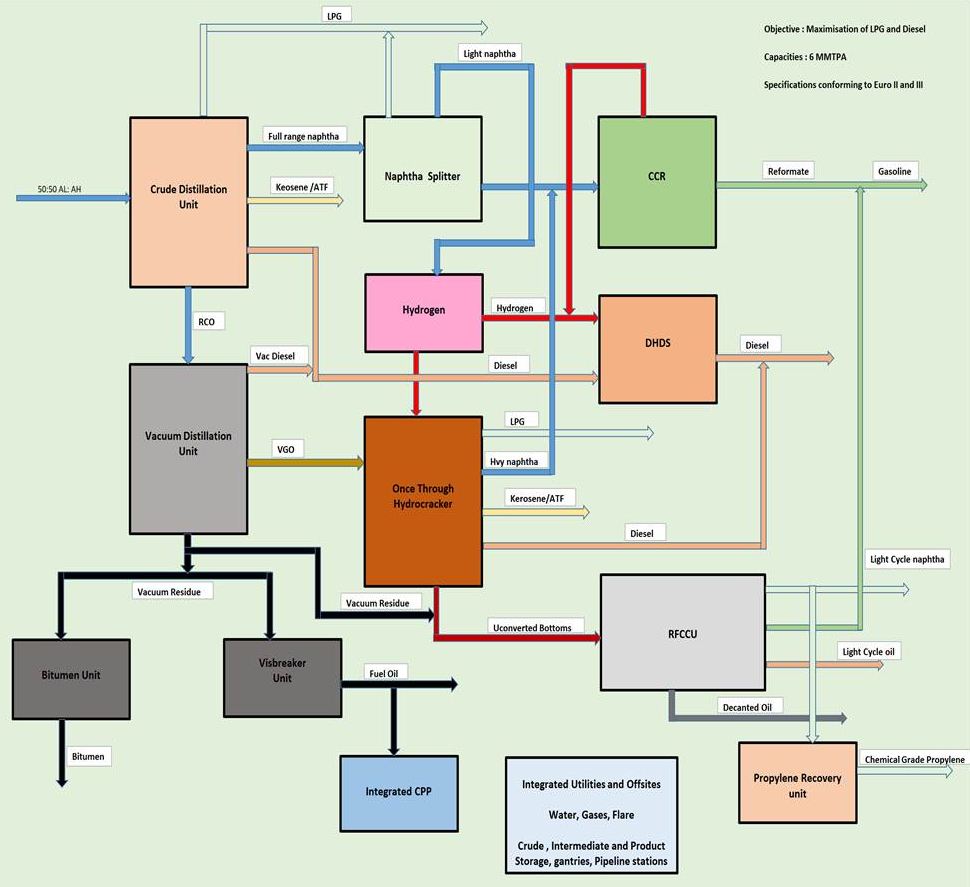
Through its subsidiaries, ONGC controls roughly one-fifth of India’s refining capacity and a growing petrochemical base:
| Asset |
Location |
Capacity / Configuration |
| HPCL Mumbai Refinery |
Mumbai, Maharashtra |
~9.5 million tpa |
| HPCL Visakhapatnam Refinery |
Visakhapatnam, Andhra Pradesh |
~8.3 million tpa (expanded to ~15 million tpa) |
| HPCL Rajasthan Refinery (HRRL, JV) |
Barmer, Rajasthan |
9 million tpa integrated refinery-cum-petrochemical complex (under development) |
| HMEL Guru Gobind Singh Refinery (HPCL JV) |
Bathinda, Punjab |
~11.3 million tpa refinery with petrochemical units |
| MRPL Mangalore Refinery |
Mangalore, Karnataka |
15 million tpa, with an integrated aromatics complex (para-xylene, benzene) following the merger of ONGC Mangalore Petrochemicals Ltd (OMPL) |
| ONGC Petro additions Ltd (OPaL) |
Dahej, Gujarat |
Dual-feed cracker of ~1.1 million tpa ethylene capacity with downstream polyethylene, polypropylene, and glycol units |
ONGC also operates gas-processing and fractionation units at Hazira and Uran (western India) that feed LPG, naphtha, and ethane/propane streams into the domestic petrochemical industry, and holds a stake in the Petronet MHB product pipeline.
International Operations: ONGC Videsh Limited
ONGC Videsh Limited (OVL), the wholly owned overseas arm, is one of India’s largest international E&P investors, with producing and exploratory assets in around 15 countries. Its most significant positions include stakes in the Sakhalin-1 project and the Vankor field in Russia, the ACG oil field and BTC pipeline in Azerbaijan, the Lower Zakum concession in the UAE, Block 06.1 in Vietnam, the Rovuma Area 1 LNG project in Mozambique, and assets in Brazil, Colombia, Venezuela, Myanmar, and Sudan/South Sudan. OVL typically contributes around 10 million tonnes of oil equivalent per year to the group’s production.
Other Businesses and Energy Transition
The group’s wider portfolio includes ONGC Tripura Power Company (OTPC), which operates a 726 MW gas-based power plant at Palatana, Tripura, supplying electricity to India’s northeast, and the Dahej SEZ. In the low-carbon space, ONGC has set a target of net-zero emissions for Scope 1 and Scope 2 by 2038, plans to build around 10 GW of renewable capacity by 2030 through ONGC Green Limited, and has entered into a joint venture with NTPC Green Energy Limited to develop renewable and green hydrogen projects.
Market Position
ONGC is consistently among India’s most profitable state-owned companies and among its largest by market capitalization. Its strategic importance to India’s energy security is underpinned by its dominant share of domestic hydrocarbon production, a reserve base in excess of one billion tonnes of oil equivalent, and — since the HPCL acquisition — an integrated refining and marketing network comprising over 20,000 retail fuel outlets nationwide. The company’s challenges centre on arresting decline in mature fields, scaling up deepwater production, and executing its energy transition strategy while maintaining its upstream cash flows.