The hybrid/emulsion ABS technology accounts for the overwhelming ABS production globally
- Technology Type
- ABS Hybrid/Emulsion Technology

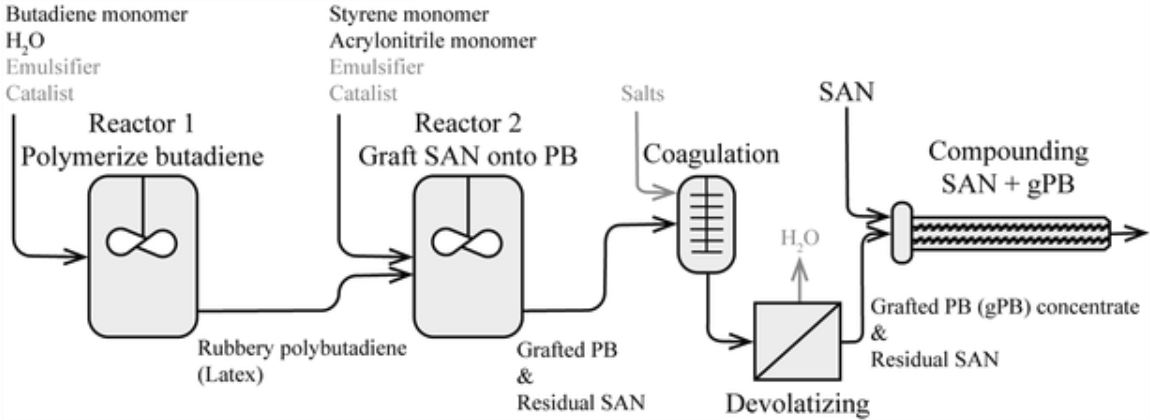
Emulsion Polymerization of ABS simplified process schematics | Source: Fernandez E. et al. . RSC Appl. Polym., 2024, 2, 1032. DOI: 10.1039/d4lp00238e
ABS (acrylonitrile–butadiene–styrene) is manufactured by combining a rubbery polybutadiene (PB) phase with a rigid styrene–acrylonitrile (SAN) matrix, and the industry's production technologies split along exactly that line.
Today two technology families dominate commercial production: continuous mass (bulk) polymerization, in which the rubber is dissolved in the monomers and polymerized in bulk, and the emulsion / hybrid route, in which the rubber is polymerized first as an aqueous polybutadiene latex, grafted with styrene and acrylonitrile in emulsion, recovered as a dry high-rubber powder, and then melt-blended with separately polymerized SAN resin. Versalis (Eni) states in its ONE-STEP® technology paper that "hybrid/emulsion technology accounts for about 97% of the ABS production globally"[1]; licensor patent backgrounds from PetroChina and Wanhua Chemical put the share of the dominant variant, emulsion grafting blended with bulk-polymerized SAN, at "80% or more" and "nearly 90% of suppliers" respectively.
This description covers the hybrid/emulsion family: its development lineage, the three-step process chain (latex synthesis and agglomeration, emulsion grafting and coaulation, blending and pelletizing), key operating parameters, the resulting product character compared with mass ABS, and the principal patents and technology packages behind it.
Continue reading here
#san #styreneacrylonitrile #emulsionpolymerization #hybridabsprocess #abs #butadienerubber #pbr #acrylonitrile #styrene #butadiene #petrochina #versalis #petrochina #cnpc #wanhua #sabic #technip #emulsiongrafting